
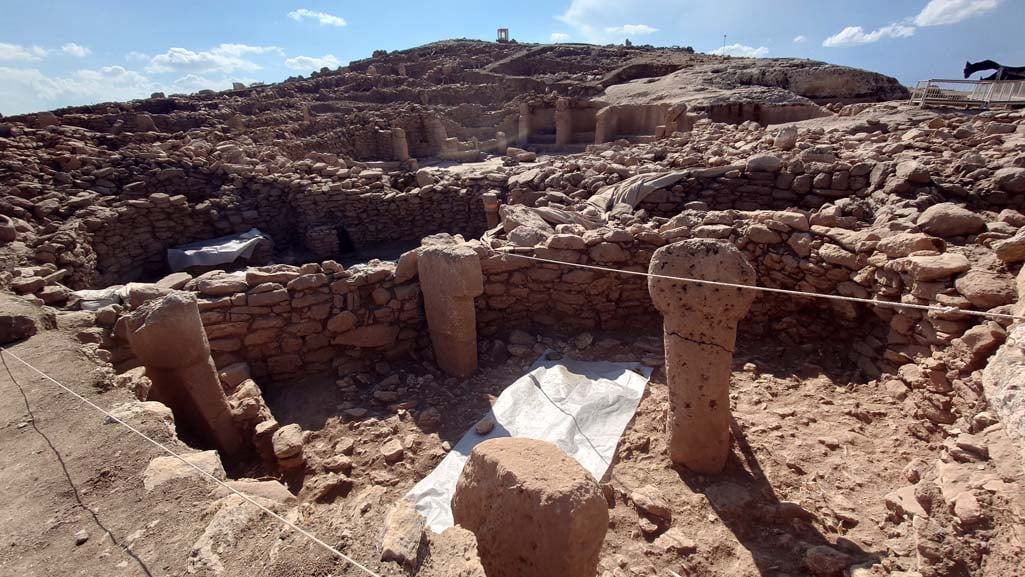
Karahantepe archaeological site, Turkey. Credit: Mahmut Bozarslan / Wikimedia Commons / Public Domain
Archaeologists in southeastern Turkey have uncovered a 12,000-year-old T-shaped pillar carved with a human face, marking a significant discovery at the Neolithic site of Karahantepe. The newly revealed structure, combining both human features and monumental scale, offers fresh insight into the symbolic and artistic expressions of early societies.
The human face pillar, found as part of the ongoing Taş Tepeler Project led by Turkey’s Ministry of Culture and Tourism, features deep-set eye sockets, a wide nose, and sharply defined facial lines.
Researchers say this is the first time a human face has been directly sculpted onto one of the region’s characteristic T-shaped monoliths—structures long believed to represent human forms through abstract carvings like arms and hands.
6 Ekim 2025 Şanlıurfa Türkiye 🇹🇷
Karahantepe | Göbeklitepe🗿
Karahantepe’de insan yüzü tasvir edilen T biçimli dikilitaş bulundu. pic.twitter.com/NZITgBZCvX
— Hermes (@hermesisos) October 6, 2025
Nihat Erdoğan, one of the lead archaeologists on the project, explained that the carved face moves beyond symbolic imagery and represents a leap toward figurative expression.
He said this discovery may reflect a shift in how early humans saw themselves and their place in the world, marking an important stage in the development of identity and self-awareness.
Karahantepe’s role in the Neolithic landscape
Located roughly 35 kilometers (22 miles) east of the better-known site of Göbeklitepe, Karahantepe is part of a group of 12 early Neolithic sites collectively known as Taş Tepeler, or “Stone Hills.” These sites contain the earliest known monumental architecture built by hunter-gatherers before the rise of agriculture.
Excavations at Karahantepe have so far revealed over 250 T-shaped pillars, communal enclosures, and detailed carvings of both humans and animals. Researchers say the site’s architectural layout appears more advanced than that of Göbeklitepe, with signs of early social organization and long-term settlement.
Nevzat Çevik, another archaeologist involved in the project, noted that the craftsmanship and design found at Karahantepe show a high level of technical skill as well as a deep spiritual understanding of the environment.
He emphasized that the human face pillar reinforces the idea that these communities were not only builders but also thinkers and artists.
Redefining the origins of human expression
The Taş Tepeler Project is one of the most extensive archaeological efforts currently underway, aimed at redefining what is known about the Neolithic Revolution—the transition from nomadic life to permanent settlements.
The latest discovery at Karahantepe offers tangible evidence of how early humans began to represent themselves through art, ritual, and architecture.
As excavations continue, Karahantepe is gaining attention as a potential centerpiece of Neolithic research in Turkey, with some experts suggesting it could eventually rival or even surpass Göbeklitepe in historical significance.