
Current U.S. payment structures inadequately support the financial sustainability of health-system-based population health programs, according to a new study published in the July edition of the NEJM Catalyst’s Innovations in Care Delivery journal.
A ten-member research team co-led by LDI Senior Fellow Matthew J. Press, MD, MSc, and Wharton School MBA student Allison Ng, analyzed the Penn Medicine Healthy Heart (PMHH) program as a case study evaluating the financial sustainability of population health initiatives in order to guide other health systems in building financial models for similar initiatives. In their modeling, only the scenario with universal coverage of Chronic Care Management (CCM) and Remote Patient Monitoring (RPM) billing codes provided sufficient revenue to at least break-even.
 Matthew Press, MD, MSc
“Today’s payment environment — both fee-for-service and value-based payment — must evolve to better support population health initiatives,” said Press.
High Cardiovascular Risk
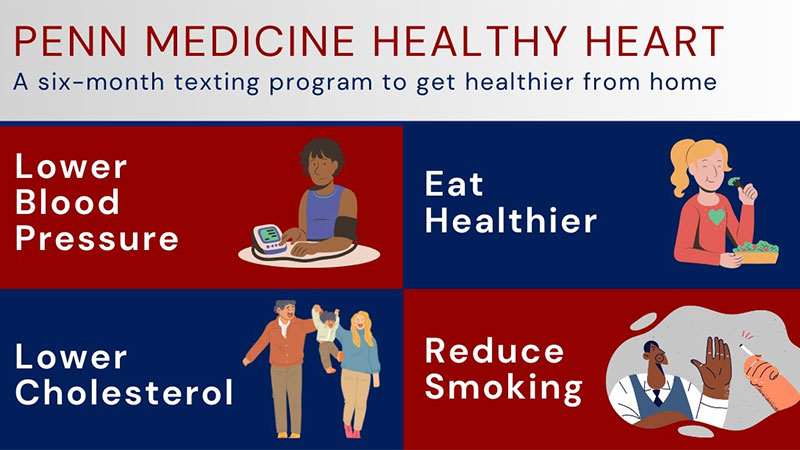
The PMHH Program is a six-month, text-based initiative designed to help primary care patients at high risk for cardiovascular disease manage blood pressure and cholesterol remotely. It aims to reduce their risk of heart disease from home through ongoing coaching, medication management, and lifestyle support via text, phone, and video managed by a central team of navigators and nurse practitioners. The clinical trial began in early 2024, following two years of pilot testing. It is the flagship of Penn Medicine’s atherosclerotic cardiovascular disease (ASCVD) Risk Reduction Initiative.
The effort to broaden the availability of population health programs is aimed at better addressing the chronic diseases that account for nearly 90 percent of U.S. health care spending. Current health systems’ population health efforts in relation to these diseases have shown clinical success but struggle under the current reimbursement systems.
The findings of the new study titled “Modeling the Financial Viability of a Population Health Program: A Formidable Challenge for Health Systems” illustrate those barriers that impede scalability in today’s payment environment.
Billing Codes are Key
The researchers examined different scenarios under varying degrees of fee-for-service (FFS) and value-based payment (VBP) and found that the only scenarios in which the initiative achieves net profit are those with optimal (universal coverage) fee-for-service billing of chronic care management (CCM) and remote monitoring (RPM) codes. Although financial modeling results will vary based on the specific intervention and market characteristics, the findings raise concerns about the ability to sufficiently reimburse population health initiatives.
Key findings were:
- Universal coverage of fee-for-service codes to support population health, including Chronic Care Management (CCM) and Remote Patient Monitoring (RPM), is critical to maintaining a financially viable program.
- Typical value-based payment models do not generate sufficient funding due to revenue from shared savings and quality programs being modest and hard to attribute to the specific intervention, as well as short budget cycles that make deferred returns-on-investment less tenable.
- A sensitivity analysis — a tool used in scientific modeling to test how sensitive results are to changes in key assumptions — found that increasing adherence to remote monitoring by 10 percent had by far the largest impact, pushing net profit up by 238 percent in the fee-for-service situation. Other changes, such as increasing participation in value-based payment or cutting labor costs, improved profit much less — typically by under 20 percent, and sometimes much less.
“A Reality Check on Value-Based Payment”
The findings suggest that fee-for-service billing for population health management activities, when all payers cover these codes, is a more viable mechanism than value-based payment for sustainably funding this particular program.
Press pointed out that “Our results serve as a bit of a reality check on claims that a typical value-based payment program alone can financially sustain population health initiatives.”
The study characterized the program’s three greatest challenges as:
- Inconsistent coverage by commercial payers of the FFS billing codes created by the Centers for Medicare and Medicaid (CMS).
- Insufficient VBP return on investment as short-term performance cycles underrepresent long-term benefits.
- Scalability hindered by a fragmented payer environment with mixed incentives and coverage rules.
The authors’ recommendations were these:
- Payers should cover these FFS codes or ensure they are specifically accounted for in capitated payments .
- VBP models should include multi-year performance metrics and account for long-term health improvements.
- CMS’s 2025 updates introducing new cardiovascular billing codes and advanced primary care management bundled codes are a positive step but need adoption across payers.
The study, “Modeling the Financial Viability of a Population Health Program: A Formidable Challenge for Health Systems,” was published July 16, 2025 in NEJM Catalyst’s Innovations in Care Delivery journal. Authors include LDI Senior Fellows Shivan J. Mehta, Neel P. Chokshi, and Kevin G. M. Volpp. The work was supported by a grant from the National Center for Advancing Translational Sciences (CTSA) of the National Institutes of Health (NIH).

More LDI News

NIH on the Brink: How to Fund Medical Breakthroughs in the Trump–Kennedy Era
With Drastic Cuts on the Table, What’s the Best Way To Fund Medical Innovation – NIH Grants, Prizes, or Bold New Models?
October 9, 2025

From 1990 to 2019, Black Life Expectancy Rose Most in Major Metros and the Northeast—but Gains Stalled or Reversed in Rural Areas and the Midwest, Especially for Younger Adults.
October 3, 2025

Clinician Nursing Home Caseloads Unrelated to Patient Outcomes
Findings Suggest That Improving Post-Acute Care Means Looking Beyond Caseloads to Nursing Home Quality
October 2, 2025

Why Work Requirements Won’t Work for Medicaid
They Reduce Coverage, Not Costs, History Shows. Smarter Incentives Would Encourage the Private Sector
October 1, 2025

The MISSION Act Gave Veterans More Choice but Raised Risks for Heart Care, LDI Fellows’ Study Finds
The 2018 MISSION Act Cut Travel Times for Veterans Needing Major Heart Procedures but That Came With More Complications in VA Community Care
October 1, 2025
The Price of Obamacare Subsidies Loss: Millions Uninsured, Thousands at Greater Risk
Penn LDI/Tradeoffs Panel Discussion Eyes Impact of December Congressional Cutoff
September 29, 2025