
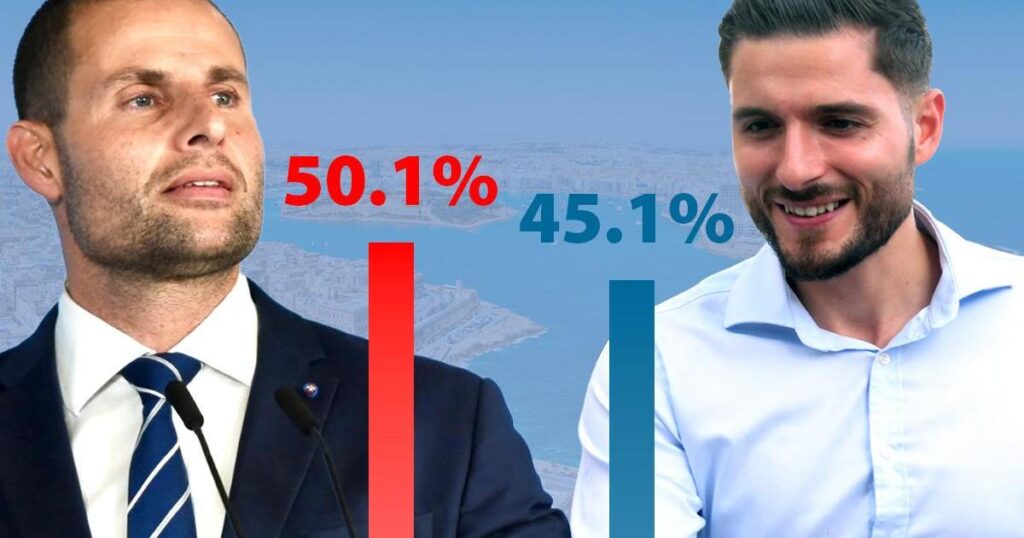
Labour is five per cent ahead of the Nationalist Party and would win an election held tomorrow by around 15,000 votes, according to a new Times of Malta poll.
The governing party’s lead has narrowed slightly from February, when the predicted gap between the two parties stood at 6.5 per cent, or an estimated 18,700 votes.
RELATED STORIES
The narrowing is mainly due to a decline in Labour’s predicted vote share, rather than an increase on the PN’s side.
According to the survey carried out by research firm Esprimi, Labour’s predicted 50.1 per cent share of the vote is down from the 51.5 per cent forecast in a similar poll published last February. In the 2022 general election, Labour won a record 55.1 per cent of the vote.
The Nationalist Party is predicted to receive a 45.1 per cent share of the vote, up marginally from the 45 per cent it was forecast to receive in February and better than the 41.7 per cent it obtained when voters last went to the polls.
Third parties, such as ADPD and Momentum, are on track to receive a combined 4.8 per cent of votes – an improvement on results in February, when they polled just 3.5 per cent.
Predictions are based on an expected turnout of just under 84 per cent, with 16.3 per cent of the electorate currently forecast to opt not to vote.
The percentage of non-voters is expected to decline drastically closer to an actual election date.
In the 2022 general election, around 14 per cent of voters chose to stay home.
Pollsters interviewed a representative sample of 600 respondents between September 29 and October 9, weeks into Alex Borg’s tenure as the PN’s new leader.
The data suggests Borg has yet to win over voters, despite his bullish claim that the PN could make “huge inroads” in narrowing the gap within his first month as leader.
But it also reveals that the new PN leader is intriguing many voter segments and is capturing the imagination of young voters – a demographic he has specifically targeted.
Other polls published in recent weeks also place Labour in the lead, albeit with varying margins.
A poll by Labour-linked statistician Vincent Marmarà predicted a 25,000-vote margin between the two parties, while one by Malta Today forecast a much narrower 8,000-vote lead.
Who do you trust?
While Labour’s vote share has taken a knock, the same cannot be said of voters’ view of Robert Abela.
His 50.11 per cent trust rating is higher than the 49.1 per cent he polled in February and ahead of Alex Borg’s 48.7 per cent rating.
But there are clear demographic and socioeconomic differences in the way the two party leaders are seen by the electorate.
Borg is held in high regard by young voters, professionals and those with a university or post-secondary education. He also scored higher among Gozitans – not surprising, given he is from Fontana – and among non-voters.
Support for Abela is more focused. Pensioners, the self-employed and tradespeople all trust him more than Borg, and by significant margins. Trust in Abela also runs deep among those who quit school after completing primary or secondary levels.
Unsurprisingly, both party leaders score much higher than average among their respective bases.
The good news for the PN is that their new leader enjoys significantly greater levels of trust than their old one – in a poll held last February, Bernard Grech’s trust rating stood at just under 37 per cent.
How is the government performing?
Citizens appear to be broadly pleased with the government overall, giving it an average score of 3.14 out of 5 when asked to rate its performance. That is higher than the 2.98 it scored when pollsters asked the same question in February.
Perspectives on the government’s performance vary widely across voting groups, and unsurprisingly, the government is viewed more positively in traditional Labour strongholds than in Nationalist-leaning regions.
Gozitans ranked the government’s performance in line with the national average.
Satisfaction with the government’s performance appears to be inversely correlated to education levels: the higher the level of education, the lower the satisfaction with government performance.
The government can, however, take some solace in knowing that even its critics appear to be slightly more satisfied than they were before: PN voters and switchers who voted Labour in 2022 but say they are now inclined to switch allegiances both gave the government a slightly higher average score than they did eight months ago.