Damn, I’m early, there aren’t even any comments from chuds about the Great Replacement yet!
Tszemix on
Being rich with no kids is a bigger fail than being poor with kids
Phantasmalicious on
Nigeria also has 20x higher infant mortality rate. Sooo…
mukaltin on
I was like yeah okay, until I realized it is INCLUDING Russia, holy sh*t.
ZestycloseAardvark36 on
We should build better borders.
bu_J on
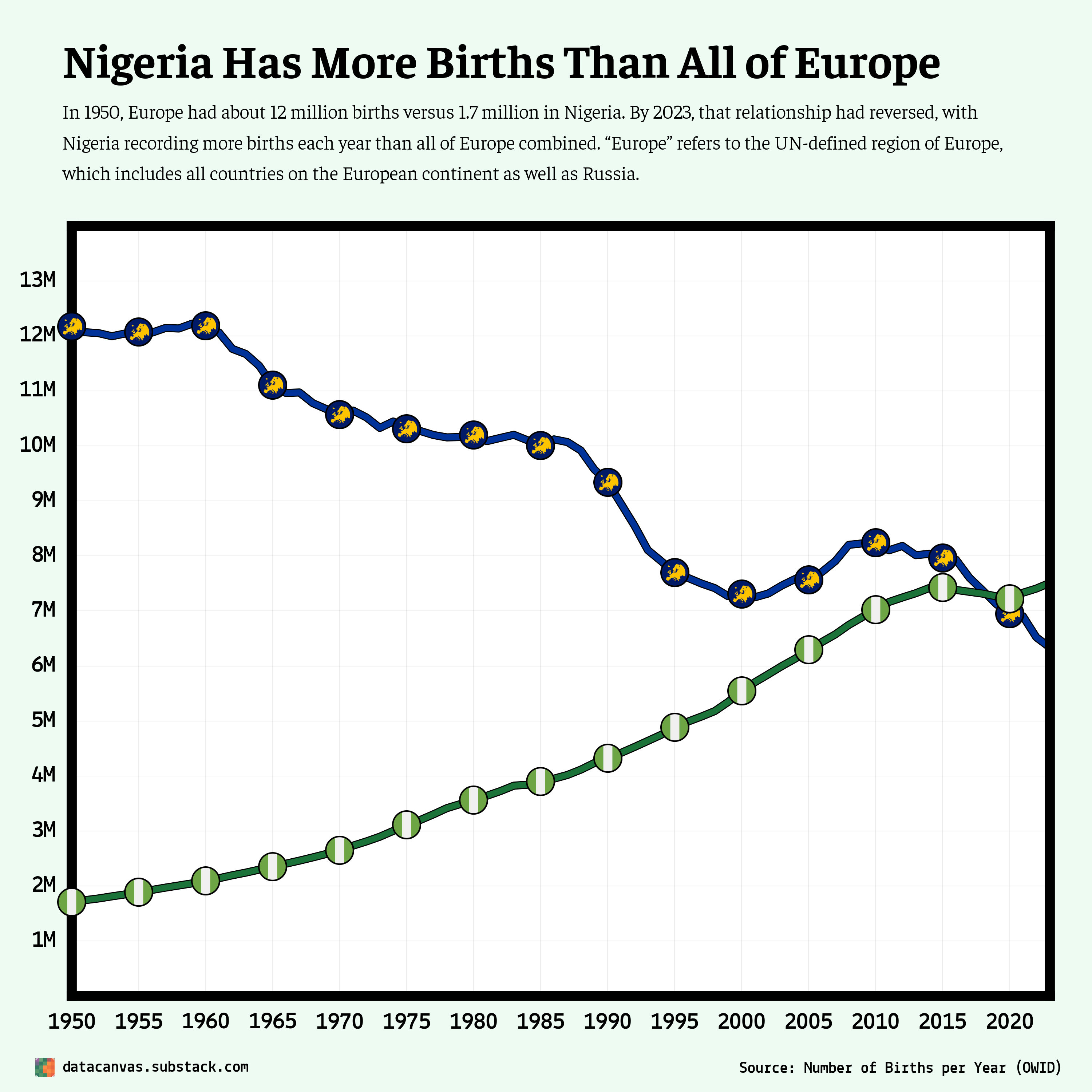
An interesting point, which the graph shows, is that Nigeria’s birth rate has already plateaued.
It’s expected as countries develop, but many countries are beginning to plateau (and drop) far earlier than expected. Egypt, for example, has dropped below 2m births far quicker than expected (it wasn’t projected to happen until 2100), and its birth rate is almost down to replacement levels (2.1) which it was not projected until after 2050.
solid_reign on
Europe: 750 million
Nigeria: 220 million
mltam on
In 1950, Nigeria had a population of 37M, today 234M.
CMDR_omnicognate on
i’m sure that will be sustainable
Radioactivocalypse on
That is pretty incredible. Considering Nigeria has little impact on the world stage, there sure are a lot of Nigerian’s being born
cueca2000 on
Let’s see the death rate and life expectancy.
mantellaaurantiaca on
Doesn’t sound beautiful. The world’s resources and environment are already strained. More people is the least this planet needs
zmrth on
I mean… Life does suck hard.
linkardtankard on
If they’re able to support them then I don’t see a problem
underworn_ on
Nigeria’s population are just estimates, a census hasn’t been done since 2006, so take every figure with a grain of salt.
Limis_ on
It’s good for Nigeria, as long as they can also provide for all the many new people
TechnologyFamiliar20 on
Which is why both continents are fucked.
redoceanblue on
We should cherish the plentitude of new princes and heires the world is gifted with!
realglasseyes on
It’s important to bring some knowledge of context to the Nigerian figures. A MINORITY of Nigerian nationals were born in hospital in 1950 and moreover there was a non-Native Registry for births with no corresponding Native Registry. I’m not sure when native Nigerian births began to be registered but certainly up to at least 1955, if you were expatriate (ie white) and born in Nigeria you would have a birth certificate and if you were native-born, you would not.
As for the 2020 figures I’m sure the majority of Nigerians are still not born in hospital, although I would guess most births probably are registered these days even in very rural areas. But the figures from the 50s have been assembled with incomplete information and a lot of guesswork, so the rise in population may not be as steep as it looks. And as somebody pointed out below, the rate of surviving children also needs to be taken into account to estimate population growth.
g_Blyn on
I read it as Nigerian has more Brits; I am disappointed
eastrandmullet on
How is this even possible. Who is having children in 2025
eastrandmullet on
Birth rates are interesting. Does Nigeria have low cost of living and good quality of life to prompt an accelerated birth rate?
Cost of living and opportunity costs of children a huge impact on Europe.
Plastic_Green_Tree on
Horrible for both, either Europe and Nigeria.
professor_fate_1 on
Unironically – What happened in Europe between 2000 and 2010? Seems like we want that to happen again..
akeean on
>In 1950, Europe had about **12 million births versus 1.7 million in Nigeria**. By **2023, that relationship had reversed**, with Nigeria recording more births each year than all of Europe combined. “Europe” refers to the UN-defined region of Europe, which includes all countries on the European continent as well as Russia.
> 12 million births versus 1.7 million in Nigeria. By 2023, that relationship had reversed
Reversed implies the ratio flipped, but it didn’t. Nigeria in fact, does not have 7 times the birthrate of all of Europe combined. So the relationship from did not reverse from 1950 to 2023. They just reached a similar number of births (albeit on a smaller population) and plateaued.
Nigeria has now about the double birthrate as Europe at roughly a third of the total population, wich is normal as while population explodes and infant birth shrinks birthrate eventually slows down. In 1950 Europe had ca 550M inhabitants and Nigeria 40M. Now it’s ~740M vs 230M. By 2050 this is predicted to be 730M vs 400M, but it really depends how many people they can feed. Widespread famine and water scarcity can really put a dampener on population growth.

![[OC] Nigeria Has More Births Than All of Europe](https://www.byteseu.com/wp-content/uploads/2025/10/hep5hh7jx1vf1-1536x1536.png "[OC] Nigeria Has More Births Than All of Europe")
27 Comments
Data source: [Births per Year (OWID)](https://ourworldindata.org/grapher/number-of-births-per-year?time=earliest..2023&country=NGA~UNM49_EUR)
Tools used: Matplotlib
Not really the flex some seem to think it is.
Damn, I’m early, there aren’t even any comments from chuds about the Great Replacement yet!
Being rich with no kids is a bigger fail than being poor with kids
Nigeria also has 20x higher infant mortality rate. Sooo…
I was like yeah okay, until I realized it is INCLUDING Russia, holy sh*t.
We should build better borders.
An interesting point, which the graph shows, is that Nigeria’s birth rate has already plateaued.
It’s expected as countries develop, but many countries are beginning to plateau (and drop) far earlier than expected. Egypt, for example, has dropped below 2m births far quicker than expected (it wasn’t projected to happen until 2100), and its birth rate is almost down to replacement levels (2.1) which it was not projected until after 2050.
Europe: 750 million
Nigeria: 220 million
In 1950, Nigeria had a population of 37M, today 234M.
i’m sure that will be sustainable
That is pretty incredible. Considering Nigeria has little impact on the world stage, there sure are a lot of Nigerian’s being born
Let’s see the death rate and life expectancy.
Doesn’t sound beautiful. The world’s resources and environment are already strained. More people is the least this planet needs
I mean… Life does suck hard.
If they’re able to support them then I don’t see a problem
Nigeria’s population are just estimates, a census hasn’t been done since 2006, so take every figure with a grain of salt.
It’s good for Nigeria, as long as they can also provide for all the many new people
Which is why both continents are fucked.
We should cherish the plentitude of new princes and heires the world is gifted with!
It’s important to bring some knowledge of context to the Nigerian figures. A MINORITY of Nigerian nationals were born in hospital in 1950 and moreover there was a non-Native Registry for births with no corresponding Native Registry. I’m not sure when native Nigerian births began to be registered but certainly up to at least 1955, if you were expatriate (ie white) and born in Nigeria you would have a birth certificate and if you were native-born, you would not.
As for the 2020 figures I’m sure the majority of Nigerians are still not born in hospital, although I would guess most births probably are registered these days even in very rural areas. But the figures from the 50s have been assembled with incomplete information and a lot of guesswork, so the rise in population may not be as steep as it looks. And as somebody pointed out below, the rate of surviving children also needs to be taken into account to estimate population growth.
I read it as Nigerian has more Brits; I am disappointed
How is this even possible. Who is having children in 2025
Birth rates are interesting. Does Nigeria have low cost of living and good quality of life to prompt an accelerated birth rate?
Cost of living and opportunity costs of children a huge impact on Europe.
Horrible for both, either Europe and Nigeria.
Unironically – What happened in Europe between 2000 and 2010? Seems like we want that to happen again..
>In 1950, Europe had about **12 million births versus 1.7 million in Nigeria**. By **2023, that relationship had reversed**, with Nigeria recording more births each year than all of Europe combined. “Europe” refers to the UN-defined region of Europe, which includes all countries on the European continent as well as Russia.
> 12 million births versus 1.7 million in Nigeria. By 2023, that relationship had reversed
Reversed implies the ratio flipped, but it didn’t. Nigeria in fact, does not have 7 times the birthrate of all of Europe combined. So the relationship from did not reverse from 1950 to 2023. They just reached a similar number of births (albeit on a smaller population) and plateaued.
Nigeria has now about the double birthrate as Europe at roughly a third of the total population, wich is normal as while population explodes and infant birth shrinks birthrate eventually slows down. In 1950 Europe had ca 550M inhabitants and Nigeria 40M. Now it’s ~740M vs 230M. By 2050 this is predicted to be 730M vs 400M, but it really depends how many people they can feed. Widespread famine and water scarcity can really put a dampener on population growth.