
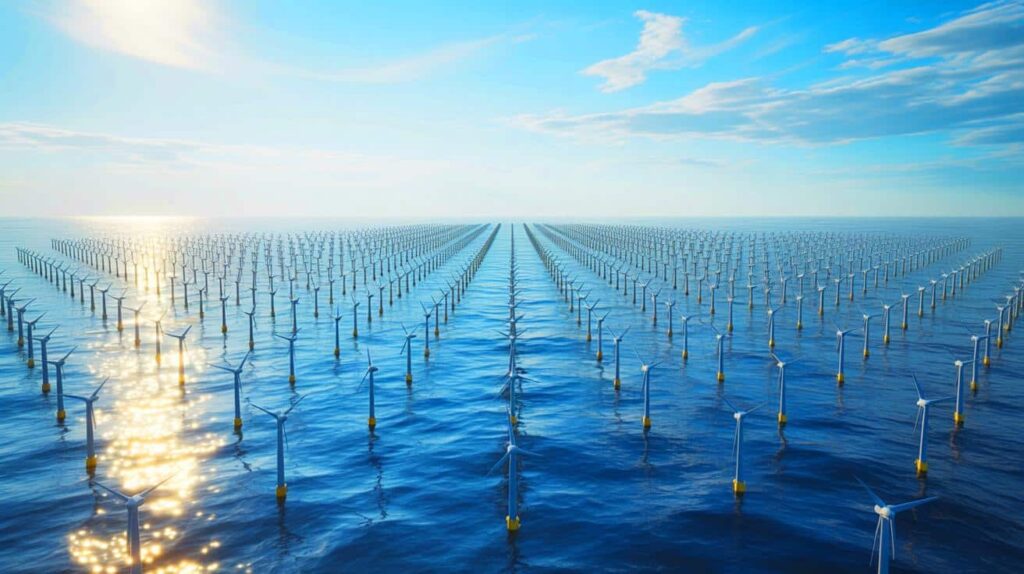
- 🌊 Norwegian company pioneers innovative offshore wind concept with tiny turbines for increased efficiency.
- 🔬 Wind Catching Systems gains Approval in Principle for its groundbreaking design.
- 💡 Unique setup prevents turbulence, enhancing energy output and efficiency.
- 🔋 Project aims to produce green hydrogen, impacting energy and transportation sectors.
As the world continues to grapple with the urgent need for clean energy, innovative solutions are emerging to challenge traditional methods. A groundbreaking project by Wind Catching Systems (WCS) is making waves with its offshore eolic wall concept, which promises to revolutionize the clean energy landscape. This Norwegian company is pioneering an approach that employs a multitude of tiny turbines packed together to maximize energy capture. However, it’s not just the design that is capturing attention; a peculiar effect observed during testing might change how we understand wind energy. The project has already received significant approvals, and its future implications could be profound, potentially redefining how we harness wind power.
Norwegian Innovation Gains Approval
Wind Catching Systems, a Norwegian company, is taking a bold step in the clean energy sector with its novel design of tiny turbines packed closely together. This innovative approach recently received the Approval in Principle (AiP) from DNV, a key milestone that confirms the soundness of the Windcatcher design. The AiP is a critical endorsement, signaling that the design meets the necessary technical and safety standards.
Building on this approval, WCS is now preparing to construct a demonstration project off the southwest coast of Norway. To ensure the design’s viability, the company tested a physical model in Norway’s Stadt Towing Tank, simulating harsh sea conditions. The data gathered from these tests have been instrumental in refining the design, bolstering confidence in its potential to transform offshore wind energy.
Transformative Potential of the Windcatcher
The Windcatcher represents a significant departure from traditional wind farm designs. At its core, this concept involves a floating structure comprised of hundreds of small turbines arranged in a grid formation. Unlike conventional turbines, which require vast spaces and specific water depths, the Windcatcher can capture up to 2.5 times more energy per square meter.
This efficiency makes it particularly appealing for countries with deep water zones, where traditional turbines aren’t feasible. The initial unit, certified at 40MW by DNV, is just the beginning. Future scaled versions aim to reach 126MW per unit, potentially generating an annual output of around 99 GWh. This output could power more than 20,000 households, marking a significant step forward in sustainable energy production.
Projecting a Future for Offshore Wind
WCS is not alone in its ambitions; with funding from Enova, the Norwegian state fund, the company has secured 9.3 million Norwegian Krone to develop a prototype. The goal is to launch the first commercial unit by 2027. This project holds the promise of making offshore wind energy competitive with fossil fuels, a milestone that could reshape energy markets globally.
With its unique design, the Windcatcher is well-suited for coastal nations like South Korea, Japan, and the United States. As more companies recognize the untapped potential beneath the ocean, innovations like the Windcatcher are poised to lead the charge in capturing this renewable treasure trove.
The Unusual Effect Observed
One of the most intriguing aspects of the Windcatcher is an unexpected effect observed during testing. The tight cluster of turbines appears to disrupt local wind patterns, effectively preventing turbulence. This is a significant advancement, as turbulence has long posed challenges to traditional wind farms, where upstream performance can hinder downstream efficiency.
This strange effect could allow the Windcatcher to maintain energy output without the typical losses associated with turbulence. Additionally, the modular and scalable setup enables excess power generated during off-peak hours to be redirected to hydrogen electrolysis, producing green hydrogen. This dual capability not only enhances energy efficiency but also opens new avenues for clean energy applications in transportation and industry.
The offshore eolic wall introduced by Wind Catching Systems is a testament to the power of innovation in the clean energy sector. With its unique design and unexpected benefits, it challenges the conventions of traditional wind energy solutions. As this project progresses, it raises important questions about the future of wind energy: Could this approach be the key to making renewable energy more accessible and reliable for all? The potential implications for the energy landscape are profound, inviting further exploration and investment in similar groundbreaking technologies.
This article is based on verified sources and supported by editorial technologies.
Did you like it? 4.5/5 (23)