
Norwegian leaders were among those traveling to Egypt earlier this week to attend the signing of a peace agreement between Israel and Hamas. Prime Minister Jonas Gahr Støre and Foreign Minister Espen Barth Eide were included since they’ve both spent decades trying to help bring peace to the Middle East, and both hope US President Donald Trump’s deal will be binding.
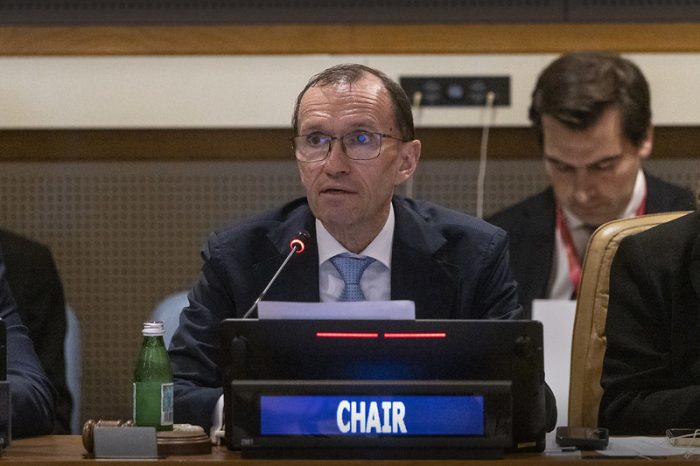 Espen Barth Eide has been involved in Middle East diplomacy for many years and firmly believes that a two-state solution is the only way to achieve peace in the Middle East. He’s shown here leading a ministerial meeting on Palestine at the opening of the United Nations a few weeks ago. PHOTO: Statsministerens kontor
“The absence of killing isn’t the same as peace,” Eide told reporters when he was back in Oslo this week. “And massive work must be done before you can say that the Gaza conflict or the deeply underlying Israel-Palestine conflict is over.”
Both Eide and Norwegian Prime Minister Støre still want the underlying reasons for the bloody conflicts to be addressed. They flew off Sunday night on the whirlwind trip til Sharm el-Sheikh, just as their own Norwegian Parliament was opening for traditional debate from Saturday to Tuesday, and then the presentation of their government’s proposed state budget for 2026 on Wednesday.
Both thought it was important to take part, though, not just in the group photo but also in efforts to develop what they hope will be a lasting peace. Støre noted “Norway’s lengthy engagement” between Israel and the Palestinians, and how Norway has long experience as leader of the donor group for Palestine and as a political supporter of Palestinian authorities. Norway has also been active in sending humanitarian aid, not least medical aid, to Gaza. When Støre and Eide received the invitation to attend from Egypt’s president on Sunday, they accepted immediately as had the leaders of the UK, France, Germany, Italy and many other countries.
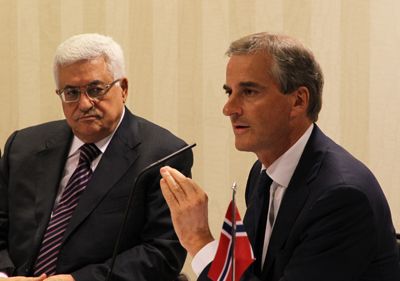 Jonas Gahr Støre’s own experience with Palestinian leaders goes way back, like this meeting with Palestinian President Mahmoud Abbas in Oslo when he was foreign minister 2011. PHOTO: Marta B. Haga/Utenriksdepartementet
“This is the start of the work with a peace plan that President Trump won acceptance for,” Støre told Norwegian Broadcasting (NRK) while flying to Egypt. “It’s a new chapter in the Middle East that’s beginning in the very delayed situation.” Støre also hailed the efforts of Egypt, Qatar and Turkey “for their important contributions” to enabling the peace plan.
Støre stated after his return that the meeting “gave real hope that the suffering in Gaza can end, even though the path to peace is still very long. The exchange of hostages and prisoners is an important step towards peace.”
The ceasefire conditions initiated by Trump were already facing challenges, though, after Monday’s jubiliation over the release of Israel’s hostages and Palestinian prisoners. “There are enough pitfalls here for everyone,” Eide told reporters outside Norway’s foreing ministry on Tuesday. “If one or more participants want to sabotage this peace plan, there are many opportunities to do that.”
He’s anxiously following developments in the next phases of the plan, which include demands that Hamas lay down its weapons. That’s already been violated after video from Gaza showed Hamas executing alleged traitors amongst them. Eide reported lots of optimism in Egypt, however, and that spirits were high. “All of the main European leaders, Arab leaders and key people in international organizations back the 20-point plan,” he said.
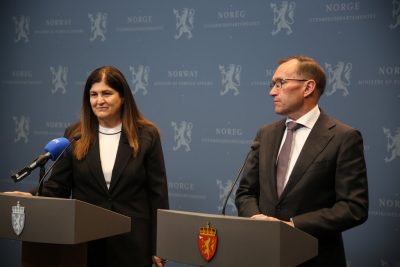 Foreign Minister Espen Barth Eide had a meeting with his Palestinian counterpart, Varsen Aghabekian, shortly before flying off to the peace deal signing in Egypt. PHOTO: Utenriksdepartementet/Martin Brynildsrud Andersson
Just before the sudden trip to Egypt, Eide had also received Palestinian Foreign Minister Varsen Aghabekian for talks in Oslo. They both had also warned that the new Gaza agreement is “just the beginning of a long path to real peace.” She had claimed over the weekend that Hamas “would turn over their weapons,” but that clearly hasn’t happened. Nor, she said, does Hamas want to be involved in the governing of Gaza. It remains unclear who will run Gaza in the long run.
“The deep underlying conflict … is by no means settled,” Eide said on Tuesday, while the situation for Palestinians is worsening on the West Bank. Both he and Støre stress that the latter must not be forgotten, with Eide noting that the new peace plan “doesn’t offer any solution” to all the violence between Israeli settlers on Palestinian territory.
Norwegian officials are thus emphasizing the importance of Palestinian leadership that includes both Gaza and the West Bank under a joint organization. That’s at least as demanding as the overwhelming work needed to rebuild Gaza, after the first phase of emergency humanitarian aid is finally able to be delivered.
NewsinEnglish.no/Nina Berglund