
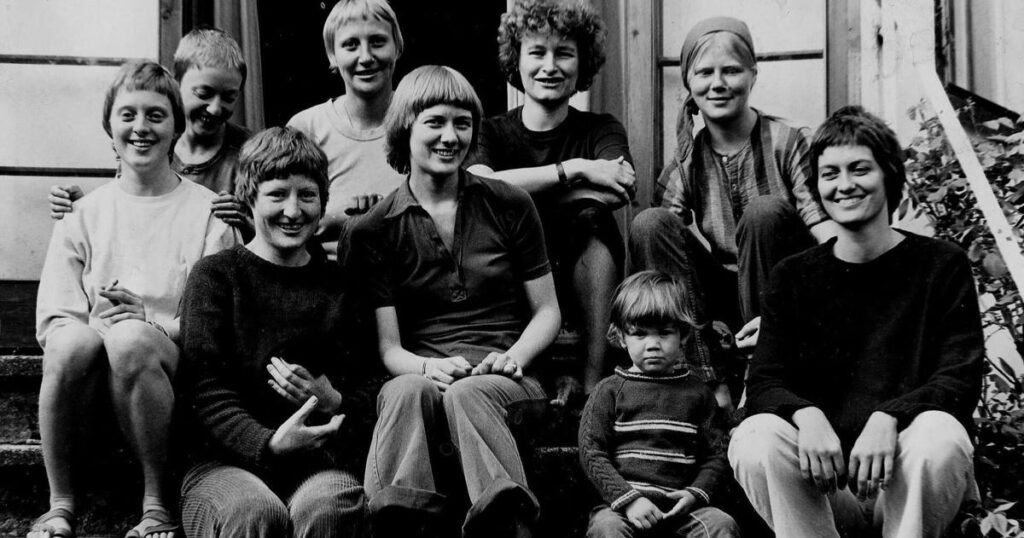
Pernille Ipsen didn’t have a traditional upbringing: She spent her earliest years in a women-only commune in Copenhagen being raised by seven women during the height of Denmark’s women’s movement.
The former University of Wisconsin–Madison professor’s collective memoir — first published in Danish in August 2020 — has now been translated to English. “My Seven Mothers,” releasing on Oct. 21, recounts her mothers’ history and shares Ipsen’s unique experience of a period of radical social change.
Each of Ipsen’s mothers had individual political beliefs and personalities. Ipsen aimed to represent each woman thoughtfully and fairly.
“I did not want to write my mothers’ memories up against each other for dramatic effect,” says Ipsen. “They were allowed to disagree and remember different things. They are each entitled to their version of their story.” While writing, she didn’t “pick sides” or try to establish “right” and “wrong,” even when recording the period of time when the women began to disagree.
To revise the book for a new audience, Ipsen worked collaboratively with a translator, Tiina Nunnally, and added a new prologue. She also edited the text to include context for readers unfamiliar with Denmark.
Ipsen will celebrate the launch of “My Seven Mothers: Making a Family in the Danish Women’s Movement” at The Harmony Bar and Grill (2201 Atwood Ave.) on Oct. 23 from 4-7 p.m.
She will also join current UW–Madison professors, Emily Callaci and Allison Daminger, in conversation for a Wisconsin Book Festival event at Central Library (201 W. Mifflin St.) on Oct. 26 from noon-1 p.m.
Q&A with Pernille IpsenCan you tell us about the origins of this book? When did you first know you wanted to tell this story?
I have been fascinated by my mothers’ stories of their time in the women’s and lesbian movements for as long as I can remember. I came of age in the ‘80s when feminist activism seemed at a low point, and I thought that if I couldn’t continue their activism then at least I could collect and remember their stories. I first had the idea to write a book about my mothers when I was 16. We were having dinner together, they were telling many anecdotes and stories, as they often did. They were probably singing, too. And at some point, I got the strong sense that I should tell our story some time. It took another 20 years before I actually began interviewing them, but the story was with me all along.
What was it like to grow up in a household shaped so directly by feminist ideals?
Wow, that is a big question! It was wonderful. I love my mothers very much and am eternally grateful for my childhood. But, as my son said to someone the other day when they asked him what it was like to have so many grandmothers: “I have never tried anything else. It is what I know.”
How do you hope the story will be received by an English-speaking audience in 2025?
I would love for Madisonians and other Americans to come away from “My Seven Mothers” with a sense of expansive possibility of “The Open Moment” (as the book is called in Danish) in the early ’70s, when feminist alliances across differences were not only doable but energizing. I also hope the story of my mothers and mine can help us all remember that family comes in many, many forms. Despite what powerful forces in the U.S. and all over the world are telling us, we can make the families that sustain us best.
Your earlier work, “Daughters of the Trade,” is an academic history about the Atlantic slave trade. What was it like to shift from academic, nonfiction writing to writing a memoir?
When I started working on “My Seven Mothers” in 2009, I did interviews in Danish for the first time, switched genre from historical writing to creative nonfiction, and started writing in Danish for the first time in many years. These changes were difficult at first, but they led me on a path that was deeply meaningful to me — and eventually helped me get over a lot of homesickness, while also bringing my mothers and I closer than we had been in years.
After 15 years as a professor of gender and women’s studies and history at UW–Madison, you’re now writing full-time. Congratulations — what are you working on next?
Thank you! I do still teach a few summer classes in Copenhagen, but I am so grateful that I get to spend more time on writing. Currently I am finishing a biography about a Danish communist graphic artist and writer, Dea Trier Mørch, who, like my mothers, did her most important work in the 1970s. I am enjoying leaning into biographical writing.
Anna Kottakis is digital editor at Madison Magazine.
COPYRIGHT 2025 BY MADISON MAGAZINE. ALL RIGHTS RESERVED. THIS MATERIAL MAY NOT BE PUBLISHED, BROADCAST, REWRITTEN OR REDISTRIBUTED.