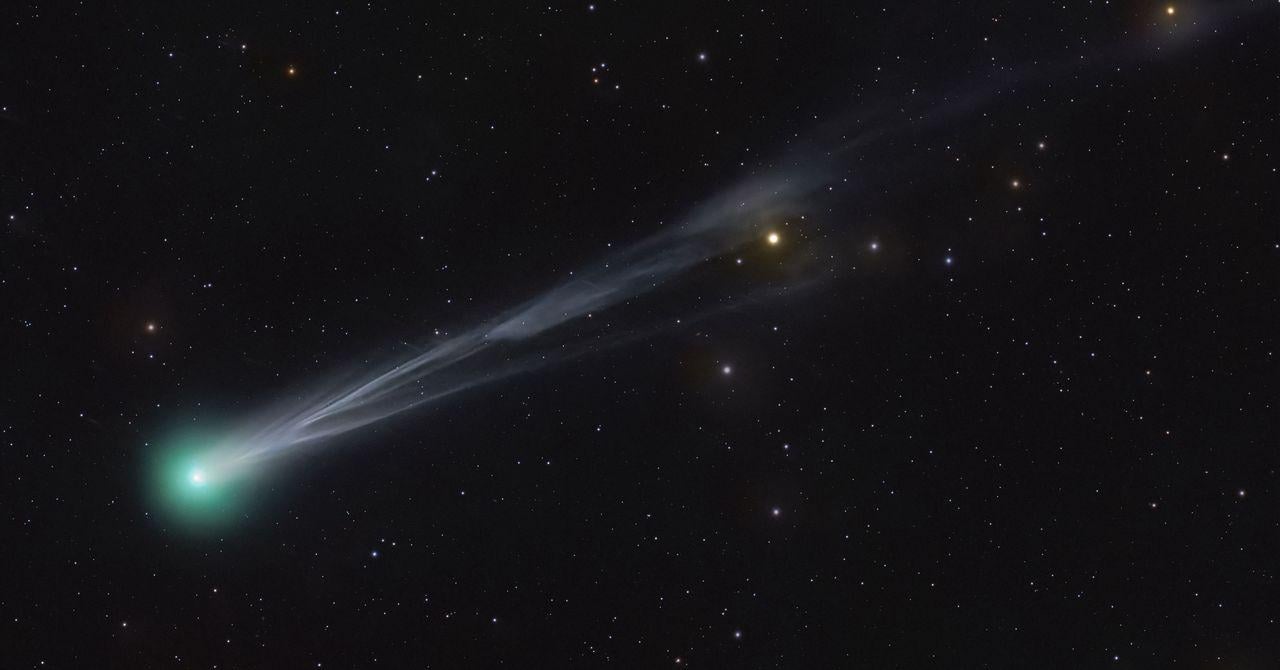
It was early January 2025 when a faint light spot was observed at the Mt. Lemmon Observatory in Arizona. Follow-up observations revealed that the object was a comet visiting from the outer edge of the solar system, and it was named Comet Lemmon (C/2025 A6). Its “period”—the time it takes to complete its lengthy orbit of the sun—is about 1,350 years.
At first, the comet was so faint that it could only be seen with specialized equipment. But it has brightened rapidly as the months have passed, and by the time fall arrived, it was bright enough to be viewed with binoculars. It will now get brighter still, as it gets closer to both the Earth and the sun, and may even become visible with the naked eye.
According to [NASA](https://www.wired.com/tag/nasa/), Comet Lemmon will be [closest to Earth around October 21, 2025](https://apod.nasa.gov/apod/ap250930.html), passing at a distance of about 0.60 astronomical units, or au (1 au is the distance between Earth and the sun). The comet is then predicted to reach perihelion—the point at which it is closest to the sun—on November 8. Around the time the comet reaches perihelion, it will likely reach its maximum brightness, and may be visible to the naked eye if conditions are favorable in dark skies.
Step 1: Don’t live in cloudy ass Germany where you have a 0.0001 % chance to see any bit of night sky between September and April. Signed: a salty German.

4 Comments
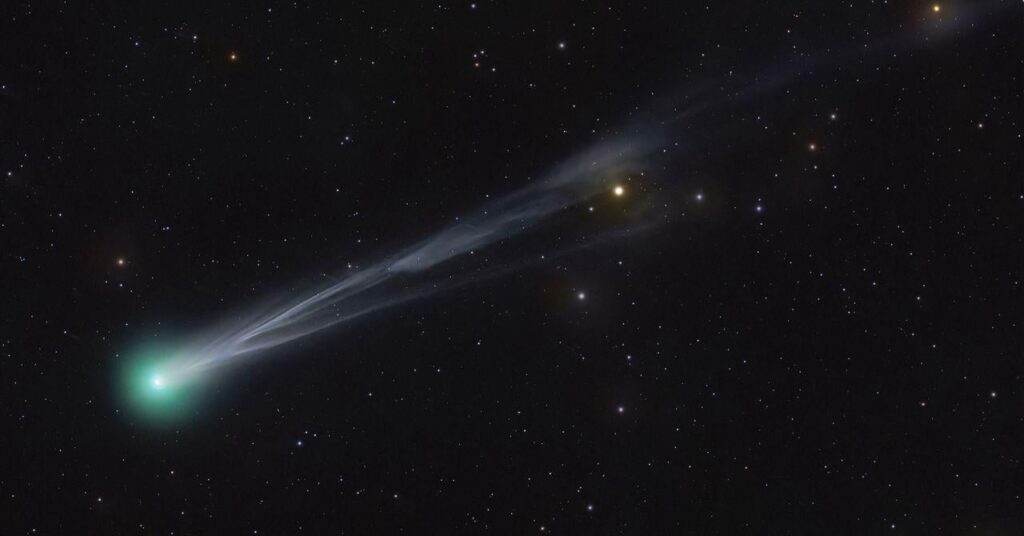
It was early January 2025 when a faint light spot was observed at the Mt. Lemmon Observatory in Arizona. Follow-up observations revealed that the object was a comet visiting from the outer edge of the solar system, and it was named Comet Lemmon (C/2025 A6). Its “period”—the time it takes to complete its lengthy orbit of the sun—is about 1,350 years.
At first, the comet was so faint that it could only be seen with specialized equipment. But it has brightened rapidly as the months have passed, and by the time fall arrived, it was bright enough to be viewed with binoculars. It will now get brighter still, as it gets closer to both the Earth and the sun, and may even become visible with the naked eye.
According to [NASA](https://www.wired.com/tag/nasa/), Comet Lemmon will be [closest to Earth around October 21, 2025](https://apod.nasa.gov/apod/ap250930.html), passing at a distance of about 0.60 astronomical units, or au (1 au is the distance between Earth and the sun). The comet is then predicted to reach perihelion—the point at which it is closest to the sun—on November 8. Around the time the comet reaches perihelion, it will likely reach its maximum brightness, and may be visible to the naked eye if conditions are favorable in dark skies.
Read more: [https://www.wired.com/story/how-to-see-comet-lemmon-this-october/](https://www.wired.com/story/how-to-see-comet-lemmon-this-october/)
[removed]
Step 1: Don’t live in cloudy ass Germany where you have a 0.0001 % chance to see any bit of night sky between September and April. Signed: a salty German.
Jack: How to see comet Lemmon
Liz: Jack, are you having a stroke?