
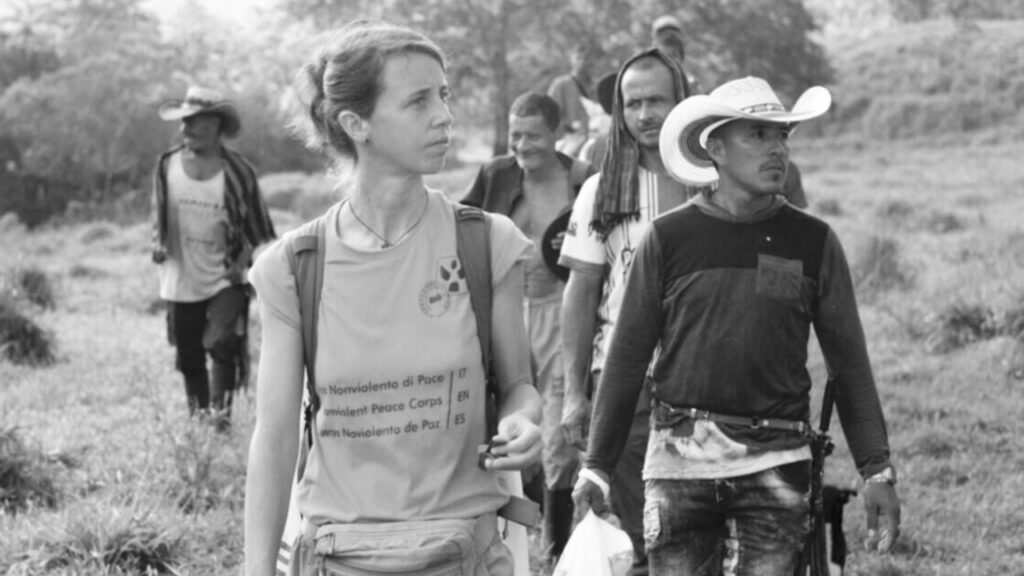
Youthful passions can become reality. Nurturing life, responding to restlessness, building relationships that embrace the world. Silvia De Munari is 38 years old and was born in a small town in the province of Vicenza, Bolzano Vicentino. She knew Latin America through books and news reports; today, she has put down roots in the Peace Community of San José de Apartadó in Colombia. “I had read a lot about Latin America, and in my town I would talk about it with the Xaverian missionaries. But reading or listening to stories about distant suffering was no longer enough – I wanted to experience it firsthand”.
The motivation that led her to teach Italian to unaccompanied minors at one of the facilities of the Pope John XXIII Community Association (APG23) in her town, or to volunteer with Caritas among the homeless, to spend two months on missions in the outskirts of Bogotá, and then a year of civil service in Chile after graduating in political science with a sociological focus, has always been the same. “It is the desire to explore a little more deeply this world that is so beautiful, but also so dramatically poor – not in the sense of lacking material goods, but poor in values”. When she learned about the Operation Dove project – that is, the opportunity for anyone to engage in non-governmental peace actions in conflict or environmental emergency areas – Silvia realized that this was the path she had been searching for: “If, through small actions, I can help people not be killed, I am willing to do it. I feel like a drop of justice in a sea of global injustice”.
The experience Silvia is currently involved in as an operator – after a year of volunteering and the necessary training – is with the Peace Community of San José de Apartadó in northwest Colombia, a region rich in minerals and natural resources. The orange t-shirt worn by Silvia and the other peace mission operators is a very clear signal to the armed groups present in the area: paramilitaries, the army, and groups linked to drug trafficking. The message “There are international operators here, passports that ‘matter’ more, do not shoot” serves to guide community members along the mule trails where cacao is cultivated or during the assemblies of this prophetic reality, born from simple people with very strong ethical values. “It is a peasant community that in 1997, thanks also to the insight and guidance of the bishop of the city of Apartadó, Isaías Duarte Cancino (later assassinated in 2002), and the Jesuit theologian Javier Giraldo, tried to find an alternative between the option of fleeing and that of joining the armed conflict. They decided to live amidst the war without taking part in it. They were inspired by the Geneva Convention, and San José became a neutral zone and later a Peace Community”.
Farmers, supported also by the local Church, had an insight that is now studied by politicians, ambassadors, and researchers. The choice to build peace through non-involvement in the war has many facets: “It means not shooting”, Silvia explains, “but also creating an alternative economy that has no ties to the conflict – that is, not cultivating coca, but organic cacao, caring for the environment and relying, for trade, on companies that do not have dealings with suspicious groups”. And it especially means paying in person – more than 300 people belonging to the Peace Community have been murdered – and not accepting economic reparations offered by the Colombian government. “The Community makes a very high ethical-moral statement: no one has the power to assign an economic value to a murdered person. Justice is carrying out a legal process, to find out not so much the name of the soldier or paramilitary who physically killed, but the one who gave the order to kill my brother, my father, my family”.
Returning to Italy, every now and then, is for the young operator a moment to return to base, to a family that has fully supported her choices. “We are four, two sisters and two brothers. My mother has always said: ‘Stay united and in life, do what you think is right for you’. My parents are simple people; they have always let us follow our own path. My brother is part of Operation Mato Grosso.” Beyond having intelligent parents, Silvia also had a little luck guiding her toward the mission. “From kindergarten through middle school, I was fortunate to have a classmate with Down syndrome, and with him we learned new ways of being alongside others. A richness I only came to understand as I grew up”. Another stroke of “luck” was “tearing my ACL while playing basketball in the second division. During the forced break, I began to reflect and realized that in life I wanted to do something else.”
Asked whether reconciliation requires going to the other side of the world, the young woman speaks of a “decolonization of the mind”: “My experience in Colombia has helped me also to see injustices, maybe smaller ones, that are closer to me, here in Italy A battle she now fights on every front, because, as Laudato Si’ reminds us, everything is connected.
Does a life like this require too many sacrifices, not to mention fear? “What I miss the most are moments of silence and walks in the high mountains. I am not afraid for myself, but for the people of the Peace Community”. Even in this, she adds, the Peace Community has opened her eyes: “They often tell me: ‘Today we continue to speak, tomorrow we could be dead. But as long as we can, we act for what is right, without waiting’. This is the reality they live, and for me it continues to be, every day, a great lesson – wherever I am”.
by Vittoria Prisciandaro
Journalist, “Credere” and “Jesus” San Paolo periodicals