
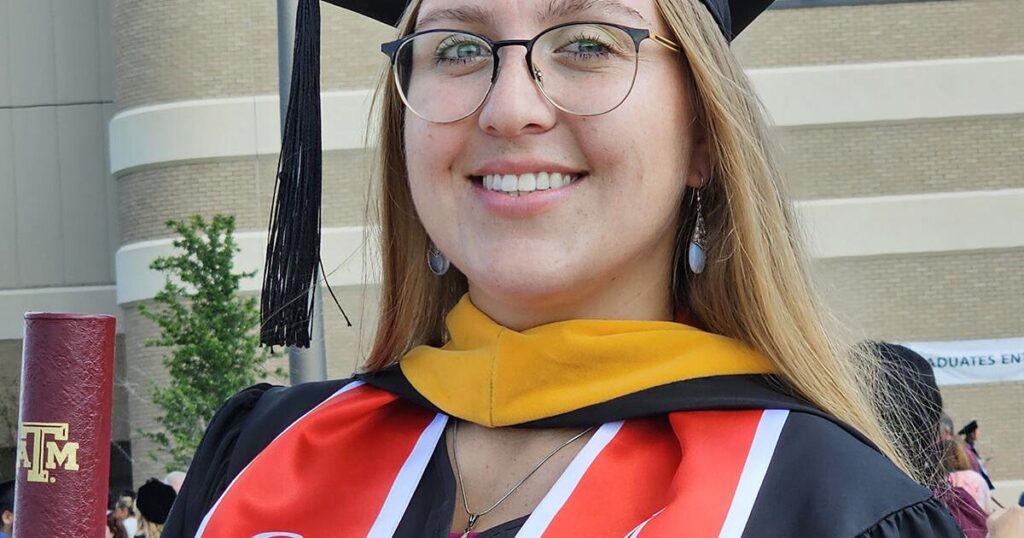

Amanda Jessel wore the Cherokee Nation stole during the August graduation ceremony at Texas A&M University.
COURTESY
AARE RIVER, Switzerland – Holding her newly earned Master of Science in chemistry, Cherokee Nation citizen Amanda Rae Jessel has left, temporarily, for the other side of the world.
Jessel completed her studies at Texas A&M University in August and is now in pursuit of her doctorate in Switzerland. She will conduct research at the Paul Scherrer Institute’s Laboratory for Battery Science near Würenlingen, Switzerland. She completed her master’s degree in only a year so she could follow her doctoral adviser, who left Texas A&M to take a position at the Scherrer Institute.
“I’ve always dreamt of studying abroad and seeing more of the world, so the chance to live in Switzerland, a place known for both scientific innovation and breathtaking landscapes, was such an amazing opportunity I could not pass up,” Jessel said.
Her interest in chemistry was sparked unexpectedly during her undergraduate studies at the University of North Florida, where she was working toward medical school.
“I joined a research lab, and that’s where everything changed,” she said. “I found myself fascinated by the questions we were asking and the hands-on nature of scientific discovery. I became infatuated with inorganic chemistry and the way it combines creativity with problem solving that opens doors to applications in energy, materials and medicine.”
Jessel is from Deltona, Florida, where she graduated suma cum laude from Deltona High School and won an athletic scholarship to play softball in-state at St. Johns River State College. Her athletic aspirations were permanently derailed by the COVID pandemic, but she continued her academic career at the University of North Florida before undertaking graduate studies at Texas A&M.
Her doctoral research deals with the study of “structure-function properties of materials for battery and neuromorphic device applications.”
An extreme oversimplification for any uninitiated: structure-function looks into what sorts of stuff – accounting for properties and how designed and applied – can most efficiently store or move ions within a power source. Neuromorphic devices are inspired by the processes of biological synapse.
Jessel seeks a career as a scientist at a national laboratory after completing her Ph.D.
“I’m excited about the potential of this research to impact how we store and process energy in the future,” she said. “Looking ahead … I’m keeping an open mind and trusting that God will guide me to where I’m meant to be. No matter the path, whether in academia, industry, or in a lab, I hope to continue pushing the boundaries of scientific knowledge while also mentoring students and encouraging the next generation of scientists.”
Jessel points to her Cherokee heritage as a consistent spring of strength, citing in particular her grandmother Penny Phillippi, who put herself through college while rearing four kids.
“Whenever things get difficult, I think about my grandma Penny and the generations of strong Cherokee women before me who faced challenges with grace and perseverance,” Jessel said. “I carried that pride with me when I wore my Cherokee Nation stole at (Texas A&M) graduation, for my grandma, my great-grandmother Nellie Mae, and all the generations of women who made it possible for me to be where I am today.”
Jessel offered her gratitude for financial support from the CN during her undergraduate studies and thanked the staff in the CN Department of Education Services for their assistance.
“I hope my story encourages other Cherokee and Native students to dream big, trust in God’s plan, and remember that our roots give us strength to reach farther than we ever imagined,” she said.