
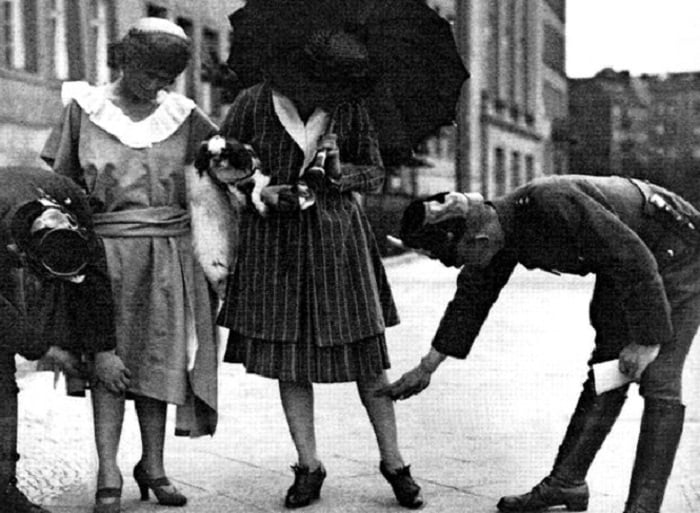
 Policemen measuring the length of women’s skirts. Credit: Public Domain
As hard as it is to believe today, there once were Morality Police in Greece tasked with measuring the length of women’s skirts.
Under the guise of efforts to preserve morality and order, General Theodoros Pangalos passed laws to control the length of skirts during his short-lived dictatorship (1925–1926).
Much to the astonishment of Greek urban society, it was announced on December 1, 1925, that it would be forbidden for all women to wear skirts in public that had hemlines higher than 30 centimeters (10 inches) from the ground.
The new law would apply to all females aged twelve and over. Those who would flout the law would be prosecuted and their parents would also be held responsible for their behavior.
Was the measure a response to PM’s wife’s fury?
According to historians, Pangalos implemented a Morality Police task force in an attempt to appease his wife, who became furious when visiting his office and saw a young lady wearing a knee-length skirt.
 Dictator Theodoros Pangalos. Credit: Public Domain
Mrs. Pangalos demanded that her husband take measures to reverse the so-called “moral decline of the nation” and put an end to “provocative attire.”
Police gave a deadline of December 15 for all women to adjust their wardrobes to the new regulations. When the deadline expired, policemen armed with measuring tapes began patrolling the streets, hunting down and measuring the skirts of offenders.
First arrest of the Morality Police in Greece
The first recorded instance of an arrest was 22-year-old Katina Vogiatzi, who was arrested because her skirt was 38 centimeters (14 inches) from the ground.
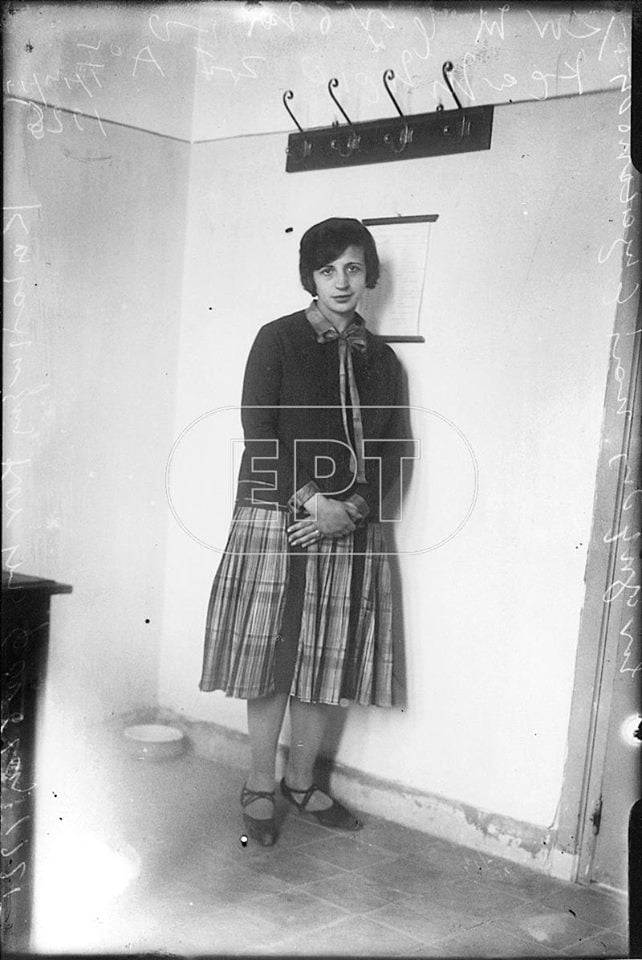 Katina Vogiatzi. Credit: ERT/Public Domain
Vogiatzi was sentenced to 24 hours in prison.
The case became front-page news all over Greece. Most journalists used the case to ridicule the dictatorship, claiming that Greece had much more important problems to solve.
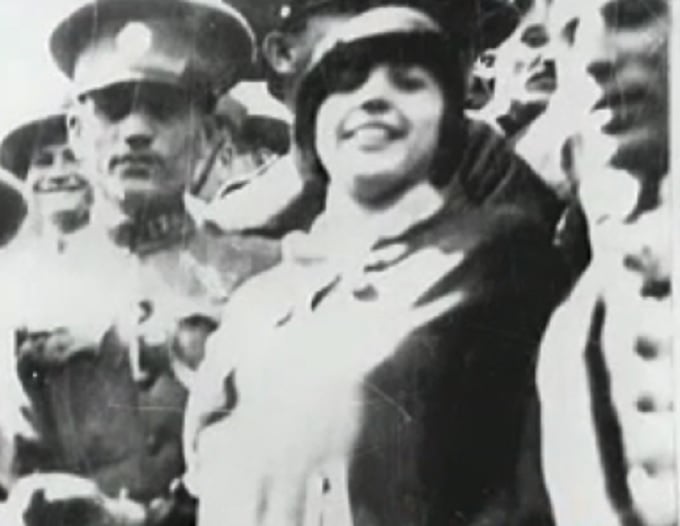 Katina Vogiatzi smiling outside the court before being sentenced to 24 hours in prison. Credit: Public Domain
Pangalos, who had staged a bloodless coup in June 1925, was overthrown in August 1926.
During the Axis Occupation of Greece, Pangalos and military officers close to him were widely suspected of collaborating with the Germans. Cleared by a court after the war, he later unsuccessfully ran for political office and passed away in 1952.
Measuring skirt length in Italy and the US
Under Mussolini’s rule in Fascist Italy, strict dress codes were implemented to promote traditional values. The police would occasionally patrol public spaces to ensure women’s skirts met “modest” length requirements, as set by the government, to uphold conservative standards.
In the 1920s, as hemlines rose with the popularity of the “flapper” style, some cities in the United States enacted local ordinances restricting how short skirts could be. In certain areas, police were sometimes tasked with measuring skirts to ensure they conformed to regulations, especially for swimsuits at public beaches.
While skirt length is no longer regulated in most Western countries, certain nations still have strict dress codes enforced by authorities, especially in public or religious spaces, though this often pertains more to covering specific parts of the body than to skirt length alone.