
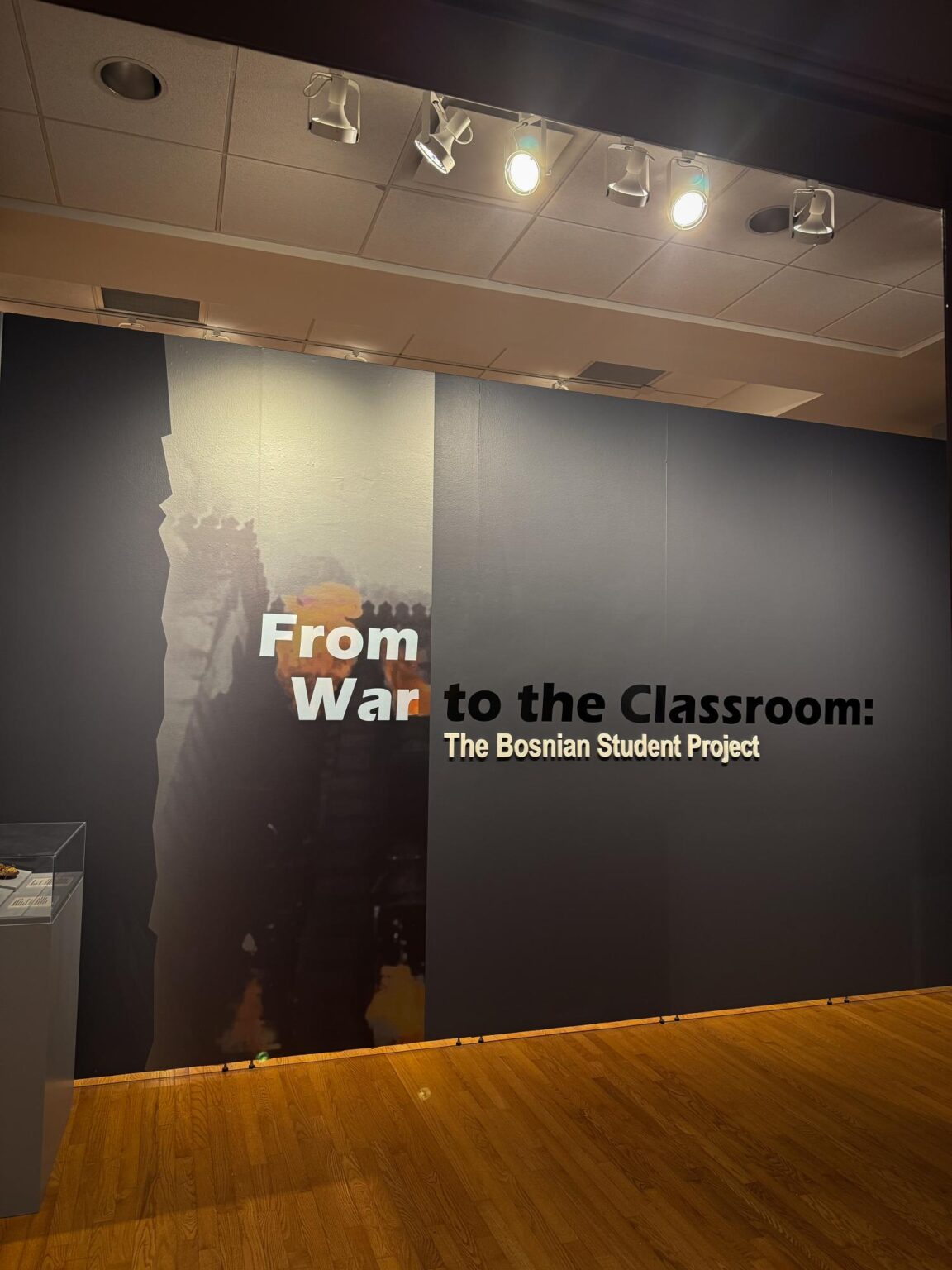
Thirty years after the Bosnian War and genocide, a new Saint Louis University Museum of Art (SLUMA) exhibit, “From War to the Classroom: The Bosnian Student Project,” invites the St. Louis and Saint Louis University (SLU) communities to reflect on the stories of survivors, students and martyrs.
The exhibit, which will run from Sept. 19 to Dec. 28, highlights the Bosnian Student Project (BSP), an initiative of the Fellowship of Reconciliation (FOR). The BSP allowed more than 160 students to escape the 1992-1995 Bosnian War and genocide and continue their studies at American universities, including SLU.
Patrick McCarthy, associate dean of University Libraries and director of the Medical Center Library, brought the project to SLU in 1994. McCarthy and other university faculty and staff appealed to SLU’s president, then Lawrence Biondi, to sponsor Vildana, a young woman who was studying at the University of Sarajevo when the Bosnian War and genocide began. McCarthy said SLU’s support allowed Vildana to continue her studies in St. Louis, where she earned her degree with honors before building a life and family in the community.
“
“That first Bosnian student opened the doors at SLU to many other Bosnians who later followed,” McCarthy said. “Today, we have dozens of Bosnian students at SLU and a thriving Bosnian Herzegovinian Student Association, for which I am proud to serve as the faculty advisor.”
Reflecting on how the exhibit came to be, McCarthy said a reunion event was being planned to mark 30 years of the BSP and, at the same time, the Center for Bosnian Studies was moving from Fontbonne University to SLU. Shared hopes of capturing the project’s history brought members of the BSP and the center together with SLUMA to plan the exhibit.
The exhibit itself provides a historical overview of the Bosnian War and genocide, showcasing artifacts like bullet shells from the Siege of Sarajevo and pictures of the devastation. It also showcases leaders and students from the BSP, including profiles on three students and the project’s co-founders, Doug Hostetter and Tosun Bayrak.
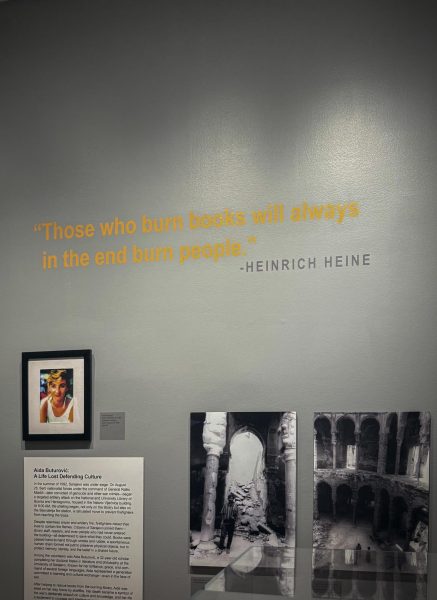 “Those who burn books will always in the end burn people,” said by Heinrich Heine, is quoted above a profile of martyr Aida Buturović at the newest exhibit at the Saint Louis University Museum of Art (SLUMA) on Sept. 25, 2025. (Nejla Hodzic)
Throughout the exhibit, museum goers can feel inspired by both the hope and power education provides amidst devastation.
One profile tells the story of Fatima, a 17-year-old who fled her besieged hometown of Tuzla in the final year of the Bosnian War after enduring years without electricity, clean water or reliable access to food.
“The courage of Prof. Bayrak, the generosity of the Doganata family, and the support of the Fellowship of Reconciliation not only changed her life–they gave her a future,” said the profile on Fatima.
Amidst these hopeful stories, the gravity of what is attacked and lost during war and genocide remains a constant reminder.
“Those who burn books will always in the end burn people,” Heinrich Heine said, quoted above a profile of Aida Buturović, a 32-year-old volunteer and scholar who was killed by shellfire on her way home after she helped rescue books during a targeted attack on a library.
For McCarthy, the exhibit represents hope, cooperation and the principle that there is always something we can do amidst injustice.
“In a world that remains so divided, the exhibit describes a hopeful account of religious and ethnic cooperation and serves as a reminder that genocide is a crime against our collective humanity, which demands a response from each of us,” McCarthy said. “We can’t do everything, but we can always do something. I am very proud of what we accomplished and the lives we saved.”
Further reflecting on the significance of this project and the involvement of SLU, McCarthy believes the university’s act of saving one student means much more.
“In the large reality of war and genocide, it is easy to overlook the importance and value of one single life,” said McCarthy. “There is a saying that is part of the great religious traditions that to save one life is to save the whole world. SLU was a place of wartime refuge for just one Bosnian student. Today, it is a place that many Bosnians call their academic home.”