
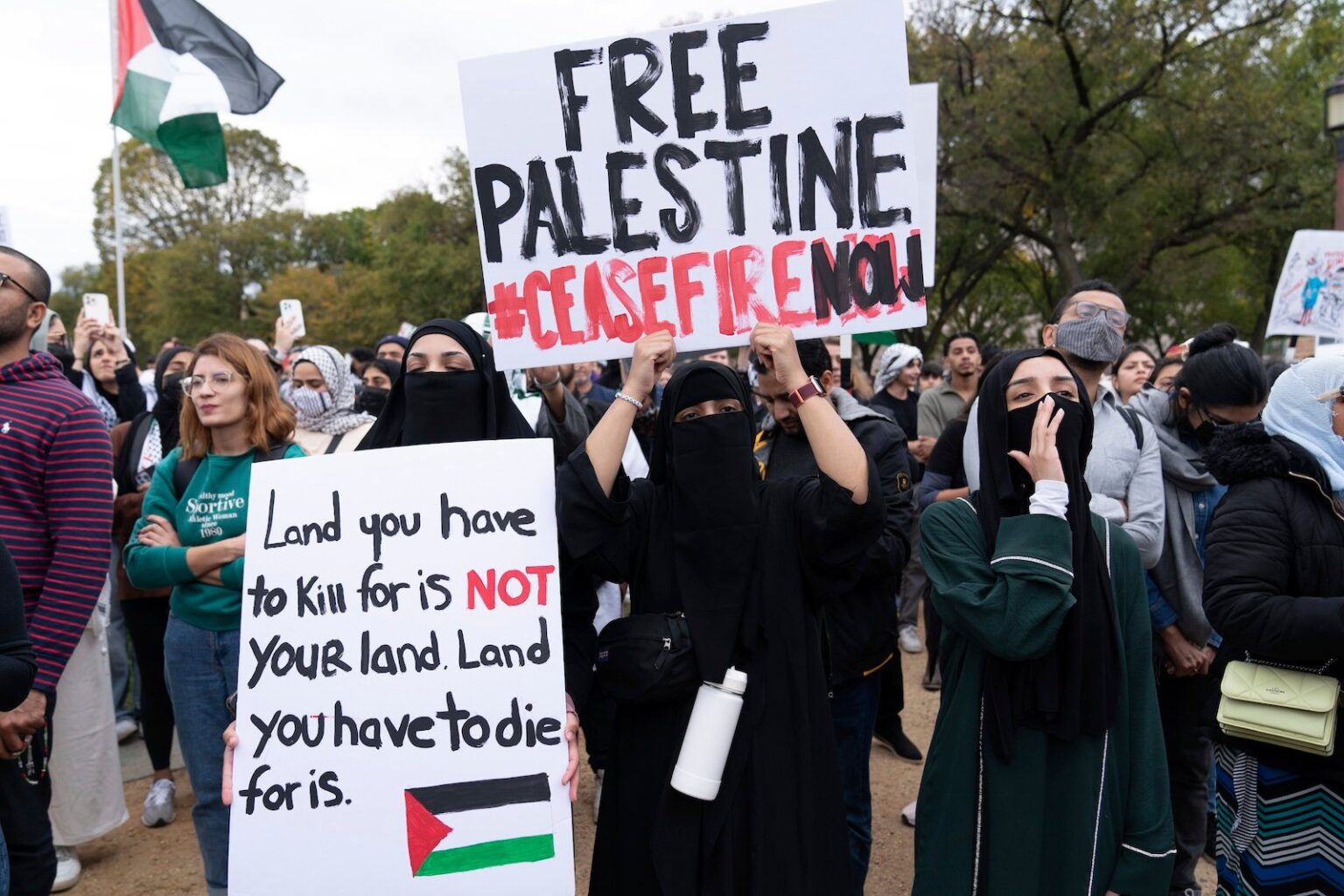
The recent attack on Jews in Britain – a murderous Yom Kippur-day rampage at a Manchester synagogue that killed Adrian Daulby z”l and Melvin Cravitz z”l – is far from an isolated assault. Whether it’s deadly incidents in the UK and United States or the surge in day-to-day cultural, political, and social anti-Jewish racism, it feels harder than ever to live as a Jew in the Diaspora.
While the State of Israel is now the primary focus of this hatred, that focus is merely a mask. Beneath it lies the same old hatred of Jews – a hatred that erases Jewish life in the Diaspora. In 2020, I identified this as Erasive Jew-Hate: a form of antisemitism that ousts Israel from the community of nations, denies Jewish experience, and strips us of our very identity – including our status as an indigenous people.
The conversation around Jewish indigeneity in the Land of Israel has devolved over recent decades, along with the framing of the Israeli-Palestinian conflict itself. During the 1990s peace process, discussions centered on a two-state solution rooted in the Oslo Accords’ recognition of Israel’s right to exist. While this wasn’t an explicit acknowledgment of Jewish indigeneity, the very act of negotiating with a Jewish state implicitly affirmed the enduring Jewish presence in the region.
Moments of pragmatism, though fleeting, showed that compromise was possible – a dramatic shift for a movement that had long rejected Jewish self-determination in the southern Levant. Yet over time, it was not the goal of peace that took hold, but rather the determined rejection of a Jewish state – what Einat Wilf calls “Palestinianism.” And today, it’s not just the Jewish state that’s being rejected, but Jewish identity itself.
The political roots of erasure
Since the Cold War, political extremes – particularly on the Left – have opposed the very idea of a Jewish state. Soviet propaganda was central to this effort, recasting traditional Jew-hate as political critique. Israel was portrayed as a white, settler-colonial entity with no authentic historical claim, while Zionism was equated with Nazism.
The Soviet Union coordinated with Arab states, whose 1967 Khartoum Resolution rejected peace, negotiation, and recognition of Israel. Within this framework, Jews were denied the right to sovereignty, and Israel was destined for eradication.
After the Second Intifada, anti-Zionism moved from the margins to the mainstream. The 2001 Durban Conference marked a turning point: the “two states” framework gave way to calls for a Palestinian state in place of Israel. In the following decades, this narrative gained momentum, aided by figures such as Jeremy Corbyn, whose leadership helped normalize anti-Zionist discourse in Britain and internationally.
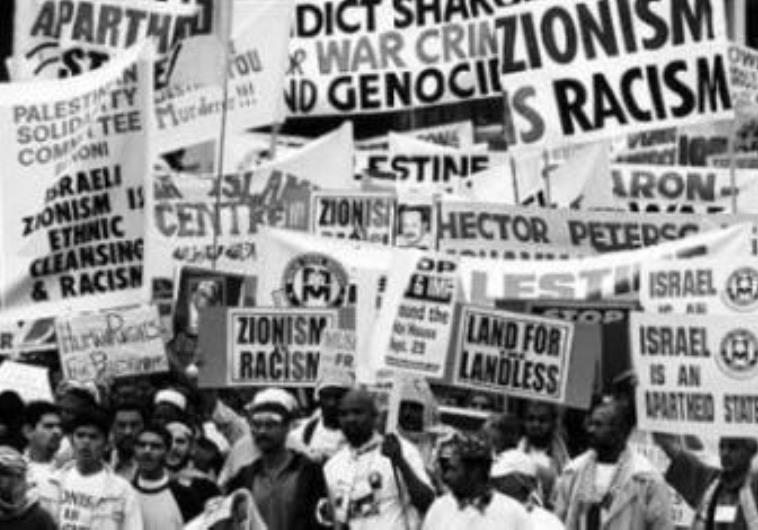
On the side of and inside the United Nations World Conference against Racism, Racial Discrimination, Xenophobia and Related Intolerance met in Durban, South Africa from August 31 to September 8, 2001.
In 2016, UNESCO passed a resolution on safeguarding Palestinian heritage in East Jerusalem but made no mention of the Jewish connection to the city. By the 2021 Israel-Palestine crisis, portrayals of Israel as a colonial imposition and Jews as foreign interlopers had intensified.
The essence of erasive Jew-hate
Erasive Jew-hate is the denial of Jewish identity, history, and connection to the Land of Israel. Its most acute expression followed Hamas’s genocidal assault on Israel on October 7, 2023. Even as the massacre unfolded, anti-Israel demonstrations were already being organized in the Diaspora – in Britain, protest applications were filed by midday. Social media amplified these narratives, with the erasure of Jewish indigeneity a recurring theme.
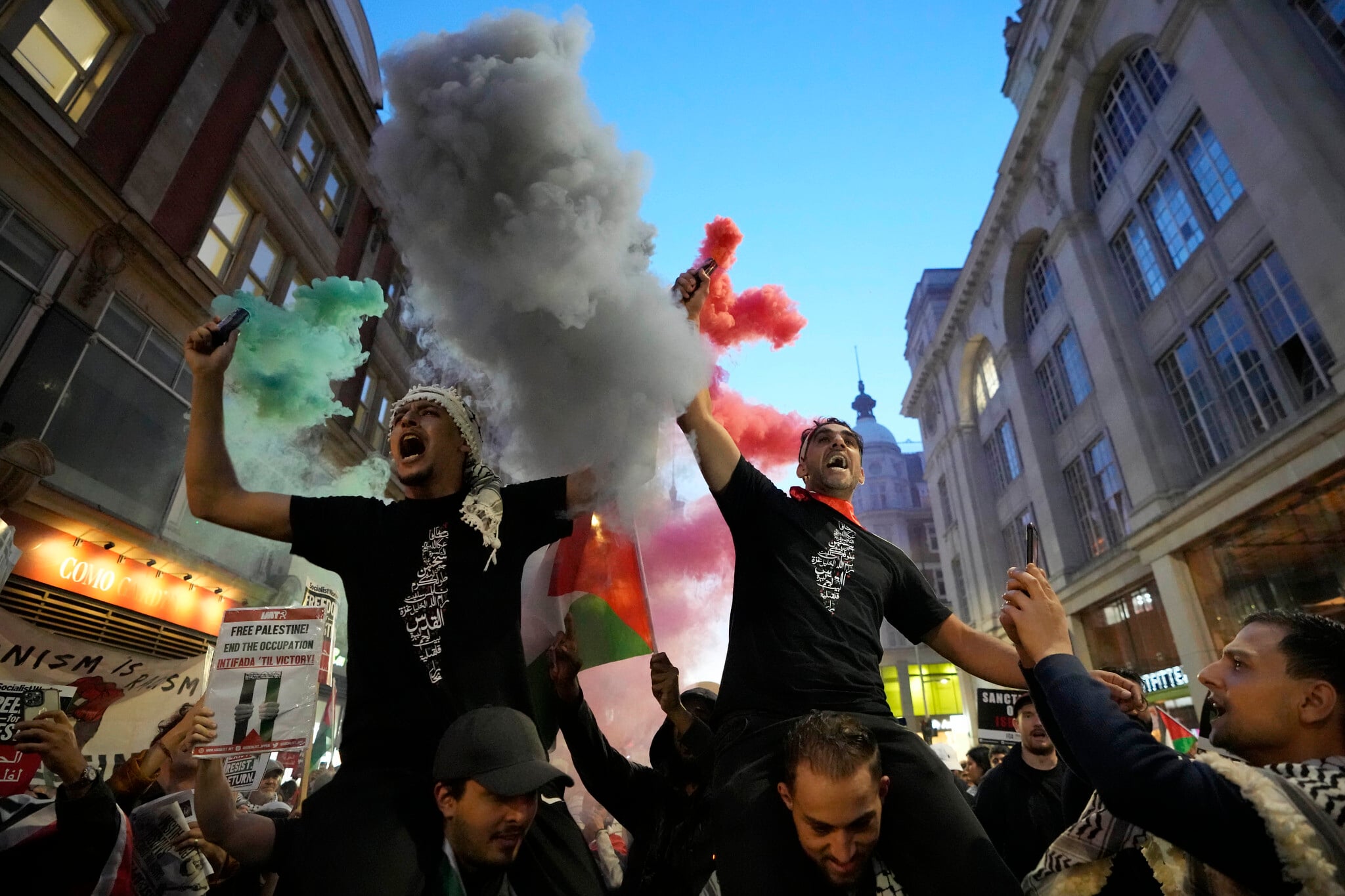
Anti-Israel protesters light flares during a demonstration in London on October 9, 2023, two days after Hamas fighters launched the October 7 terror onslaught on Israel that killed 1,200 people. (AP Photo/Kirsty Wigglesworth)
After October 7, this erasure assumed a more mainstream face. Studies of TikTok and X discourse reveal a sharp increase in antisemitic narratives denying Jewish peoplehood and connection to Israel. In October 2024, British public figure Bushra Shaikh tweeted: “One state solution. Palestine. And send this European problem back to fucking Europe.” The post gained over half a million views. Another viral account claimed Israel “has terrible music, art, and culture because they… do not have a native, original historical continuity,” garnering more than 37,000 likes and 2 million views. Social media has normalized rhetoric that strips Jews of indigeneity.
Erasure through cultural revisionism
Every December, claims that Jesus was a Palestinian resurface. In 2024, Bear Grylls tweeted that Mary was a “terrified Palestinian girl.” In Boston, a nativity scene was vandalized with the words “Jesus was a Palestinian.” Even when commentators acknowledge Jesus’ Jewishness, they simultaneously recast him as Palestinian. On CNN in 2023, Father Edward Beck described Christmas as being “about a Palestinian Jew.” This is a historical fallacy. Jesus was a Jew.
Beyond social media, Jewish indigeneity is often ignored or denied in activist discourse. In 2025, Harry LaForme and Karen Restoule, lawyers for the Anishinaabe – a group of North American Indigenous peoples – criticized campus activism for its blindness to “the indigeneity of the Jewish people in the region that is Israel.” Protest chants such as “Go back to Poland” erase Jewish ties to Israel while undermining Jewish belonging in the societies where we live. On my own social media, comments denying Jewish indigeneity are commonplace.
Jewish students, already vulnerable, are increasingly targeted. Reports in late 2023 described menorah lightings canceled and Jewish symbols removed from campus events – clear acts of cultural erasure. Commentators have noted how Indigenous rights discourses are selectively deployed to deny Jewish claims. Even Shabbat and Hanukkah have been reframed as symbols of colonial complicity rather than Indigenous practice.
These examples illuminate how post–October 7 discourse has accelerated erasure. Chants deny Jews any homeland; online narratives cast them as impostors; Jewish symbols are suppressed; and intellectual frameworks recast Zionism as colonization. This discursive shift has real-world consequences: it excludes Jews from Indigenous frameworks, silences their historical experience, and justifies violence. What’s being erased is not only the Jewish claim to the Land of Israel but also the very possibility of understanding Jews as an Indigenous people rather than a colonizing one in the Middle East.
Jewish pride: Reclaiming the narrative
To resist this, Jews must define and reclaim their own narrative. For too long, Jewish identity has been defined by outsiders and reduced to “religion” or “faith” rather than recognized as a people whose culture includes religion. Central to this reclamation is the assertion of Jewish indigeneity.
As I argue in The Jews: An Indigenous People (2025), the Jewish people meet the UN criteria for indigeneity. Affirming this status deepens Jewish self-understanding and underscores our integral relationship to Israel.
This approach lies at the heart of Jewish Pride, a movement dedicated to liberating Jews from internalized shame and rejecting definitions imposed by others. Only by rejecting Erasive Jew-hate and engaging proactively with Jewish identity can the Jewish people flourish with pride and authenticity.
The threat is not only external. Internalized anti-Jewishness corrodes self-perception and reinforces erasure. As the philosopher Theodor Lessing wrote, “In order to change humans into dogs, all that is needed is to shout at them long enough, ‘You dog!’” For centuries, Jews have faced precisely this dynamic. Today, particularly within parts of the contemporary Left, Jews are forced to choose between their authentic identity and membership in their chosen communities. Tragically, many choose the latter, regardless of how much damage it inflicts on themselves and their people.
To reclaim our humanity, Jews must unapologetically assert the right to self-definition. Only then can Erasive Jew-hate be countered. Without this, the erasure of Jewish indigeneity will continue to accelerate – imperiling both Jewish identity and the legitimacy of Israel as the Jewish state. And this we cannot tolerate.
Ben M. Freeman, founder of the modern Jewish Pride movement, is a leading educator, author, and public intellectual. His acclaimed trilogy includes Jewish Pride: Rebuilding a People (2021), Reclaiming Our Story (2022), and The Jews: An Indigenous People (2025). A Holocaust scholar for over fifteen years, Freeman gained prominence during the UK’s Corbyn crisis and was named a top ‘ViZionary.’ He is a Comper Center Fellow.