
Twice, the President of Serbia, Aleksandar Vučić, has admitted that he placed the foreign-policy interests of others above the interests of the citizens of Serbia.
The first time in May 2022, when he stated that we would “live ten times better had we imposed sanctions on Russia”, and that billions of euros of foreign investment would flow into our budget, and the second time more recently. “Since I did not agree to give my word to the Americans that the Petroleum Industry of Serbia would be nationalised, (American) sanctions have today come into force,” he said on 9 October – thus ending the saga surrounding the company, which since 2009 has been majority-owned by the Russian corporation Gazprom.
The fact that the sanctions had previously been postponed eight times was, by all appearances, more of a concession to the Croatian pipeline company JANAF than a result of the official Belgrade’s negotiation skills. After all: if one seeks the fruits of the SNS’s foreign policy, one should note this: on the one hand, it was long known that the Russians would not relinquish their ownership stake in NIS, and on the other hand it has been known since the Biden administration that the Americans would not give up on imposing sanctions.
What the Serbian authorities have been doing all that time, perhaps it is best if we don’t find out. And what they will do now – according to the words of the Minister of Mining and Energy Dubravka Handanović Đedović – will be known after Vučić’s meeting with the member of the Board of Gazprom, Aleksandr Dyukov, or rather the Deputy Russian Minister of Energy Pavel Sorokin. In other words, we will be told by others what about ourselves, and the president will report back to us. Although it is not the first time that the Serbian authorities have had to pull chestnuts out of the fire with bare hands while sitting by the blaze, the fate of NIS actually only revealed two foreseen facts – the USA indeed plays a major role in Serbia, and the relations between official Belgrade and Washington, in the 143 years since their establishment, have probably only been lower during the 1990s.
After all, the Office of Foreign Assets Control of the US Treasury has already placed Serbian individuals and enterprises under sanctions. NIS thus found itself in the company of Vučić’s loyal operative Aleksandar Vulin, the minister without portfolio Nenad Popović, arms-dealer Slobodan Tešić, Luka Karadžić (brother of Radovan Karadžić), the grey eminence of northern Kosovo and organiser of the Banjska incident Milan Radoičić, but also companies such as Novi Pazar – put and Inkop Ćuprija, which are ultimately owned by Zvonko Veselinović… all that without counting Serbs from Bosnia and Herzegovina, led by political heavyweights Željka Cvijanović and Milorad Dodik. And the list of those sanctioned is not the only indicator that love is not flourishing. Some learn from other people’s mistakes, some don’t even learn from their own.
It was not always so. Foreign-policy commentator Boško Jakšić, not long after the signing of the Washington Agreement in September 2020, said it was good that the USA were once again showing interest in the Balkans, including Serbia, because some of Serbia’s problems cannot be solved without American participation.
Where are we today?
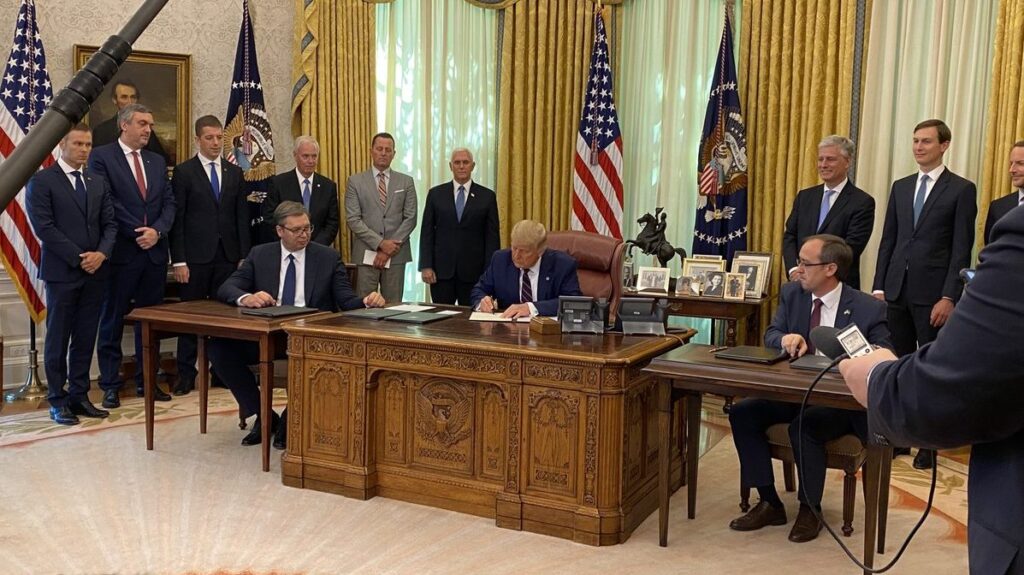
“Belgrade did not understand, or did not want to understand lessons offered by that Agreement. They related to normalisation of Serbia-Kosovo relations via economic incentives, a favourite foreign-policy tool of President Trump. In the end, it was not implemented, but Israel recognised Kosovo, and Serbia committed to being, at that time, the only European country to move the embassy from Tel Aviv to Jerusalem. Some may remember the confused look of President Vučić when they handed him the papers to sign. Five years was a sufficient period for drawing lessons about the interests that America can and wants to realise in Serbia,” Jakšić now tells Radar.
At that time, Trump, in front of the domestic audience, gained the halo of peacemaker, and the USA, shortly after, handed the Serbian-Kosovo conundrum back to the European Union. At least Vučić from the White House took away paper, pencil and keys. The gifts, as he said, he gave to his children.
According to Ivan Vujačić, professor at the Faculty of Economics in Belgrade and former ambassador of Serbia in Washington, the Trump administration was hugely unpredictable – for example, around 1,300 people dealing with analyses of especially Eastern European developments were dismissed from the State Department – so it is impossible to detect its foreign-policy trends, except one: the transactional.
“Before Gaza and Iran became the burning issues, there should have been an agreement by which the trade war between China and the USA would have been pacified or ended. And yet, even though Trump in late October was supposed to meet Xi Jinping at the APEC summit, he recently threatened Beijing with one-hundred-percent sanctions.
Vučić himself said the largest part of his meeting with Secretary of State Mark Rubio in New York was devoted precisely to NIS, and now it is said that no further talks on that matter will take place. I assume that the Serbian side counted on Trump and Putin cooperating on ending the war in Ukraine and that the sanctions on NIS could be bypassed, but anyone who followed talks between the Russian and American presidents could sense that this would not happen,” Vujačić tells Radar and adds that he doubts that Rubio asked for the meeting to take place, as Vučić initially claimed.
Trump, you Serb… I mean, American!
Be that as it may, judging by the pro-Trump campaign in Serbia ahead of the US presidential election late last year, a naïve observer might even have thought that the Serbian authorities were genuinely ready for his second coming. Not only to the White House, but also to Serbia, to Kosovo, to Bosnia and Herzegovina – everywhere the Biden administration was seen as hostile to the interests of the Serbian nation. The balloon of enthusiasm quickly deflated.
“At the beginning of his second term, there were hints that there was room for improvement in bilateral relations. Nevertheless, even amid announcements of a Strategic Dialogue between the two countries, now planned for the end of the year and which will undoubtedly be of greater benefit to Belgrade than to Washington, it was already clear that sanctions on NIS were entirely certain. Trump wanted the Russians to be largely eliminated from Serbia’s energy market, where they effectively hold a monopoly, and that this gap should be filled by purchasing liquefied natural gas from America. That would demonstrate that Washington was sufficiently agile and strong to ‘unbind’ another country from Russia. In strategic terms, that was also the only thing Serbia could offer America,” Jakšić continues.
Coincidentally or not, in September 2024, Serbia’s foreign minister Marko Đurić and US Under Secretary of State for Economic Growth, Energy, and the Environment José Fernández initialled an Agreement on Strategic Cooperation in the Field of Energy – the only intergovernmental agreement between the two countries signed in a long time. Đurić said that the “agreement would result in a more reliable and long-term stable supply” for Serbia. His words now, just thirteen months later, sound both ridiculous and sad.
A debacle in Florida
Perhaps not quite the blunder of May last year, though large enough that someone imaginative might have turned it into a farce, were it not so embarrassing. President Vučić had initially announced important meetings with Trump in Florida, even though the conclusions of the Serbian Government regarding visits of heads of state to other countries – mandatory before both official and unofficial visits – were missing. In other words, either no one knew about it, or the diplomatic and state mechanisms had seriously failed.
In the end, the Serbian public, instead of photographs of the two statesmen, received the news that the President of Serbia, due to health problems, was returning urgently to Belgrade on a ten-hour flight. Reportedly, he felt unwell after not being allowed to attend, as a private individual, the Republican Party convention at which donor funds were being raised. American law explicitly prohibits the presence of officials from other countries at such events. The only meeting held was with Rudy Giuliani, the former mayor of New York. Richard Grenell, Trump’s and Vučić’s close ally, briefly commented on social media that he hoped everything was fine and that he regretted not meeting Vučić. Not Trump – Grenell.
“It seems to me that the President of Serbia’s dreams were shattered then – dreams that he could become as favoured by his American counterpart as Viktor Orbán is. I’m not sure he wanted to offer him the General Staff building at that point. The importance of that project would have been merely symbolic, if even that. Because, no matter how much those hotels might have cost, it would have been just a drop in the financial ocean – both for Trump and for his son-in-law Jared Kushner,” Jakšić explains.
Vujačić also believes that the issue of the Serbian Army’s General Staff building is being misinterpreted by the local public. “If the Serbian representatives really counted on such a purchase winning them someone’s favour, it speaks of an insulting view of those with whom you are negotiating. We simply are not in America’s focus. After all, Trump recently claimed that he had prevented a war between Kosovo and Serbia – a war that absolutely no one here had heard of. Yet no one from Serbia asked him anything about it, nor was there any reaction in any other way,” our interlocutor says.
A vivid proof of the closed doors of the White House – even the gift keys will not open them – was seen at the recent UN General Assembly, when Vučić was not invited to join the group of 145 leaders of different countries who were formally photographed and shook hands with the US President. According to Jakšić, the message was more than clear.
Ambitions and capabilities
The trouble is that, in all likelihood, the whole of Serbia will remain standing in front of those doors.
“The strategic mistake of our foreign policy is that we nominally aspire to the EU, but do not actually address it. Vučić perhaps naively, but certainly wrongly, calculated that he could bypass the Union – especially since the European Parliament has increasingly criticised his policies in Serbia – by exploiting the transatlantic divide and finding a Western ally in America, so that he could continue balancing between Russia and China. But his capabilities do not match his ambitions. Remember – he offered to mediate between Russia and Ukraine, or in the war in the Middle East, but the true measure of his megalomaniac aspirations is Expo 2027. As soon as we test ourselves abroad, Serbia experiences a foreign policy collapse,” Jakšić says.
Apart from the sanctions on NIS, which are a punishment for relations with Russia, Serbia is also facing American tariffs of 35 per cent – the highest in the region and among the highest in the group of ninety targeted countries – due to the Serbian economy’s excessive reliance on Chinese investors, who for years have been the largest exporters here.
This series of wrong moves would not be even slightly amusing if Vučić had not seen in Trump a potentially closest ally who could allow him to continue “sitting on four chairs”.
Moreover, there is no doubt that the great powers of the East will at some point take advantage of Serbia’s vulnerabilities.
Vučić has indeed tried all along not to offend either Russia or China, even thanking them for warnings about a “colour revolution”, and once even received from Russia’s FSB a clumsily translated confirmation that no sonic weapon had been used on 15 March. Still, the question remains whether he has thus managed to avert any unpleasant surprises from Moscow or Beijing.
“To be clear, NIS’s production is very small within Gazprom’s total production. A gesture of goodwill from the Russian side would have been to agree to some form of arrangement that would allow Serbia to avoid sanctions. That did not happen. I believe they are working to ensure that Vučić clashes even further with the West, so that he would, like a ripe pear, fall into the arms of the East,” Jakšić says.
As further fouls in Serbia’s foreign policy – which will come due when it suits someone more powerful – Jakšić lists relations with Turkey, whose president, Recep Tayyip Erdoğan, until recently a friend, our president sharply reproached for selling drones, as well as relations with Israel.
“Vučić boasts about exporting arms to Israel at a time when even Tel Aviv’s biggest allies are imposing restrictions. He defiantly meets with Netanyahu at a time when many avoid even casual encounters with him. The Serbian delegation stays in the hall as Netanyahu takes the podium at the UN General Assembly, while hundreds of other delegations leave the hall in protest. The Israeli foreign minister Gideon Sa’ar visits Belgrade. Had Israeli media not reported that Serbia had signed a $1.6 billion deal to purchase state-of-the-art weaponry from an Israeli company, one wonders whether we would have ever found out about it. Our president is ashamed of activist Ognjen Marković, a detained member of the flotilla that tried to deliver humanitarian aid to Gaza, though any other country would be proud of him. We risk ending up isolated in the same way Israel has been. Now that a ceasefire has been signed, Western allies will mend relations with that country. We will remain stranded on the sandbank,” Jakšić concludes.
What the ambassadors are saying
A particular issue singled out is the problem of diplomatic appointments between the two countries. On one side, the current foreign minister Đurić, a pro-Western member of the SNS, gave up his post to the former president of the Democratic Party and one-time defence minister Dragan Šutanovac.
“His appointment primarily revealed a shortage of qualified personnel within the SNS. As a politician with experience in public administration, he was a logical choice, acceptable to the American side. In the past, he had said that he would, without hesitation, impose sanctions on Russia, given that the Russian ambassador had once voted for sanctions against the Federal Republic of Yugoslavia in the UN Security Council. His political conduct sounded pragmatic,” says Branka Latinović, former ambassador and vice-president of the Forum for International Relations of the European Movement, speaking to Radar.
Meanwhile, according to Biljana Đorđević, co-president of the Green-Left Front, Šutanovac said at a meeting of the parliamentary Committee on Foreign Affairs, prior to taking up his post, that he would present the student protests to his counterparts in Washington as a “revolution backed by Russian security services.”
On the other side, the appointment of Christopher Hill as US ambassador to Serbia reminded our interlocutor of the time of Yugoslavia and the Cold War division of the planet.
“Back then, Belgrade served as an observation post for both East and West, so high-quality personnel were sent there. Mr Hill was brought out of retirement – a heavyweight diplomat who knew local circumstances well and who had once been influential in Washington. Whether his engagement failed to produce better results because, at his age, he did not want to shift from third into fifth gear, or for some other reason, we can only speculate. To be fair, while he was here, there were some objective obstacles to improving relations – such as the Banjska incident or attacks by citizens on KFOR units,” she says.
With Hill’s departure, the post of US ambassador has been left vacant. Already in March – relatively soon after the Trump administration took the reins – the nomination of Mark Brnovich, former attorney general of Arizona, appeared before the Senate. Six months later, it was withdrawn, and Brnovich attributed this outcome to the “work of the deep state.”
“As far as I know, he had achieved good results in the judiciary. Since he does not come from diplomacy or circles close to it, I would say the plan might have been for him to build cooperation with Serbia’s judiciary. However, it is unusual for a nomination to ‘sit’ for six months, just as it is rare for ambassadors to be appointed to countries to which they have personal or family ties. Perhaps that was what blocked his appointment – or perhaps something from his biography. It’s difficult to speculate,” Latinović concludes.
There will certainly be no US ambassador in Serbia for the time being – only a chargé d’affaires – which suggests that Serbia is not exactly high on the list of America’s diplomatic priorities.
CIA, spies and scandals
In August last year, CIA Director William Burns paid a surprise visit to the region. His two-day stay in Belgrade passed in loud silence from Serbian officials, while their counterparts in Pristina and Sarajevo informed their publics about meetings with the former aide to Hillary Clinton and former US ambassador to Moscow.
Interestingly, neither the US embassy nor the CIA press office wanted to confirm his presence in Belgrade. Whether this was a gentleman’s “agreement of non-mention” – otherwise it would be harder to accuse foreign agencies of staging colour revolutions, and we know exactly which ones – or whether it involved discussions beyond the bounds of secrecy, is not known.
Still, Vujačić believes that the meetings with Burns were held at the highest level, and that the topics concerned security matters.
“The Banjska incident surprised American agencies, and talk about the secession of Republika Srpska was becoming louder. I believe that Burns, as an operative with diplomatic experience, wanted to send a clear message to everyone that new destabilisations simply must not occur,” our interlocutor says.
On the other hand, the escape of two detainees – Cuy Guanghaj and John Miller – whom the US had requested for extradition on charges of espionage and trafficking in military technology, from house arrest in Belgrade in early September 2025, is described by Vujačić as a lapse that will never disappear from the agenda of interstate dialogue and that, at best, will merely fall lower down the list of priorities.
(Radar,20.10.2025)
https://radar.nova.rs/politika/vucic-i-tramp-kako-se-sef-igrao-i-preigrao/