
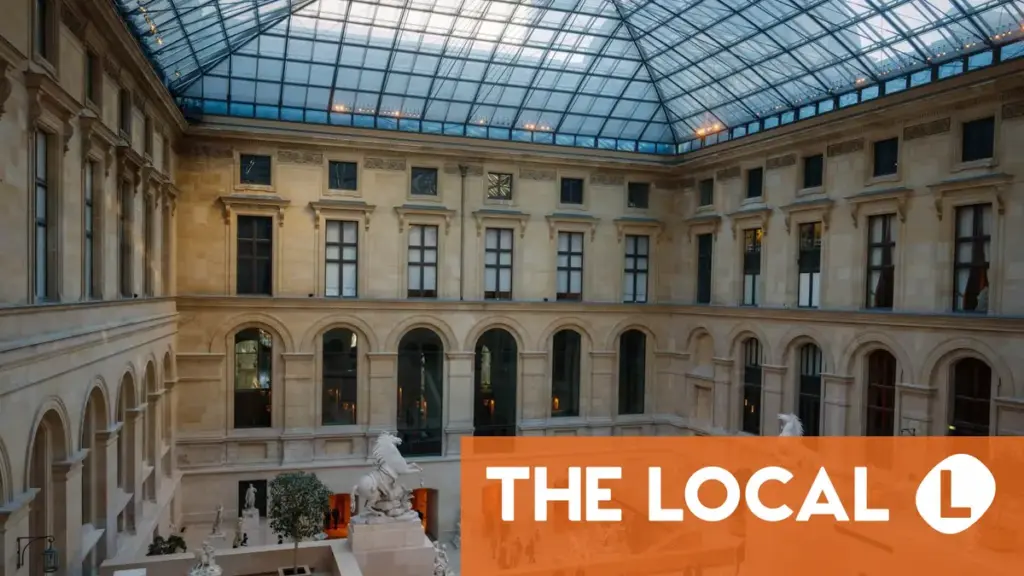
As politicians decry the ‘national humiliation’ of the theft of the crown jewels from the Louvre, John Lichfield ponders whether France has simply too many treasures to protect them all properly.
The Louvre burglary reminds us of an uncomfortable fact – France is too rich.
In terms of cash, the state is skint. In terms of possessions – buildings, works of art, baubles – the French state is loaded.
The country is like a struggling aristocratic family. It has many wonderful possessions – cathedrals, châteaux, museums – but does not have the resources, or the will, to look after them properly.
Who knew that there was such a thing as the French crown jewels? Who knew that they were in the Louvre (apart from four men on motorbikes)?
I have been to the Louvre dozens of time over the last half century. I knew that the world’s largest museum contained the world’s most famous painting. I knew that it contained an unparallelled collection of 17th and 18th century art and an extraordinary array of pillaged Egyptian and Greek and Roman treasures.
Advertisement
I knew nothing about the French crown jewels, which were comparatively little visited in a 60-metres long gallery with a convenient (for thieves) first floor window and balcony overlooking the street.
Why would a Republic keep crown jewels? Maybe the Republic subliminally did not want to keep them.
Marine Le Pen says that they were an important part of the country’s cultural heritage. I wonder if SHE knew that they existed before some of them vanished down a banal furniture removal lift on Sunday morning?
READ ALSO: Paris Louvre heist lays bare museum security complaints✎
The jewels, mostly from the brief 19th century French restorations of monarchy and empire, should have had their own safe space. Properly advertised and properly protected, they would have attracted thousands of people who like to see that kind of thing. They would have paid their security upkeep and more.
Some ignoble, hardline Republican might suggest that they should be sold off to reduce France’s debt. They are said to be “incalculable” in value but several experts have told the French media that their jewels were comparatively down-market affairs.
Broken up, they might fetch a few million euros. Sold intact as royal heirlooms, they might be priceless, whatever that means.
Only the state could have put them on the market. They might go for, say, one billion euros. They would reduce France’s €3,400,000,000,000 state debt to €3,399,000,000,000.
Pawning or selling the state jewels would make only a modest annual supplement to France’s budget for culture, which amounts to €8.3 billion a year. Even this – returning to my first point – is not enough to pay for both subsidies for live culture AND the upkeep and security of all France’s wonderful, ancient possessions.
France has 154 cathedrals, of which more than half are medieval and belong to the state, not the church. Keeping them standing is an enormous strain on the culture budget. The cathedrals, like down-at-heel aristocrats, are constantly scrambling for cash to stop the roof falling in.
Advertisement
I was once allowed to take a short cut through the two thirds or more of the Palace of Versailles which is not open to the public. The visited rooms are gilded and magnificent. The many unvisited rooms are empty and pale grey.
Travelling around France, you have a similar sense of a country over-loaded with possessions. There are hundreds of obscure villages, churches or châteaux that would be celebrated beauty spots in other countries. France has 45,000 châteaux, more than one for every commune (and France has an absurd number of communes but that is another story).
All of this is part of France’s charm to outsiders. To most of the French, it is invisible. To insider-outsiders like me, it is amusing and disconcerting.
The national culture budget is enormous compared to other countries but insufficient to preserve architectural treasures more precious (to many) than Queen Marie-Amélie’s necklace.
Any talk of monetising national heirlooms to ensure their survival – such as entry prices for all cathedrals – is discouraged or mocked.
What money there is for a sprawling, monstrosity of a museum like the Louvre has evidently not been invested in security.
Advertisement
Politicians speak of a “national humiliation” because the country has lost jewels that it never knew that it had.
These are the problems of a country which was once one of the world’s aristocrats but can no longer afford to keep up the family home.