
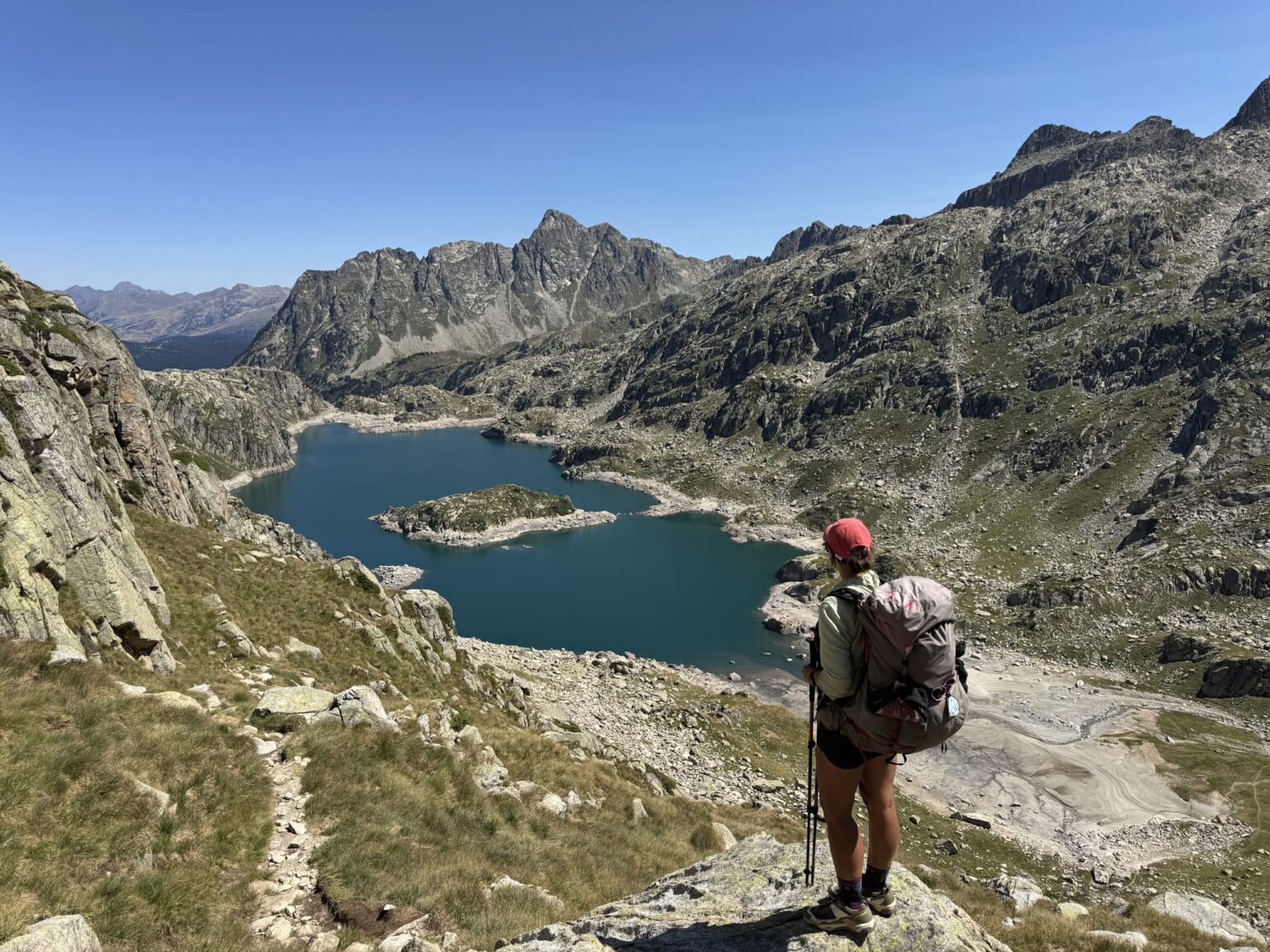
In the week between Benasque and El Serrat, the heatwave finally breaks, and the Pyrenees reveal their contrasting sides. We hike along clear mountain lakes and steep ridges, count sheep, lose trail junctions in the fog (and our cheese to a very determined dog), warm our hands and hearts with hot chocolate, flee from thunderstorms, and eventually reach Andorra on sore feet.
HRP Day 21 – Between Aneto and Col de Mulleres
Road A-139 to Hospital de Vielha: 12.7 miles / 4,660 ft elevation gain / 8.5 hours
After our break in Benasque, we’re full of energy again. We catch the 9 am bus back to where we left the trail and start hiking past marmots toward La Besurta. The road ends there, at the last bus stop, where another wave of day hikers pours out. The weather is a gift: sunshine, just enough clouds swirling around the peaks to make the landscape dramatic, and it’s not hot anymore. The heat wave finally seems to be over.

View of Waterfalls and Aneto at Forau d’Aigualluts
The trail climbs gently until we reach a pretty waterfall with Aneto — the highest peak in the Pyrenees — in the background. We cross a grassy plain fed by a river that originates from what’s left of Aneto’s once-mighty glaciers. Then the trail steepens, and we vanish into the clouds. Suddenly we can see only about 150 feet ahead; hikers appear like ghosts in the gray, then fade away again. After a junction, the crowds thin out, and every so often, the fog opens just long enough to reveal glimpses of the spectacular rocky landscape.

The landscape disappears into the clouds
We scramble over boulders to a small lake almost invisible in the mist. It’s cold, and I pull on my down jacket. But as we eat our sandwiches, the fog lifts, and the sun reveals the jagged peaks around us. The final climb rewards us with sweeping views: ridgelines, the twin summits of Pico Forcanada, and a sea of clouds below.

Climb to Col de Mulleres
We first walk across smooth rock slabs, then scramble over big boulders where the route is difficult to follow. We pick our own line upward and eventually reach the summit of Tuc de Mulleres (9,875 ft). From here, the view stretches across the Mulleres Valley, dotted with lakes and sharp ridges draped in clouds, and back toward Aneto, towering behind us.

Scrambling down from Col de Mulleres
We meet a couple from London who came up from the other side of Col de Mulleres, the pass we’re now heading toward. We know that the first stretch down from the pass is tricky, so we’re glad to have someone to follow who’s already done it. But their line looks a bit sketchy, so I choose an easier-looking one that better matches the route on my map. Carefully and deliberately, we climb down a few exposed rocks before picking up a steep scree path. Looking back from below, it seems impossible that we just came down that. It’s amazing how things that look intimidating from afar often turn out to be manageable once you’re right there.

Descent from Col de Mulleres
The descent drags on across endless boulder fields, and several cairns lead us astray. Eventually, we follow a creek cascading into the valley, with steel cables to help us down the steeper sections. Suddenly we hear bells and look up — across the slope, an enormous flock of sheep spreads out, hundreds of white dots moving like a living cloud over the grass. If you ever wanted to count sheep, this would be the place.

How many sheep can you count?
In the valley we find a flat meadow with several good tent spots. Unfortunately, I soak my feet during a stream crossing to our chosen site, but my new shoes hold up great. I’m wearing the updated version of my favorite Salomon model, and so far I couldn’t be happier. Even at the end of the day, my feet don’t hurt anymore.
It turns bitterly cold once the sun drops behind the mountains. Finally, my sleep system gets to prove itself: for the first time, I zip up my sleeping bag all the way and sink into the cozy warmth.
HRP Day 22 – Lac de Mar and Aigüestortes National Park
Hospital de Vielha to Lac deth Cap de Rencules: 11.6 miles / 5,940 ft elevation gain / 7.5 hours
The morning starts cool again — starting in leggings and a down jacket has become standard. After the heat waves of the past days, I actually find it refreshing. Less pleasant, however, is that my shoes are still wet from yesterday. From the parking area at Hospital de Vielha, we climb back into the mountains. The GR 11 joins us for a while, its clear markings and well-defined trail making for easy progress. Of course, that changes the moment we leave it, and the route once again turns rugged and demanding.

Lac de Rius
We pass several lakes before reaching Colhada de Lac de Mar. From here we can see Lac de Rius behind us and Lac de Mar ahead — the perfect place for lunch. Lac de Mar lies like a heavenly jewel among the rocks, though this year it’s noticeably low on water. Ryan jumps in for a quick swim, but I stay on shore. I’ve never been one for the romantic idea of plunging into icy mountain lakes when the air isn’t warm enough to make me sweat. As usual, the route along the lakeshore is confusing and scattered with boulders.

View of Lac de Mar
The descent to Refugio de la Restanca is slow, winding down steep rock steps that demand careful footing. We reach the reservoir and the hut beside it, where we enjoy a Coke in the shade. But the sugar soon gets its revenge. On the next steep climb, my legs start shaking, something I’ve noticed more often lately after sweet drinks. A quick break with some nuts balances things out again.

Lacs Mangades
There are lots of hikers here, and the narrow paths make passing tricky, especially since few seem to know the simple rule of “uphill has the right of way.” Only in the late afternoon, as the crowds thin, does it grow quiet again.

A brief visit to Parc Nacional d’Aigüestortes i Estany de Sant Maurici
The next pass is relatively easy, and at the top we briefly enter Parc Nacional d’Aigüestortes i Estany de Sant Maurici. Jagged peaks, a maze of shimmering lakes — a breathtaking sight we admire once more from the next pass before descending to another lake, where we find a perfect campsite.
On the HRP, one beautiful day follows the next, and with the cooler weather, it’s easier than ever to savor the beauty of the Pyrenees.

Campsite of today
HRP Day 23 – From Cowboy Hats to Cowbells
Lac deth Cap de Rencules to Estany Rosari de Baciver via Salardú: 16.9 miles / 3,840 ft elevation gain / 7.5 hours
The day begins with a lovely sunrise: the sky glowing red behind the mountains, and we start early, hoping to make it to Salardú by lunchtime. First, the trail passes a lake with a dam, then drops to a road we follow for about six miles. My body goes into autopilot while we keep listening to our audiobook together.

Sunrise on the HRP
By midday we reach Salardú and stumble straight into a country rock festival. Line dancing, a mechanical bull, cowboy hats and boots, and more American flags than I’ve ever seen outside the U.S. It feels like stepping into a parallel universe. Fittingly, we also meet the first American hiker we’ve seen on the HRP: Jackson from Iowa. Sadly, no corn dogs — much to Ryan’s disappointment.

Country-Rock-Festival in Salardú
After that surreal interlude, we turn to the essentials: food. The café other hikers had recommended is still closed, so we end up somewhere else and order burgers. Then we restock at the small grocery store, which has everything we like — cheese, salami, wraps, and baguettes. One of the great perks of hiking in Europe: fewer sugary snacks, more savory options.
In the afternoon we climb again, first along the road — not ideal, since there’s no shoulder — but soon we branch off onto a shaded forest path. The final stretch is steep and leads us to the church in Bagergue, where a shaded bench seems to be waiting just for us. We gratefully sit down to rest and dry out; it’s turned hot again today.

Estany de Baciver
Afterward, we continue up a dirt road that climbs gently, occasionally interrupted by a passing car. Eventually we reach a ski area that leads us to the first of several lakes. From there, the trail rises onto a plateau with two more. At the last lake, we pitch our tent — a perfect spot, right at the final water source for a while and just below tomorrow’s climb, which we can already see ahead. We’re well placed to reach the next village by lunchtime — at a restaurant we’ve already been told not to miss.

Cowbells ring from across the lake, marmots whistle among the rocks, and ducks fly overhead. It’s an idyllic ending to a day full of contrasts.
HRP Day 24 – Ridges, Boulders, and a “Mini Market” in a Basket
Estany Rosari de Baciver to Bassa de Sobriu: 11.2 miles / 4,560 ft elevation gain / 8 hours
The day begins with an incredibly steep climb up to Tuc de Marimanya (8,734 ft). There’s no trail, just a few scattered cairns. We push our way up the grassy slope in the tightest switchbacks I’ve ever done. A group of mountain goats watches us, as if wondering why we’re moving so slowly. The view behind us makes up for the effort: below, the lakes we passed yesterday glimmer in the morning light, while peaks and ridges rise in every direction beyond.

Morning climb to Tuc de Marimanya, followed by a ridge walk
We follow one of those ridges toward the next summit, and the ridge walk turns out to be a true highlight. It offers dizzying views down to another lake, and we place our steps carefully along the exposed edge. The rest of the ridge is easier; we only need to cross a few short boulder fields and blueberry bushes before reaching Coll d’Airoto.

Descent from Coll d’Airoto
But the fun ends abruptly. Ahead lies a massive boulder field, first with giant rocks, then smaller ones, but all equally exhausting. Finding the route is difficult in this labyrinth, and the slow, cautious scrambling feels endless. When we realize we’ve gone too low, we climb straight up an insanely steep slope of grass, rocks, and scattered trees. At least uphill, not down.
After nearly four hours for barely three miles, we finally reach the pass Collado del Clot de Moredo. What a grind. From here, it’s a steep but easier descent into a valley with a lake. At last, a proper trail again, one we can actually follow without effort.

Crossing a large boulder field, followed by a lovely descent from Collado del Clot de Moredo
We shortcut a dirt road via steep side trails as the day grows hotter and our stomachs grow louder. Luckily, we learned last night that Refugi d’Alós d’Isil doesn’t serve food today — rest day. Disappointing, yes, but at least we’re not rushing there with false hopes. Instead, we stop for lunch in the shade by a creek.
In the tiny village of Alós d’Isil, we get a surprise: a young man sitting by the refuge offers us cold drinks and offers us his “mini market” — a basket filled with supplies. We buy salami, manage to refill our gas canister (there had been none in Salardú), and Ryan gets his cigarettes. A true blessing! Even without a meal, the visit was absolutely worth it. The seller, Aniol, tells us his story: he grew up in the Pyrenees, hiked the HRP himself at the age of 18 while summiting every peak along the way, and spent three years cycling through South America — from Ushuaia to Mexico — until dengue fever ended the trip. Impressive doesn’t even begin to cover it. He’s been here ever since — ten years now.

Refugi d’Alós and its “Mini Market”
We say goodbye and begin another steep climb in the afternoon heat. Sweat runs down our faces; horses block the narrow trail now and then, but we always find a way around. Eventually we reach a marshy plateau with a creek and a roaring waterfall above us. Our route still leads higher, to a lake where we plan to camp.
When we arrive at the lake, we treat ourselves to a swim — a must after such a sweaty day. The surrounding grass is alive with movement: thousands of grasshoppers, flies, and other buzzing creatures. Some bite; I pull out a fly from behind my ear in disgust. I retreat into the tent while Ryan cooks outside, unfazed by the swarm. We’re both very hungry today, and looking at our snack stash, I’m not sure we’ll make it all the way to our next planned resupply in Andorra. We might have to stop in Tavascan after all.

Evening mood on the HRP
HRP Day 25 – Three Passes and a Cheese Tragedy
Bassa de Sobriu to Riu de Guerosso: 9.4 miles / 4,200 ft elevation gain / 7 hours
The morning starts strange: We’re waking up to odd sounds nearby. A harsh, raspy barking, almost like a cat trying to cough up a hairball, only much louder. It has to be an animal, but which one? We peer toward the noise but see nothing. Other campers by the lake heard it too, so at least we’re not imagining things. Later I learn it was actually deer. Apparently, they “bark” as a warning call — a sound that doesn’t fit their gentle image at all.

Climbing three passes
Ahead of us lie three passes: Coll de la Cornella, Coll de Curios, and Coll de Calberante. The climbs are surprisingly straightforward — bright yellow markings, a clear trail, no issues. Only the descent from the first pass is extremely steep and covered in loose scree, forcing us to go slowly. Otherwise, it’s one beautiful lake after another.

Gallina Lake
We take our lunch break at Refugi Enric Pujol — really just a tiny bivouac hut, but a cozy one. Then a dog appears and steals the rest of our cheese. With the entire Ziplock bag in its mouth, it trots off while its owners watch indifferently. We’re left standing there in disbelief, mourning the loss of our precious cheese we’d been rationing carefully to last until the next resupply.

Refugi Enric Pujol
Just as we’re about to leave, the rain starts. A Czech couple — Dominika and Tomáš — arrives at the hut, with perfect timing. We wait out the shower together, chatting about their Hyperlite packs, before continuing the descent over slick, rain-slicked rocks and past small waterfalls.
At the bottom, we reach the scattered stone houses of Noarre. Summer dwellings without road access, remote but idyllic. No one else seems to be around. We consider descending to Tavascan. Not because we need food, but because of the weather. Tomorrow’s forecast calls for steady rain. But we don’t want to believe it. Surely it won’t rain all day… The forecasts have been wrong before. So we keep going.

Noarre
The next climb begins in the rain, but we find shelter in the forest, crouched beneath a tree and our Tyvek sheet. After a while it clears, and we reach a marshy plain sparkling in the sunlight. The grass is bright green, the streams glinting — it feels like another world. Eventually we arrive at a small lake. With thunderstorms forecasted for the night, we decide to camp here, feeling safer among the trees than on the higher, open ground.

Climb to Estany Inferior de Guerosso
We’re not thrilled to stop early while the weather still holds, but it’s the smarter choice. Indeed, during the night the rain pounds on the tent again and again. Flashes of lightning flicker on the horizon, though without thunder. Thanks to earplugs, we still manage to sleep surprisingly well despite the roaring rain.
HRP Day 26 – Rain, Cabin Warmth, and a Thunderstorm Finale
Riu de Guerosso to Cabana de Basello: 13.2 miles / 5,350 ft elevation gain / 8 hours
After a night of heavy rain, I wake up early. Above me, the stars are shining — a promising start. At first light we climb toward the pass, which we reach after about an hour without difficulty. On the other side lies the vast Lac de Certascan. An Italian family is heading up toward Pic de Certascan, a summit that can be reached in an hour from the pass we just crossed. We, on the other hand, have one goal only: to stay ahead of the incoming weather. Dark clouds are gathering ahead, even as the sun still shines here.

Descent to Lac de Certascan
The descent to the lake takes us past horses with their foals grazing peacefully in a meadow laced with sunlit streams. At Refugi de Certascan, we’re greeted by warmth — not just the heat inside, but the friendliness of the women running it. We order hot chocolate just as the rain begins, feeling a wave of sympathy for the family now somewhere on that mountain. Our worries about charging our devices disappear as we’re allowed to plug in. Soon, lasagna, longaniza sausage with potatoes, carrot cake, and a cinnamon roll appear on the table. We’re tempted to stay. It’s only 9:30 am, we’re cozy, dry, playing Uno, and watching the rain fall.

Physical and personal warmth at Refugi de Certascan
But the hut fills up: first a Spanish family, then the Italians return. Soon it’s crowded and noisy. We pack up and take advantage of a short break in the rain — only to walk straight into the next shower. Now, perhaps, the Italian family pities us. How the tables turn. Carefully, we descend over slick rocks into the forest, already soaked through.

Descent into the rain
Among the trees, we pitch the tent for a while just to escape the rain. It’s still wet from last night. We have a second lunch, wait, and, miraculously, the sky clears again. Onward we go: first gentle switchbacks, then steeper climbs in muggy air. My glasses fog up; the air feels thick and heavy. We’re hoping to reach the bivouac hut Refugi Baborte before the next downpour.
We almost make it — the rain starts again just before Coll de Sellente. I groan; everything had just dried. Rain jackets back on. Luckily, it doesn’t last long. When we arrive at the orange bivy hut by Baborte Lake, we see it’s already full. At least five people are inside the small hut. I don’t bother checking further. The hut sleeps nine, but it’s obviously packed. If it were pouring, I might try to squeeze in, but not tonight.
We sit outside like strays, spreading out the tent to dry and eating a quick snack. A Swiss hiker named Tim pokes his head out to chat; he’s hiking with his mother and says they’re taking it easy. Apparently, the Czech couple is here too; I spotted their white Hyperlite packs in the tiny entryway and send them our regards via Tim.

Drying our tent at Refugi Baborte
We head out again, hoping to reach the trees and find a somewhat sheltered campsite before the next storm hits. Soon we come upon a small plateau with a hut, though it’s barely fit for emergencies. Inside the dark hut there’s only a straw bed. It’s the kind of place where mice would probably dance on your face at night. We prefer the tent and find a decent spot among the trees near the hut.
Then the night’s performance begins: rain, followed by heavy thunderstorms rolling directly overhead. In between, a brief pause allows for a quick bathroom break. The strange sounds we heard the day before — the “barking” deer — echo again through the dark. Despite the thunder and rain, we eventually drift off to sleep, wrapped in the storm’s wild symphony.
HRP Day 27 – A Misty Walk into Andorra
Cabana de Basello to El Serrat: 14.4 miles / 4,920 ft elevation gain / 8 hours
The day starts out promising as the last gray clouds drift away, a few raindrops still falling before blue sky takes over. We begin descending — only to take the wrong trail, adding a small detour before finding our way back to the HRP.
At a roadside parking lot, the next climb begins. My body feels tired today, even though I ate well yesterday. At Port de Boet we cross back into France and straight into the clouds. From here on, we spend the entire day in fog: cold, damp, and with zero visibility.

At Port de Boet we enter the clouds
We miss another turn and descend farther than we should have. By the time we realize it, it’s too late. Eventually we rejoin the HRP via a different route that overlaps with the HexaTrek. We’re racking up extra time and elevation on what should have been an easy day. Being engrossed in our audiobook — and the total lack of visibility — doesn’t help. Ryan gets grumpy; I take it in stride. What’s done is done.
Conditions stay challenging. My glasses fog up and get covered in fine water droplets. I finally take them off and rely on my bare eyes, which just barely focus well enough to see the ground. We don’t take a real lunch break today as it’s too cold and too wet. A quick snack is all we can do to prevent Ryan from tipping into full hangry mode.
Since everything is slippery, I move slower than Ryan. Every step feels like a potential fall, so I tread carefully. A stream crossing in the valley gets our feet completely soaked, and the steep 650-foot climb back up to the HRP doesn’t help. The grass is so wet our shoes never stand a chance of drying out. I shrug it off: we’re already drenched anyway. At least now I’m the faster one — uphill is my territory, while Ryan’s quicker on descents. Fair balance, I’d say.

Climb to Port de Rat, the border to Andorra
At Port de Rat, the border into Andorra, there’s still no view. Still — Andorra is officially my 48th country. Just as a heavy rain begins, we reach a restaurant in a ski area. I’m freezing and beyond grateful to step into the warmth. We order hot chocolate and burgers while I figure out how to get to La Massana. Turns out the bus only runs from El Serrat — six kilometers farther down the road. We wait for the rain to stop, then continue our descent, which turns out to be surprisingly beautiful once the weather clears.

Arinsal skiing area in Andorra
We just miss the bus in El Serrat. I’m frustrated. The planned 9-mile day has turned into 14, with extra climbs, sore feet from constant wetness, and now this. I just want a shower and a bed. We start hitching, hoping to catch a ride before the next bus.

Descent to El Serrat
A friendly man in a VW van pulls over. He turns out to be a bear researcher, telling us there are five bears in Andorra and that he’d recently spotted a mother with cubs, whom he sees almost daily. With a wink, he adds that they only tell tourists the bears are shy.
A cycling race is going on in La Massana, and the road into town is closed, so he drops us off before the barrier. Walking the last two miles to the hotel on my raw feet does not spark joy. So, we walk to a bus stop, trying to figure out how to buy tickets on the not-so-intuitive app before the bus arrives. We make it just in time, and the driver drops us right near our hotel. After days on trail I always look forward to a shower, but in this cold, wet weather, it feels even more heavenly. I’m equally thrilled to get rid of my soggy socks and shoes.
That evening we hit the laundromat to wash our clothes, which smell unmistakably like wet dog. The place is packed with a group of young guys who’ve taken over all the seating and are loudly chatting. We pass the 30-minute wash cycle wandering through the supermarket next door, then sit on the floor waiting for the dryer to finish.
By the time we’re done, we’re hungry again. We head to a pizza restaurant, but service is slow and our energy is gone. At 11 pm, we finally collapse into bed at the hotel. What a day. Tomorrow we’re going to spend a Zero in this lovely Andorran town. It looks like there’s a lot of good food to be found here – Crepes, Bratwurst, Tapas, a vegan restaurant with great reviews are only a few of the choices.

La Massana, Andorra