
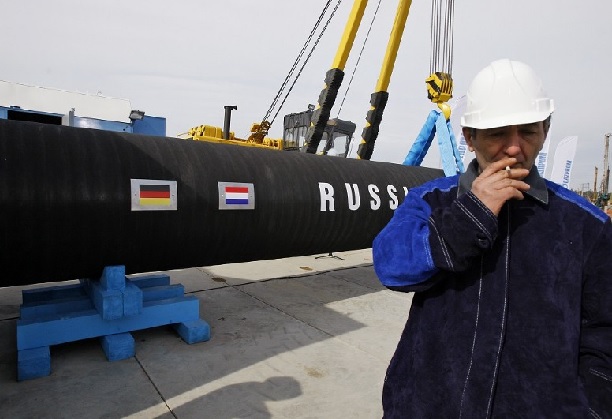
The claim that Serbia will be prevented from transferring Russian gas is false, stated EU Commissioner for Enlargement Marta Kos in her address to the European Parliament (EP).
She explained that the decision of the Council of the European Union (EU) to ban the import of Russian gas, which also applies to the transit of this energy source through the EU, does not imply that member states will halt transfers to third countries such as Serbia. “The European Union is not cutting off Serbia’s gas supply. These are lies. On the contrary, the EU supports Serbia in diversifying all sources of supply and integrating into the EU’s energy networks,” she said.
Kos also noted that Serbia’s close relations with Moscow and Beijing, accompanied by hostile rhetoric towards the European Union, are contrary to European values and standards.
According to her, Brussels expects Serbia to make a strategic choice and take concrete steps in upholding democratic principles and implementing reforms.
“Now is the time for the authorities to demonstrate Serbia’s commitment to its EU path – in both words and deeds,” she concluded.
Kos addressed Members of the European Parliament on 21 October during the debate on the resolution concerning Serbia.
The focus of the document is the situation in Serbia one year after the 1 November 2024 tragedy, when 16 people were killed and one person seriously injured following the collapse of the canopy at the Novi Sad Railway Station. The collapse triggered a wave of mass protests demanding that the authorities be held accountable, while government representatives denied any responsibility for the incident.
In her opening remarks, European Commissioner Marta Kos stated that the EU expects police actions and conduct during the protests to be proportionate and that fundamental civil rights will be respected.
“It is a priority to investigate all allegations of excessive use of force,” she added. She went on to say that Brussels condemns any acts of hatred, vandalism, or violence during the protests and calls on all parties to reduce tensions. “We expect any candidate country for EU membership to uphold all the values on which we are founded – respect for human dignity, freedom, democracy, and the rule of law,” she stated.
She also added that Serbia must adhere to the principles of freedom of assembly, media freedom, and academic freedom.
In the draft resolution of the European Parliament (EP) on Serbia, Members of the European Parliament express their support for the right of students and citizens to peaceful protest, strongly condemning the wave of state-sponsored violence, intimidation, and arbitrary arrests.
The document, published on the European Parliament’s website, states that Serbia’s leadership bears political responsibility for the escalation of repression, the normalisation of violence, and the weakening of democratic institutions in the country.
Picula: ‘The government in Serbia has betrayed its citizens’
The European Parliament’s rapporteur for Serbia, Tonino Picula, said during the debate that the resolution is not an attack on Serbia. He also stated that it is not Europe that has betrayed Serbia, but rather that Serbia’s own government has betrayed its citizens. “The tragedy in Novi Sad shows that corruption is not an ordinary crime – corruption destroys institutions and costs lives,” he said.
“This disaster reflects some of Serbia’s key structural problems – the non-transparent involvement of foreign actors in the project, the absence of inspections that would have ensured the facility met safety standards, interference with the investigation and the independence of the judiciary after the tragedy, and the repression of citizens demanding accountability and change,” the rapporteur for Serbia assessed.
The European Parliament is expected to vote on the resolution on 22 October.
What did Members of the European Parliament say?
During the debate, Members of the European Parliament from different political groups spoke about the resolution on Serbia.
Vladimir Prebilič, an MEP from the Greens, stated that the case of Novi Sad makes it clearer than ever that corruption kills.
“Sixteen lives were lost because someone embezzled money… We call for a tougher EU stance – we must send a monitoring mission to Serbia and make it clear that there will be no EU funding until the REM Council is established, the electoral register is completed, and the intimidation of the media ends,” he said.
MEP Irena Joveva from the Renew group also called for targeted EU sanctions against those responsible. “Those who order the beatings of demonstrators call the beaten ‘Nazis’ and invent fake students and scholarships,” she stated.
Ivaylo Valchev from the European Conservatives and Reformists reminded that the Union is founded on democracy, the rule of law, and fundamental rights. “Vučić’s regime does not align with those values,” he said.
Tomáš Frölich, an MEP from the right-wing ESN group, argued that legitimate protests against the regime in Serbia are being used for geopolitical purposes. “Serbia is pragmatic regarding Russia and China; that is Serbia’s own choice. It is a sovereign and proud country that does not want your condescending behaviour,” he said.
Andrey Kovachev of the European People’s Party stated that Serbia is “at a crossroads.”
He observed that the government “is trying to balance between Russia, China and the EU, thereby undermining hopes for the country’s European future.”
He expressed solidarity with the students who are peacefully protesting to defend dignity, democracy and the future, and said he wished to clearly distance himself from “pro-Russian nationalist protests filled with violence.”
Member of the European Parliament Thijs Reuten said that the European Union must support the legitimate demands of those in Serbia who are calling for democracy, transparency and justice.
“This is not a government following the path towards the EU,” Reuten stated.
What does the European Parliament’s resolution say?
The European Parliament’s resolution is titled “On Polarisation and Increased Repression in Serbia, One Year After the Novi Sad Tragedy.” It reiterates the call for a full and transparent investigation and judicial process to ensure that those responsible for the collapse of the canopy are brought to justice. The resolution condemns the open interference of the Russian Federation in the protests in Serbia through disinformation spread by Russian officials, including Vladimir Putin, claiming that a “colour revolution” supported by the West is taking place.
Serbian authorities are urged to “take action against such malign propaganda in domestic media instead of participating in its dissemination.”
Members of the European Parliament also support the deployment of an ad hoc mission to assess the state of democracy in Serbia, with the participation of the European Parliament.
The European Commission is called upon to initiate a proposal for targeted individual sanctions against those responsible for serious violations of law and human rights in Serbia.
Informal Inquiry Committee presented its report to the European Parliament
On 21 October, a panel was held in the European Parliament, organised by several parliamentary groups, to mark the anniversary of the canopy collapse at the Novi Sad Railway Station.
At the panel, experts from Serbia, representing the informal Inquiry Committee, presented the findings of their report on the incident.
“We call on the European Parliament to take concrete steps to support democracy and the rule of law in Serbia,” said Professor and Committee member Tanasije Marinković.
Judge and Committee member Radmila Dragičević Dičić pointed out that the main conclusion of the report is that corruption kills.
“The corruption we uncovered in this case led to incompetence, lack of accountability, the lowering of all construction standards, and the selection of companies that were neither competent nor experienced,” she emphasised.
“The main goal was to siphon money from the project and launder it,” added Dragičević Dičić.
She also commented on the narrative spread by certain government officials and pro-government media – that the canopy collapse was a terrorist attack.
She assessed this as “another attempt by the authorities and state media to divert attention from corruption towards a conspiracy theory.”
The Committee concluded that corruption in the high-speed railway project to the Hungarian border alone resulted in the theft of 700 million euros, according to Professor Ognjen Radonjić.
“The price of that corruption and incompetence was paid by the 16 people who died under the canopy and one person who was seriously injured. Brutal repression was carried out against everyone, especially the students who demanded a fair investigation,” he added.
He also warned about another “corrupt and unsafe project currently being prepared in Serbia – the international exhibition EXPO 2027.”
Committee member and Professor Vladimir Obradović stated that corruption is entrenched in every public project and that, aside from corruption itself, the safety of such projects is also concerning.
“The families of the victims are still waiting for justice – a year has passed, and there is no accountability or justice,” he said and added: “A government that cannot deliver justice cannot claim to uphold European values.” Obradović also emphasised that Europe can no longer turn a blind eye if a candidate country abandons European procedures and engages in questionable political deals.
(Radio Free Europe, 23.10.2025)
https://www.slobodnaevropa.org/a/srbija-evropski-parlament-debata-rezolucija-protesti/33566067.html