
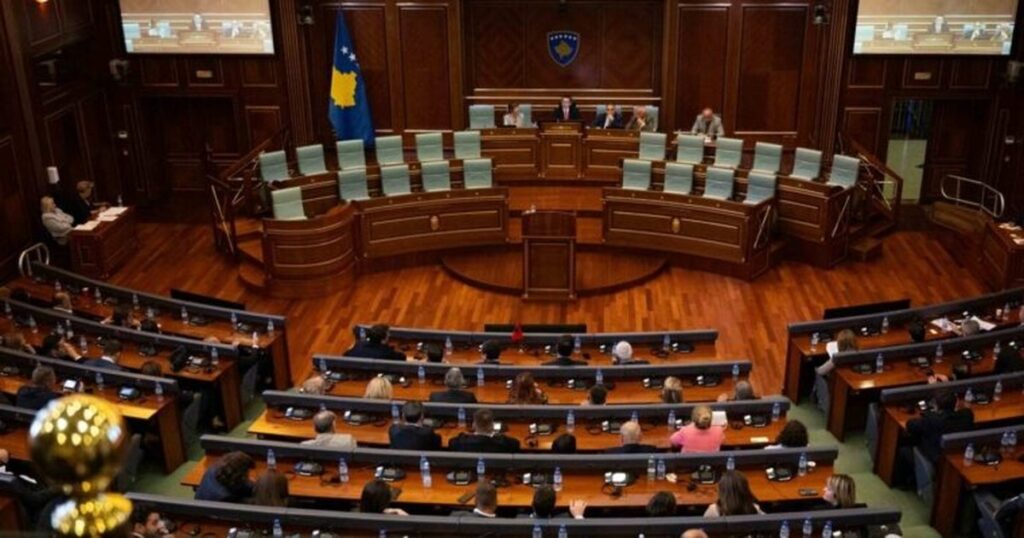
Kosovo entered 2025 aware that there would be parliamentary elections, but without knowing what would await them.
Challenge to the constitution of the Assembly, successive complaints to the Constitutional Court, an incumbent Government with limited powers, and risking foreign funds worth hundreds of millions of euros.
Just when it seems like things can’t get any worse, the issue of the state budget for next year comes up – which, according to the Ministry of Finance’s forecasts, is expected to be around 3.5 billion euros. For former Minister of Economy, Haki Shatri, the current situation is very worrying.
“The budget is the material basis of the functioning of the state. If this basis is destroyed, the state goes bankrupt, it cannot function,” he tells Radio Free Europe. To avoid that, the budget must go through several stages, so that it can enter into force on January 1, 2026.
Budget approval stages
The budget for the next year begins to be prepared as early as March, in several budget circulars, and is then distributed for review to all institutions that are financed by the budget.
Under ideal conditions, the Government completes all preparations and, according to the Law on Public Finance Management, the deadline for budget approval is October 30.
Thus, the deputies have two months, from November 1 to December 31, to review the document in two readings, in committees, and make the necessary changes. But, the first problem now is that Kosovo has a government in office with limited powers.
The Law on Government does not mention the term Government in office, but rather the Government in resignation, which is defined as a government that functions after the dissolution of the Assembly until the election of a new government.
The law provides that such a government cannot adopt new laws, but can propose to the Assembly the approval of the state budget.
So far, so good. But Kosovo also has a second problem, as it is awaiting a decision from the Constitutional Court to determine whether the Assembly was constituted in accordance with laws and regulations, and depending on the decision, the budget approval process could also be delayed.
“Eventually, if we are left without [the formation of] a Government and without an Assembly, there is a risk that from January 1 there will be no budget and no payment procedure can take place without a decision by the Assembly,” says Shatri.
Among the payments that are blocked are: salaries, pensions, fuel payments for the Police and the army, or even those for supplies of consumables for institutions.
“Practically, it falls to the state to put the lock on it,” Shatri estimates.
Speaking about the deadlines for budget approval, the acting Minister of Finance, Hekuran Murati, said a few days ago that the Government “will do its best, for the good of the state, for the good of the republic, so that the institutions function continuously as we have done so far.”
Second option
To avoid a deadlock, there is another option. If the Government approves the budget, and the deputies delay in completing the necessary procedures, then the executive can make a proposal to supplement/amend the current Budget Law, so that it does not expire on December 31, but allows for subsequent expenditures for January or even February, with the monthly average of the previous year, or as it is otherwise known, the 1/12 rule.
Shatri recalls that something like this has happened to Kosovo two or three times since its declaration of independence. What law could be proposed, if the deadlines are met?
The acting Prime Minister of Kosovo, Albin Kurti, has a few days left to present the new government composition to the Parliament, and to understand whether it will receive the necessary votes.
Even if he or someone else manages to form the Government and begins the budget process, Shatri does not believe that the document will be very well thought out, given the situation the country has been through so far.
Why? Because, according to him, there was no all-powerful minister who could draft adequate development policies for the coming year, and consequently, the next budget could be a copy of the previous one.
Other economic damages
The President of the Kosovo Chamber of Commerce, Lulzim Rafuna, tells Radio Free Europe that Kosovo is suffering greatly economically from the lack of fully-fledged institutions.
“Businesses want predictability, to understand what fiscal policy will be, what investments in capital projects are, so that public investments can then attract private investments.”
He says that the focus in budget allocations for next year should be, among other things, on reforms in fiscal policies, increasing the budget for capital investments, and improving the image of the state, which opens the doors to foreign investment.
Shatri also mentions the need to utilize opportunities for public loans and credits, to ensure a space for the country’s dynamic development.
According to a World Bank report, economic growth is expected to decline from 3.6 percent in 2024 to 3 percent in 2025 for the Western Balkan countries. The largest declines are expected for Serbia and Kosovo, which, however, remain slightly above the regional average./ REL