
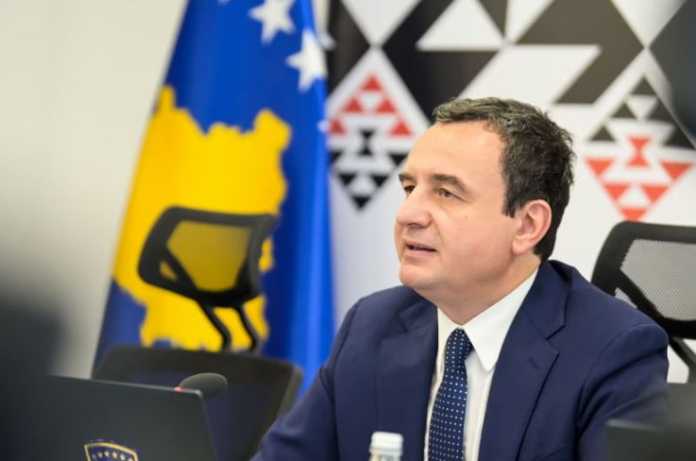
The nominee for forming Kosovo’s new government, the leader of Vetëvendosje Movement and acting Prime Minister Albin Kurti, has two more legal days to present his proposed cabinet to the members of the Kosovo Assembly.
If the government is not elected by Sunday — following the February elections and months of efforts to form new institutions — Kosovo could face another institutional crisis.
In the parliamentary elections of February 9, Vetëvendosje received the most votes, but not enough to form a government alone.
It remains uncertain whether the party will be able to secure support from other parties’ MPs by Sunday.
According to political analyst Agon Maliqi, Kurti’s options are exhausted and Kosovo will head toward new elections. (Listen to his interview.)
Earlier, Vetëvendosje ruled out any talks with the Democratic Party of Kosovo (PDK) but left the door open for cooperation with the Democratic League of Kosovo (LDK).
For now — at least publicly — no coalition agreement appears to be on the horizon.
What Happens Next?
Earlier this week, Kurti hinted that he might not be able to form a new government and suggested that new elections could be an alternative solution.
However, the Constitution of Kosovo stipulates that if the proposed government does not receive the required majority of MPs, the President of Kosovo must appoint a second nominee for Prime Minister within ten days, someone deemed to have the best chance of forming a government.
The new nominee would again have 15 days to present the cabinet composition and government program to the Assembly.
Based on the 2020 Constitutional Court decision, the second nominee can also come from the second-largest party — in this case, the Democratic Party of Kosovo (PDK).
If the government is not elected for the second time, the President must call new elections, which must be held within 40 days of the announcement.
Until then, the caretaker government would continue to perform its duties.
What Do the Numbers Say?
In the February elections, Vetëvendosje won 48 out of 120 seats in the Kosovo Assembly, followed by the Democratic Party of Kosovo (24 seats), the Democratic League of Kosovo (20 seats), and the Alliance for the Future of Kosovo – Nisma coalition (8 seats).
The Serb community holds 10 guaranteed seats in the Assembly — nine of which were won by the Serb List (Lista Srpska), while one seat was won by Nenad Rashiq from the Party for Freedom, Justice, and Survival.
Another 10 seats are reserved for other minority communities recognized by the Constitution of Kosovo: Bosniaks, Turks, Gorani, Roma, Ashkali, and Egyptians.
To elect a new government, the nominee must secure at least 61 votes.
On October 20, the President of Kosovo, Vjosa Osmani, stated that there is still time to reach an agreement for forming the government but criticized the Serb List for “creating obstacles.”
The Serb List has filed a complaint with the Constitutional Court challenging the election of Rashiq as Deputy Speaker of the Assembly, and the case is pending a decision.
What if the Constitutional Court Rules in Favor of the Serb List?
If the Constitutional Court of Kosovo upholds the Serb List’s complaint, this would effectively mean that the Assembly of Kosovo is not properly constituted.
Such a ruling would make it impossible to take any steps toward forming a new government and institutions.
Previously, the Constitutional Court had ruled in favor of the Serb List, stating that the Assembly cannot be considered constituted without electing a Deputy Speaker from the Serb community.
Subsequently, Rashiq was elected to the position because none of the nine candidates from the Serb List managed to secure the necessary votes.
According to the Rules of Procedure of the Assembly, a Deputy Speaker from the Serb community must be nominated by the majority of MPs from that community — the very point on which the Serb List bases its appeal.
The Assembly of Kosovo was constituted on October 10, eight months after the elections.
The political and institutional crisis initially arose from disagreements among the major Albanian parties over the election of the Assembly Speaker, and later due to the election of a Deputy Speaker from the Serb community.
(Source: Radio Free Europe / REL)