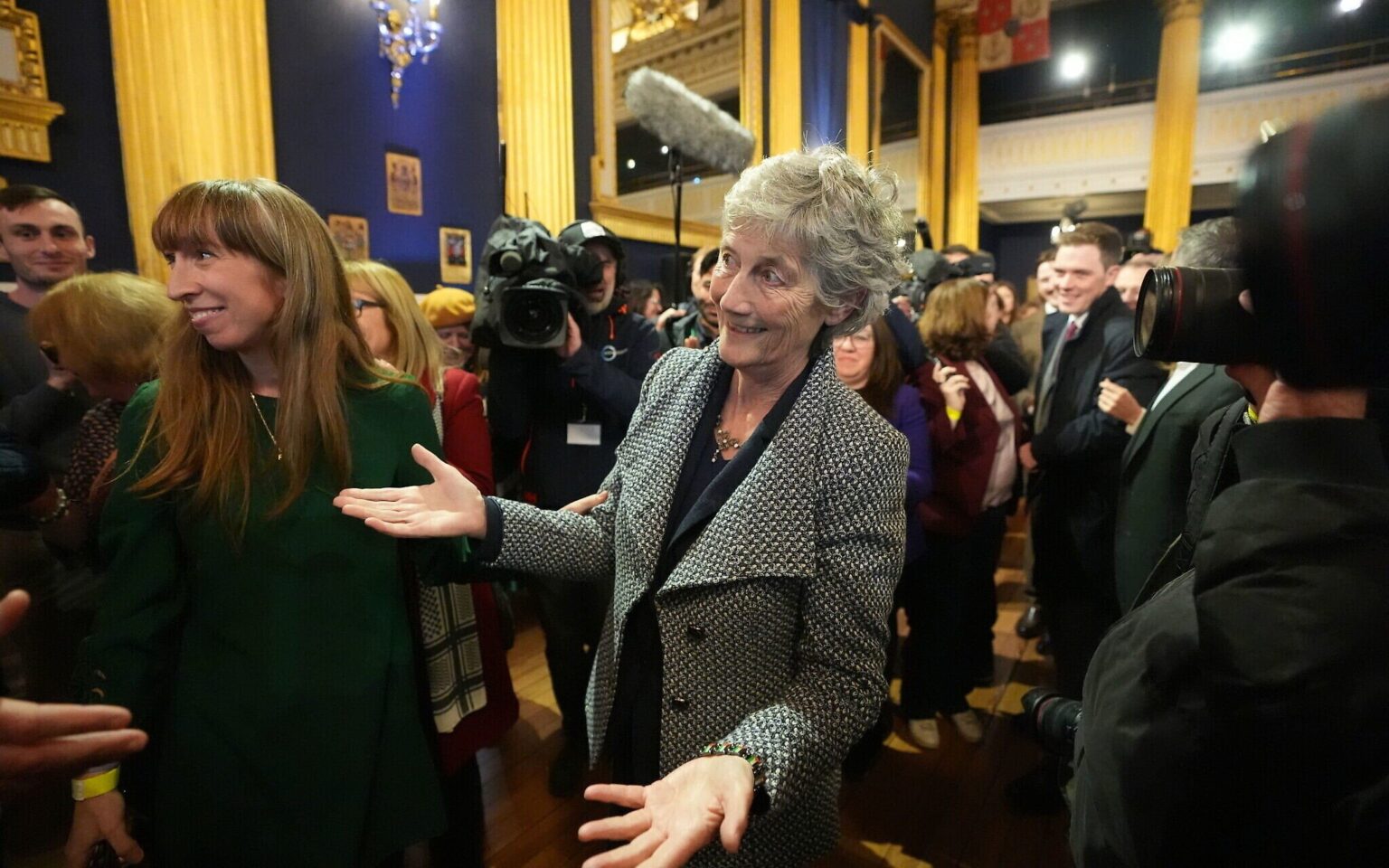
Catherine Connolly, a veteran lawmaker on the far left of the Irish political spectrum, was elected president by a landslide margin on Saturday.
Official results showed strong voter support for Connolly as president, a largely ceremonial role in Ireland. She won 63 percent of first-preference votes once ineligible votes were excluded, compared to 29% for her rival Heather Humphreys, of the center-right party Fine Gael.
She has drawn criticism for her views on the Hamas terror group, which she said in September was “part of the fabric of the Palestinian people.” Ireland’s Prime Minister Micheál Martin criticized those comments.
Connolly later maintained that she “utterly condemned” Hamas’s actions and that its October 7, 2023, onslaught against Israel, which launched the war, was “absolutely unacceptable.”
But she criticized Israel for carrying out what she said was a “genocide” in Gaza, an accusation Israel adamantly rejects. She has also accused Israel of being a “terrorist state.”
“If we in this Dáil can’t recognize that Israel is a terrorist state, then we’re in serious trouble,” she said in a video shared on her campaign’s Facebook page in June, referring to the lower house of the Irish legislature where she served. She went on to criticize Israel’s strikes on Iran’s nuclear program, its military conduct in Gaza, and other Israeli policies.
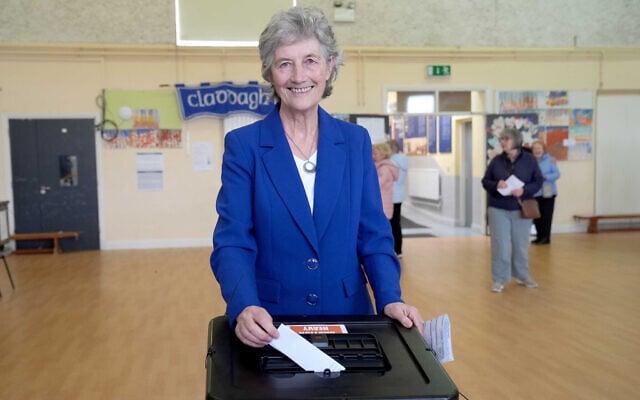
Catherine Connolly casts her vote in the election for the next Irish president at Claddagh National School in Galway city, Ireland, October 24, 2025. (Brian Lawless/PA via AP)
Connolly, 68, is a long-time critic of the European Union in overwhelmingly pro-EU Ireland. She was backed by the left-dominated opposition, was not a household name, and was underestimated by many at the start of the campaign.
An independent candidate, she built momentum as the campaign progressed, and enthused younger voters.
“I will be a president who listens, who reflects and who speaks when it’s necessary. Together we can shape a new republic that values everybody,” Connolly said in a speech at Dublin Castle.
Ireland’s president is largely a figurehead, with seldom-used powers to test the constitutionality of legislation, but often speaks on the global stage and welcomes other heads of state to the country.
Many of Connolly’s views — from denouncing the EU’s plans to boost military spending to questioning the trustworthiness of the United States, Britain and France over their stance on the war in Gaza — are well to the left of many of the parties backing her, as well as outspoken incumbent Michael Higgins, himself a critic of Israel.
Higgins has been president since 2011, having served the maximum two seven-year terms.
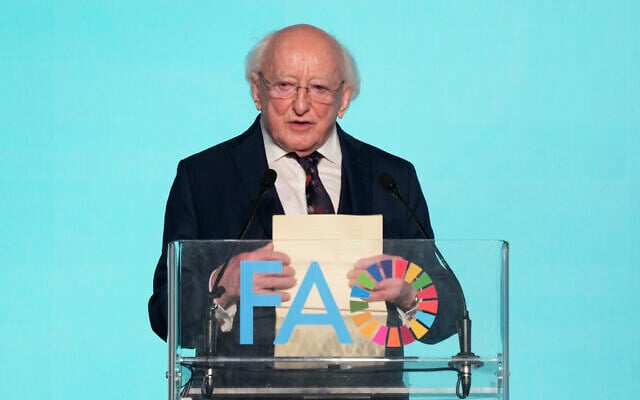
Irish President Michael Higgins speaks at a 42nd World Food Day celebration at FAO headquarters in Rome, Italy, October 16, 2023. (AP Photo/Alessandra Tarantino)
Connolly will be Ireland’s 10th president and the third woman to hold the post. She is a former clinical psychologist and barrister.
Although she served as deputy speaker of Ireland’s lower house after being first elected in 2016, her win was widely viewed as continuing the recent trend of choosing a more independent president based on the candidate’s values. It amounted to a stinging rebuke to the recently re-elected center-right coalition.
She also benefited from dire campaigns from the two governing parties. Humphreys was not Fine Gael’s first choice. Fianna Fail’s pick, former Gaelic football coach Jim Gavin, abandoned his bid due to a financial scandal.
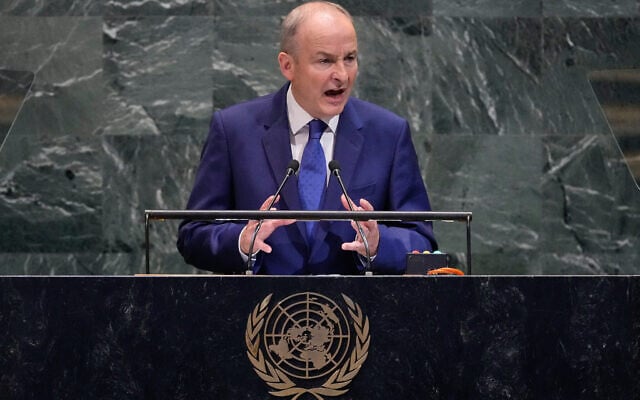
Irish Prime Minister Micheal Martin addresses the 80th session of the United Nations General Assembly, September 26, 2025. (AP Photo/Richard Drew)
A record 13% of voters also spoiled their votes, partly due to a planned protest by supporters of a conservative campaigner who failed to secure the required support from elected representatives to make the ballot.
Martin said the government was open to reforming the nomination process.
On Saturday, Martin congratulated Connolly on her “very comprehensive election victory.” He said he was looking forward to working with the new president as “Ireland continues to play a significant role on the global stage, and as we look forward to hosting the EU presidency in the second half of 2026.”