
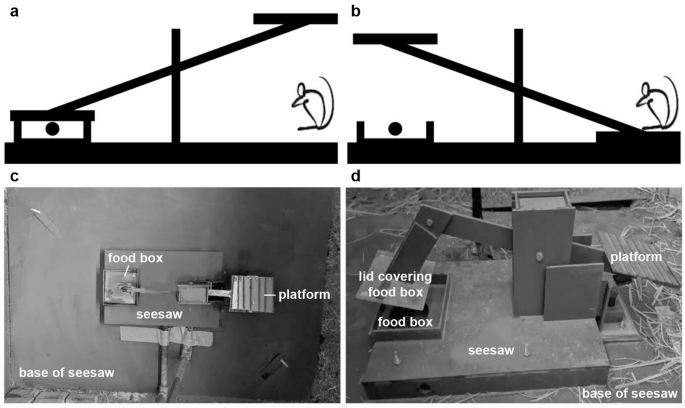
Knowledge of the behaviours of wild Norway rats is rather limited35,36,37. Colony size can reach over 150 individuals36. Natural colonies are structured in variable subgroups ranging from single individuals of either sex to pairs, unisex groups and harems with and without offspring35,37. Norway rats caught at 9 sites had little genetic relatedness among individuals caught at the same sites, but showed high levels of genetic diversity and genetic structuring across small geographic distances38.
Field studies of Norway rats, Rattus norvegicus, anecdotally reported what appeared to be social transmission of foraging behaviours and food preferences35,39, which was subsequently supported by laboratory studies done with inbreed lab strains of Norway rats27,40,41 and wild-type Norway rats42. Young Norway rats learned from conspecifics where, when and what to eat42, whereas adult male Norway rats learned food preferences from excretory markings and gustatory cues of conspecifics33,34. Furthermore, adult male Norway rats improved their foraging efficiency in the presence of trained demonstrators with food available, and they showed a shorter latency to start digging and a greater number of food items dug up in this condition27.
Norway rats are highly social animals43,45 that can distinguish between kin and non-kin44,45, between different degrees of relatedness46, between colony members and intruders47 and between single individuals (i.e. true individual recognition48. We used Norway rats that are well-known for their capacity to cooperate by using detailed information from their social partners30,49,50,51,52,53,54. Norway rats account for their partners’ need50,51,55, solicitation56,57,58 and helpfulness52,54,59,60,61 when cooperating. These and other studies illustrate the capacity of Norway rats to respond appropriately to social cues62 Most studies of Norway rats have been done in the laboratory. To study the behaviour of rats under semi-natural conditions, we established six colonies of wild-type Norway rats in outdoor enclosures.
Experimental subjects and housing conditions
Fifty-six outbred, female wild-type Norway rats, Rattus norvegicus (source: Behavioural Physiology Unit, Groningen Institute of Evolutionary Life Sciences, University of Groningen, The Netherlands) were brought to the Ethologische Station Hasli of the University of Bern, Switzerland. The rats were individually marked by a white hair dye (rats were habituated to the smell and application) and by ear punches. The patterns of the hair dye allowed us to identify each individual rat within a colony. If blood was visible after ear punching, we stopped it by gently pressing on the ear with a paper tissue for 10 s. The rats were housed indoors in groups of 4 to 6 littermates per housing cage (80 cm x 50 cm x 37.5 cm). To avoid male-male competition for females and possibly deaths caused by overt aggression, only females were included in the formation of each colony. The rats were habituated to handling (see Supplementary Information, S2 for more information). The study is reported in accordance with the ARRIVE guidelines. The license to perform animal experiments was provided by the Swiss Federal Veterinary Office of the Canton of Bern (license number BE 55/18) to M.T. The ticket for indispensable research was provided by the University of Bern (ticket number EAC-201216-T#212) to M.T. The experiment was performed in accordance with relevant guidelines and regulations.
Following 6 weeks of acclimatisation, i.e. gradual temperature decrease, the rats moved into outdoor enclosures under semi-natural environmental conditions. Each enclosure (294 cm x 208 cm x 258 cm) consisted of (i) a cement floor covered with 5 cm of soil, and stainless-steel walls, (ii) an area of soil (132 cm x 105 cm, and 40 cm deep) for digging and building tunnels, (iii) 3 wooden shelters, (iv) 3 heat lamps (turned on when the temperature was < 6˚C), (v) 2 PVC tubes, (vi) 2 pieces of wood, (vii) 4 infrared light bulbs (Supplementary Information, Fig. S1), and (viii) a Raspberry Pi Model 3 B + with a Raspberry Pi camera H with a fisheye lens and night vision to record videos with a frame rate of 30 frames/s and a resolution of 1024 frame width by 768 frame height. Hay and straw were provided weekly for the rats to build nests. Grain mix was additionally provided five times a week, and fresh fruits or vegetables were provided twice a week. We performed daily, weekly and monthly health checks.
Apparatus
We provided 1 seesaw per colony. Each seesaw consisted of a platform connected by a lever to a lid, which covered food rewards in a food box. The seesaw rested on a PVC base (102 cm x 72 cm x 0.5 cm, Fig. 1a and c). Rats could lower the platform by sitting on it, but they could also access the food by lifting the covering lid (Fig. 1b and d). To dissuade rats from accessing the food rewards by lifting the lid, it was surrounded by 4 pieces of PVC, which made lid-lifting difficult. A similar seesaw was used to study cooperation in keas, Nestor notabilis22. When a rat lowered the platform, this was connected with an electromagnet and 2 microswitches (Fig. 1d). The electromagnet connected with a microswitch, a 24 V power supply, and a time relay, which kept the food tray open for 63 s. The second microswitch connected with a Raspberry Pi Model 3 B+, which automatically logged the dates and times when the seesaw was opened and closed. Data were relayed from the Raspberry Pi to a server via an Ethernet cable.
Main study: training
In the pilot study, we used 20 rats (see Supplementary Information, S3), and in the main study we tested 36 rats. To experimentally induce seesaw manipulations, 12 rats were randomly selected from different families for training. Each rat was placed in an experimental cage (80 cm x 50 cm x 37.5 cm) with the seesaw in the training room and returned to its housing cage after each training session. A successful manipulation of the seesaw was defined as lowering the platform by sitting on the platform or by lifting the lid and eating the food reward. An unsuccessful manipulation of the seesaw was defined as: 1) not lowering the platform all the way down to connect with the microswitches and the electromagnet, or ii) lowering the platform without eating the food reward. The food rewards were peanut halves for the first 5 successful sessions to increase the motivation to manipulate the seesaw, and were then changed to oats. An observer recorded the number of successful and unsuccessful manipulations. The criterion to consider a rat as trained, hereafter ‘experienced rats’, was ≥ 4 successful manipulations per 15 min session on 2 consecutive days (the criterion was met after 19 to 26 training sessions). Trained rats successfully manipulated the seesaw by sitting on the platform and not by attempting to lift the lid.
Main study: procedure
We experimentally introduced seesaw manipulations in 4 of the 6 colonies and manipulated the number of experienced rats and the relatedness composition of each colony (6 rats/colony). The rats had 1 week to habituate to the new physical and social environment, and the mean mass and age of rats were 193 g ± 5 g and 72 days ± 0.5 days, respectively. There were 4 experienced rats in 2 colonies, 2 experienced rats in 2 colonies, and 0 experienced rats in 2 colonies (Table 2). There were full siblings (all sisters) in 2 colonies, no siblings (no sisters) in 2 colonies, and mixed siblings (3 pairs of 2 sisters) in 2 colonies (Table 2). Naïve rats had no previous experience with the seesaw. The study lasted 26 observation days from November 28th, 2019 to December 31 st, 2019 and yielded 2,195.42 h of video recordings. The study ran under red light conditions at night, with daily temperatures between 0 °C and 8 °C.
The seesaw was covered by a cage top each morning to prevent access, and it was uncovered in the evening so that the rats had access to it overnight during their active period. The food box was filled with oats as food rewards. To account for local enhancement, the position of the seesaw was changed by moving the seesaw to a different location inside the enclosures after the first 15 days (Supplementary Information, Fig. S1a and Fig. S1b). Researchers looked at the videos and recorded the identity of the rats that (i) lowered the platform, (ii) witnessed conspecifics successfully manipulate the seesaw from any location in the enclosure, except when in the food cage, houses or the area with soil (Fig. S1), (iii) attended to the apparatus, i.e. were present on the base of the apparatus when it was manipulated by a conspecific as a proxy of witnessing conspecifics manipulate the seesaw, (iv) ate the food reward, and (v) manipulated the seesaw in a new or modified way (innovation), such as lifting the lid rather than sitting on the platform. For each naïve rat, the latency to the first successful manipulation of the seesaw was recorded as the time from the start of the experiment in the colony to the first successful manipulation of the seesaw. If a naïve rat did not successfully manipulate the seesaw at all during the study, this latency was determined as the time from the start of the experiment in the colony to the end of the study, and we recorded that the event did not occur. For each naïve rat that subsequently acquired the successful manipulation of the seesaw, we recorded the intervals between successful manipulations of the seesaw, starting from the interval between the 1 st and 2nd successes, then between the 2nd and 3rd successes and so forth, until the end of the study. The number of successful and unsuccessful manipulations of the seesaw were recorded.
Statistical analysis
To assess the inter-observer reliability, we calculated the index of concordance between the 2 observers for the identity of rats manipulating the seesaw and if the manipulation was a success63. To investigate for effects on naïve rats’ latencies to the first successful manipulation of the seesaw, i.e. the acquisition of a novel behavioural trait, we ran a semi-parametric Cox proportional hazard mixed model to assess the effects of (i) the number of experienced rats in the colony, (ii) its relatedness composition, and (iii) the location of the seesaw in the enclosure as a time dependent covariate as fixed effects on naïve rats’ latency to the first successful manipulation of the seesaw. Colony number was included as a random intercept effect, and there were no theoretically important random slopes. We compared the full model to the null model, i.e. without the number of experienced rats and the relatedness composition. The proportional hazard assumption was met64.
The effects of the number of experienced rats and relatedness composition of colonies on the latency to first successful manipulation of the seesaw may be explained by the occurrence of potential intermediate steps in the acquisition of social information prior to the first successful manipulation of the seesaw. We assessed if intermediate steps influenced the acquisition of the first successful manipulation of the seesaw, and each model is a proxy of naïve rats witnessing conspecifics manipulating the seesaw A generalized linear mixed model with a quasi-Poisson (Poisson lognormal) distribution was conducted to assess the influence of the number of experienced rats and the relatedness composition of colonies on the number of times each naïve rat attended to the apparatus when another rat lowered the platform, prior to first success. A generalized linear mixed model with a quasi-Poisson (Poisson lognormal) distribution was conducted to assess the influence of the number of experienced rats and the relatedness composition of colonies on the cumulative number of times each naïve rat witnessed another rat successfully manipulating the seesaw, prior to first success. A generalized linear mixed model with a quasi-Poisson (Poisson lognormal) distribution was conducted to assess the influence of the number of experienced rats and the relatedness composition of colonies on the cumulative number of times each naïve rat ate the reward when another rat lowered the platform, prior to first success. For these models, colonies and an observation-level value65 were the random intercept effects, and we applied an offset to account for each rat’s latency to the first successful manipulation of the seesaw or till the end of the study for rats that did not acquire the task. We accounted for all theoretically important random slopes. We compared the full models to the null models.
To test for effects on the intervals between successful manipulations of the seesaw, i.e. the rate of performance of the acquired trait, we ran a parametric event history analysis with a Weibull distribution, since the proportional hazard assumption was not met. The fixed effects were (i) the number of experienced rats in the colony, (ii) its relatedness composition, and (iii) the location of the seesaw in the enclosure as a time dependent covariate, and we included rat identities and colonies as random effects, i.e. shared gamma frailty. We compared the full model to the null model, i.e. without the number of experienced rats and the relatedness composition.
A linear mixed model with a Gaussian distribution was conducted to assess the influence of the experience of the previous rat (naïve vs. experienced) and the kinship of the rats (sister vs. non-sister), as fixed effects, on the latency for naïve rats to successfully manipulate the seesaw after it was manipulated by another rat. The colonies and individual rats were random intercept effects. The model residuals were normally distributed when we log-transformed the response variable, i.e. the latency for naïve rats to successfully manipulate the seesaw after it was manipulated by another rat. We accounted for all theoretically important random slopes. We compared the full model to the null model.
We recorded the identity of rats that innovated, i.e. developed new or modified behaviour to successfully manipulate the seesaw, and we recorded how often individual rats successfully and unsuccessfully manipulated the seesaw by using these new or modified techniques. Lifting the lid rather than sitting on the platform is an alternative way to successfully manipulate the seesaw, which none of the experienced rats learned during the training sessions. A generalized linear mixed model with a binomial distribution was used to assess the experience of rats, i.e. naïve or experienced, on the likelihood of successful manipulations of the seesaw by using innovated manipulations (i.e. lifting the lid and sitting on the platform for the rats living in colonies without experienced rats; lifting the lid for rats living in colonies with experienced rats). The rat identities and the colonies were random intercept effects. There were few successful openings of the seesaw by using innovations, therefore we only included the experience of rats, i.e. naïve or experienced, as a fixed effect. We compared the full model to the null model.
To test the significance of the fixed effects of interest, we ran full-null model comparisons to avoid cryptic multiple testing, avoiding multiple testing and highly inflated type I errors23. We ran the same models with different levels of comparison (e.g. 4 vs. 2 experienced rats and full sibling vs. no sibling). This does not increase the type I error rate and it is not multiple testing, since we were not running a different model with a different set of variables. We assessed the model stability based on DFBetas and reported the minimum and maximum values, which represent the minimum and maximum values of the difference in each parameter estimate with and without each data point. We used R version 4.0.366 with the frailtyPenal function of the “frailtypack”67,68, “survival”69,70, “coxme”71, “survminer”72, “lme4”73, “ggplot2”74 and “multcomp”75 packages. Throughout the paper, means and estimated coefficients are reported with their standard error, unless otherwise stated; an alpha of 0.05 was adopted.