
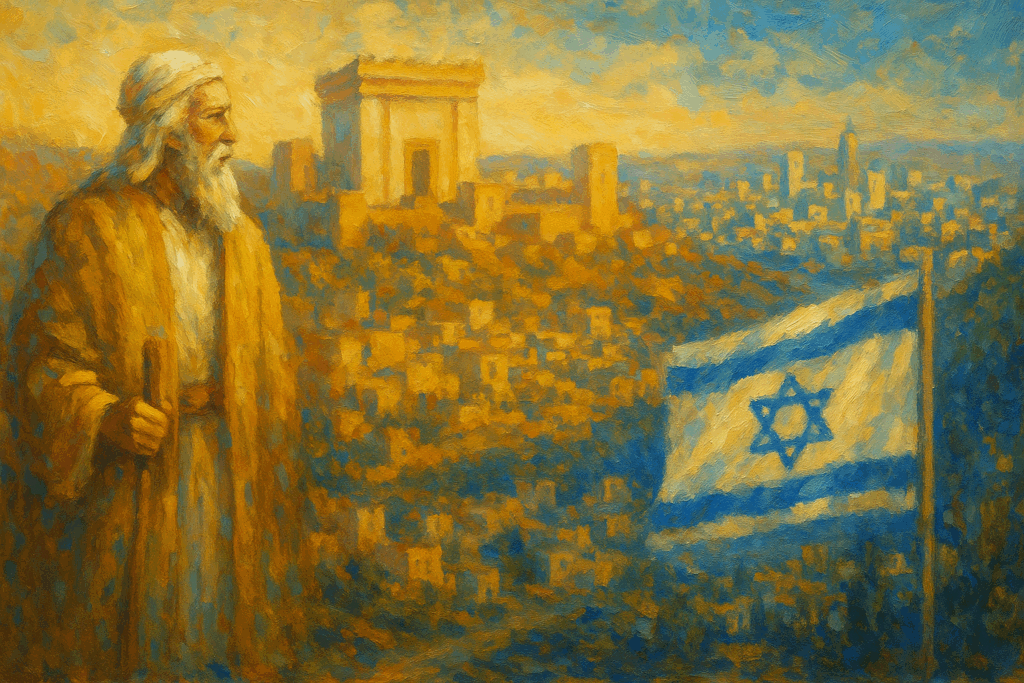
The story of the Jewish people — and of Israel — is not just about land, wars, elections, or borders. It’s the story of how “we” keeps getting rebuilt.
We began as a family around a patriarch’s fire. We became tribes on shared land bound by law. We lost that land — twice — and reinvented ourselves across continents as a portable nation held together by memory and Torah. We returned to the land as a modern state, forced ourselves into one people through shared danger, and then slowly fractured again into competing internal tribes: religious vs. secular, Ashkenazi vs. Mizrahi, settlers vs. Tel Aviv, Haredi vs. military, Jewish vs. Arab citizens.
On October 7, 2023, Jews in Israel watched 1,200 people murdered and hundreds kidnapped in a single day — the deadliest day for Jews since the Holocaust. For a moment, Israelis remembered the old “we”: we defend each other, no matter what. But the rage that followed — especially toward a government seen by many as having failed in its most basic duty — also exposed how fragile that “we” had already become.
We are now living in a narrow, volatile strip of land, facing enemies who are explicit about wanting us gone, and partners who increasingly want to dictate our post-war arrangements in Gaza, including multinational stabilization plans and formal recognition of a Palestinian state. We are being told, by events, not by theory: if we cannot hold ourselves together internally, we will not be able to hold anything.
The question in front of us in 2025 is not just “Can Israel survive?” Israel remains militarily formidable. The question is, “Can we stay one society while we survive?” Because if we fail at that, everything else follows.
Below is how we got here — and why this moment is more than just another crisis.
Abraham’s tent: Survival starts with “me and my family”
Jewish history opens with individuals and households, not with a state. Abraham, Isaac, Jacob — these are not prime ministers. They’re patriarchs. The social unit is the family. The driving instinct is survival and continuity: protect my people, my flocks, my line.
In that early mode, morality is mostly local. You owe loyalty to kin. You negotiate alliances. You endure famine. You defend your own. There is a promise of land, but there is no state, no army, no court system. It’s not yet “Am Yisrael.” It’s “my house will live.”
That matters, because it gives us our first reflex: when danger comes, pull tight and protect your own at any cost.
You still see that reflex today. When people here say “my community first,” they’re not inventing something new. They’re going all the way back to Genesis.
From families to tribes: “We” becomes national — and moral
Then something huge happens in our story.
The descendants of those patriarchal families don’t just multiply. They turn into tribes that begin to see themselves as one people — Israel — under a shared covenant.
This is more than biology. It’s law.
At Sinai, the Torah does something almost no other ancient text does: it doesn’t just tell you how to pray. It tells you how to build a society. Courts, testimony, restitution, protections for widows and orphans, restraints on kings, debt release cycles, mandatory care for the poor, and the relentless refrain: “You were strangers in Egypt, so do not oppress the stranger.”
This is the first version of a Jewish civic model:
- We are a people on land,
- We live under shared law,
- And our power is morally limited.
That last part is crucial. The Torah is not just “this land is yours.” It’s also “you may not become Pharaoh.” Jewishness is framed not only as identity, but as obligation. That’s the seed of a radical idea: being Jewish as a people is supposed to mean ruling justly.
And then we lose it.
Disaster: We lose sovereignty — and we lose each other
Twice.
The First Temple is destroyed by Babylon. The Second Temple is destroyed by Rome. Both times, we’re not just conquered physically. We’re broken socially. Our internal factions and failures matter. Jewish memory is merciless on this point. We don’t just blame Babylon and Rome. We blame ourselves: corruption, injustice, civil war.
Out of that trauma comes a terrifying lesson: when we turn on each other and abandon core obligations, we don’t just “have a crisis.” We get expelled from history.
After 70 CE, we enter nearly 2,000 years without sovereignty.
Now the question becomes: How do you stay a people when you no longer have land, army, king, border, vote?
That question defines Jewish identity for most of our history.
The Diaspora: We invent “portable peoplehood”
This is one of the most improbable achievements in human civilization.
After losing the land, the Jews do not disappear. We don’t dissolve into everyone else. Instead, we build what you could call virtual kinship — a nation that moves.
Wherever we end up (Babylonia, Morocco, Poland, Yemen), we keep the same calendar, pray from the same texts, keep the same food laws, marry through the same rituals, study the same Torah and later Talmud, and say the same line at the end of the Seder: “Next year in Jerusalem.”
That line is not nostalgia. It’s a GPS coordinate.
This is how a global people is sustained without a country:
- Law replaces territory.
- Shared memory replaces border control.
- Charity networks and rabbinic courts replace state services.
- “We are responsible for each other” becomes not poetry, but logistics.
But note the emotional cost. When you live at the mercy of others — subject to expulsions, pogroms, ghettos, quotas, professional bans, forced conversions — you learn a harsh rule: no one will save you except your own. The “we” tightens again, out of necessity. We become experts in mutual protection because we have to be.
That survival reflex — “only we will defend us” — will later become Zionism’s core.
Zionism: Turning prayer into policy
By the late 1800s, the situation for Jews in Europe is untenable. Violent antisemitism spikes in Eastern Europe and Russia; “enlightenment” doesn’t end hatred in Western Europe. The Dreyfus Affair in France drives home the point: even “modern,” “civilized,” “integrated” Europe can turn on you.
Theodor Herzl comes to a brutal conclusion in 1896: this won’t stop. Jews need a state of their own, with the legitimacy of great powers behind it.
That is the birth of political Zionism. And it is revolutionary for two reasons:
- It says Jews are not just a faith community. We are a people with a right to sovereignty.
- It says safety must come from Jewish power, not from begging for tolerance.
In 1917, the British Empire issues the Balfour Declaration, saying it “views with favour the establishment in Palestine of a national home for the Jewish people,” while also saying the existing non-Jewish communities’ rights must be protected.
That sentence, vague as it is, matters. It’s the first time a major power says out loud: the Jews are a nation, and that nation belongs — in some form — in Palestine. It also bakes in a second obligation: you don’t get to pretend nobody else lives there. That moral/political duality is still with us.
Between 1917 and 1948, under the British Mandate, the Jewish Yishuv in Palestine behaves like a state-in-waiting. Hebrew is revived as a living language. Defense organizations form. Farms, schools, unions, courts, trade structures, and eventually quasi-government structures emerge.
We are no longer just studying how to be a people. We’re rehearsing being one.
1948: The State of Israel — national kinship made real
In 1948, Israel declares independence. The surrounding Arab states invade. Israel survives. Hundreds of thousands of Palestinian Arabs flee or are expelled in what Palestinians call the Nakba. Hundreds of thousands of Jews from Arab and Muslim countries flee or are expelled and arrive in Israel. These displacements shape everything that follows.
Inside Israel, Phase One is simple and ruthless: survive.
The mindset of the first decades (roughly 1948–1967) is:
- Everyone fights.
- Everyone sacrifices.
- Everyone becomes Israeli.
The state pushes a melting-pot identity. Hebrew is non-negotiable. The army is universal (for Jewish and Druze men, and Jewish women). You can be from Poland or Morocco, Yemen or Iraq — you’re now part of one “we.” If you live here, you defend here.
This is the closest we’ve come in modern times to actual Jewish national kinship: not just “we’re all Jews,” but “we share one fate, in one place, with one army.”
But there’s a crack in the miracle.
That melting pot was not egalitarian. Ashkenazi elites largely ran the system. Mizrahi and Sephardi Jews were often shoved into poor peripheral “development towns” with limited upward paths and told to shed their culture fast. Palestinian Arabs who remained as citizens were put under military rule and kept politically and economically marginalized in a state that defines itself as Jewish.
So yes, there was a national “we.” But it wasn’t equally shared in dignity. And that debt comes due later.
1967 and after: We split into tribes again
In 1967, Israel wins the Six-Day War, capturing the West Bank (including East Jerusalem), Gaza, Sinai, and the Golan Heights. The shock of that victory cannot be overstated. Overnight, Israel shifts from “on the brink of annihilation” to “regional military power.”
That victory also lights a fuse.
Parts of the religious Zionist world see the capture of biblical Judea and Samaria (the West Bank) as divine confirmation. Settling that land becomes not just strategy, but a mitzvah. Holding the land becomes sacred.
Others see something else: permanent military control over millions of Palestinians with no citizenship and no vote. For them, this is a moral and democratic time bomb. They ask: How can we, a people who know the heart of the stranger, become the occupier of that stranger?
At the same time, inside Israel:
- Mizrahi/Sephardi Jews who felt disrespected by the old Ashkenazi socialist elite begin shifting toward parties that speak to their story and pride.
- Haredi (ultra-Orthodox) communities grow, negotiate army exemptions, and demand autonomy in education and lifestyle.
- Palestinian Arab citizens of Israel push harder for equal standing and recognition.
- Secular Israelis, especially in Tel Aviv and the coastal cities, start imagining a “normal country” — high-tech, Mediterranean cafes, global integration, less messianic talk, more start-ups.
By the 1990s and 2000s, after Oslo, after Rabin’s assassination by a Jew, after the suicide bombings of the Second Intifada, after rockets, after walls and checkpoints and targeted killings, Israel is no longer one fused nation. It is a federation of tribes sharing a flag.
And they don’t fully trust each other anymore.
2023–2025: The crisis of trust
This internal mistrust, which has been building for decades, erupted in the 2023 judicial overhaul fight.
The Netanyahu government moved to weaken the Supreme Court’s ability to review government decisions and to give politicians more control over judicial appointments. Hundreds of thousands of Israelis protested in the streets for months, waving Israeli flags and calling it an attack on democracy.
Air Force reservists — including elite pilots — threatened not to serve. Tech CEOs warned of capital flight. Former security chiefs said, in public, that the social contract was being broken.
Let’s be very clear about what that moment was: it was Israelis saying, out loud, “I don’t just fear Iran or Hamas. I fear what you — my fellow Israelis — will do to me with the machinery of the state if you get unchecked power.”
That is the loudest alarm bell a society can ring.
Then came October 7, 2023.
Hamas fighters crossed into Israel from Gaza and massacred civilians in border communities and at a music festival, killing around 1,200 people and kidnapping roughly 250 into Gaza. It was the worst mass killing of Jews in a single day since the Holocaust.
In that moment, all the infighting went silent. The reflex from the Abraham stage — “protect our own at any cost” — slammed back to the surface. The country mobilized. Israelis demanded two things: destroy Hamas’ capacity to do that again, and bring the hostages home.
But unity bought by horror is not the same thing as trust.
Families of the murdered and kidnapped turned their fury inward at the government. How was this allowed to happen? Why weren’t we protected? Why is no one resigning? In 1973, after the Yom Kippur War surprise attack, Golda Meir eventually stepped down. In 2023–2025, Benjamin Netanyahu did not. That refusal to accept responsibility is now part of Israel’s internal legitimacy crisis.
Meanwhile, Israel’s response in Gaza has drawn extraordinary international outrage over the scale of destruction and humanitarian catastrophe. The U.S. and European partners are now talking — not hypothetically, but operationally — about multinational stabilization forces, security arrangements in Gaza that include non-Israeli actors, and accelerating formal recognition of a Palestinian state.
That is something new in Zionist history. The founding Zionist instinct was: “We defend ourselves by ourselves.” Now Israel is being pushed, in real time, toward a scenario where the “day after” in Gaza is managed alongside outside powers and in the direction of Palestinian sovereignty.
So we are in a moment where:
- The external message is: “You are strong, but you will not act alone forever.”
- The internal message is: “I don’t trust you with my future.”
- The emotional message is: “Never again just happened again, and we will never forgive that.”
That combination is not stable.
The warning
Let’s not be poetic here.
Right now, nearly half of the world’s Jews depend on Israel, live in Israel, or emotionally anchor their safety in Israel. We are living in a small, crowded, heavily armed, globally scrutinized, permanently threatened strip of land. There is no spare Israel. There is no alternate refuge. There is no Plan B.
We have moved, across history, from:
- A single tent (protect my family),
- To tribes on land (protect our people under law),
- To exile (protect each other wherever we are, because no one else will),
- To sovereignty (protect the state that protects the Jews),
- To fragmentation (protect my sector from your sector),
- To today’s moment (protect the future of all of us, or we risk losing the thing that protects any of us).
Here’s the uncomfortable truth: the old unifying forces — shared trauma, shared army, shared Hebrew, shared sense of “the world hates us” — are no longer enough to guarantee cohesion. Trauma unifies briefly, then curdles into accusation. The army is no longer universally shared (see Haredi exemptions, Palestinian citizens’ fraught relationship to service, reservists threatening refusal). Hebrew doesn’t mean the same story anymore. Even “the world hates us” is now argued internally: some Israelis say global pressure is antisemitic; others say it’s the price of policies we chose.
We are past the point where “we’re all in this together” can just be stated and expected to function. It has to be rebuilt.
That means:
- A definition of “Jewish state” that isn’t code for “my tribe wins.”
- A security doctrine that is absolutely uncompromising about Jewish safety, after October 7, but that still accepts that we are accountable for how we use that power.
- Institutions — courts, police, media, military command — that are trusted across tribes, not just by whoever currently holds the coalition.
- A social and economic contract that convinces people in development towns, in Arab towns, in Haredi neighborhoods, in the periphery, that they are not disposable citizens of someone else’s country.
This is not moral window dressing. This is survival math.
If we fail to create a renewed shared “we,” we risk replaying the oldest Jewish nightmare: internal fracture, moral rot, delegitimization, and pressure from outside powers that do not have our survival at the top of their list. We have seen that movie. We know how it ends.
And if we get it right?
Then Israel stops being only the place where Jews can run. It becomes, again, what Torah actually imagines: a society where power and obligation sit in the same chair. A people on its land, under law — not just law of force, but law of responsibility.
That’s the real question of 2025. Not just “What happens in Gaza?” Not just “What happens to judicial reform?” Not even “What happens to Netanyahu?”
The real question is: Can 9 million Israelis — and 15 million Jews worldwide who now orbit this place — still mean “we,” and mean it in time?