
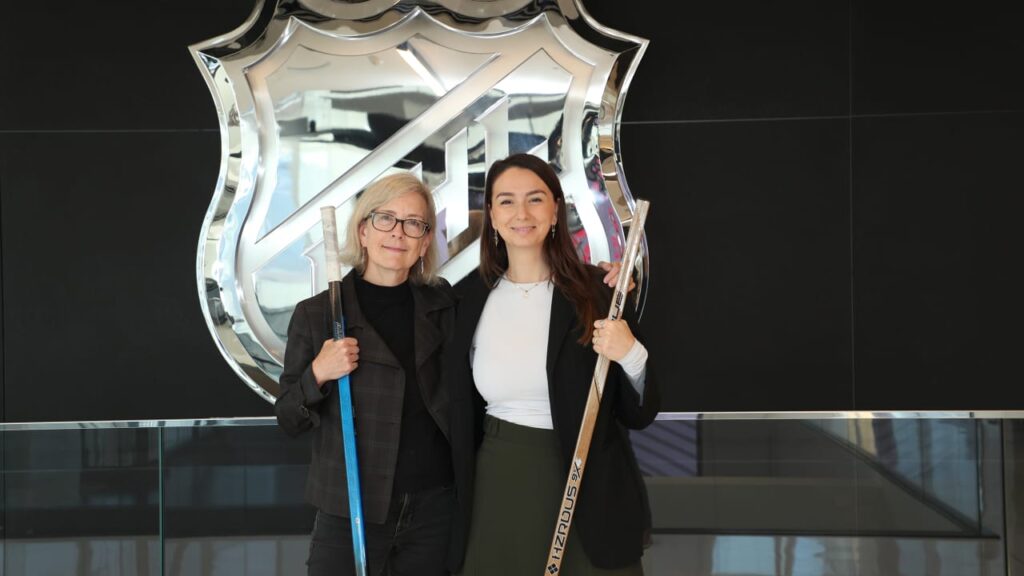
There’s a limited hockey presence in Kosovo, so Uka had to study the game and research her mentor, Susan Cohig. Uka is a certified trainer in human rights education through the Council of Europe and has worked with educators, sports professionals and youth leaders in Kosovo and throughout Europe. Cohig, NHL executive vice president of club business affairs, is in her 29th year at the League. She was named the 2020 Woman of the Year by WISE (Women in Sports & Entertainment), and early in her career was part of the management team responsible for the relocation of the Quebec Nordiques to Denver and becoming the Colorado Avalanche in 1995.
The connection between Uka and Cohig and the NHL mentoring team was instantaneous.
“When we met initially, met Bardha for our first virtual meeting, we thought, ‘This woman is going to be amazing,’ and we couldn’t wait to meet her in person and to collaborate on the things that she wants to be able to do and go back to Kosovo and accomplish,” Cohig said. “To be identified and considered for the program, and then ultimately selected, every delegate is exceptional.”
Uka’s childhood was shaped by a nation rebuilding after the 16-month Kosovo War (1998-99), following a long history of occupation by Serbia, and culminating in Kosovo’s declaration of independence Feb. 17, 2008. Ambitions of a career in swimming were dissolved when she was hospitalized at the age of 12 because of food poisoning while in a professional camp, bullied by her coach and sexually objectified by a physical education teacher.
She left the sport but refused to quit. A fire was ignited. There was no way, literally and metaphorically, any child in Kosovo would, as she put it, swim with rats or frogs.
It was time for her childlike voice to roar like a lion.
“If I had to drop out of swimming because the circumstances were like that back at the time, it doesn’t mean that I have to keep my mouth shut and just accept the reality as it is,” Uka said. “When I realized that I have a voice, I then also realized that being in swimming but not having a voice to scream that this is a negative experience … I do want to fix the situation. This is not just a job that I do 8-4. This is something that I actually believe and it’s something that has touched me personally.”
Personal trauma became a rallying cry, with Uka using her voice. Her country is getting a platform to be recognized for its youthful spirit.
She’s bringing that narrative home.
“We don’t want people to just see us as a post-war country,” she said. “We want people to come and visit us for the sport, for the (five) Olympic medals, for the great food that we have and as part of the culture.”