
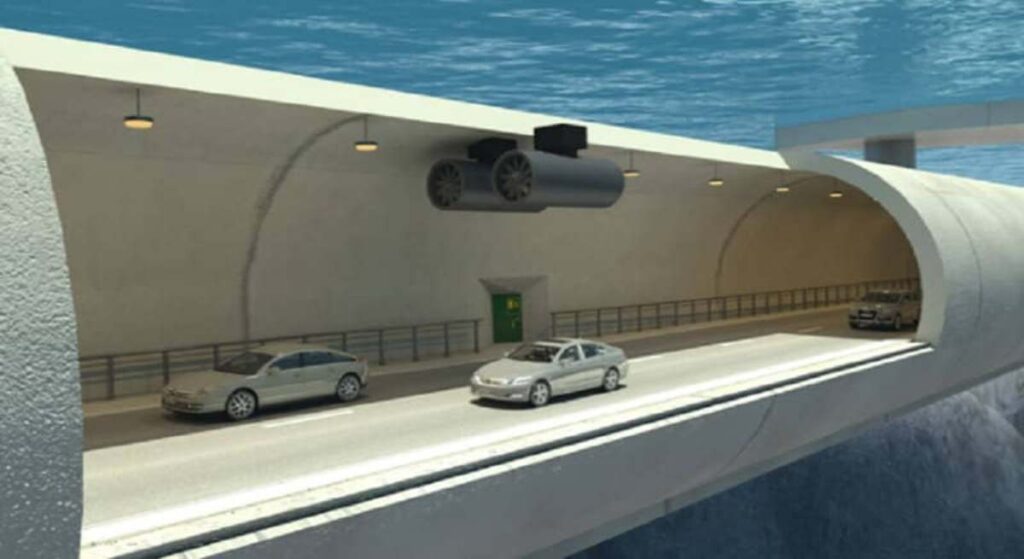
Marrakech – A Spanish government study has concluded that the construction of a tunnel connecting Morocco and Spain is technically feasible.
According to Spanish news outlet Vozpópuli, the ambitious project would take approximately a decade to complete and require an investment of around €8.5 billion for the Spanish portion alone.
The study was conducted by German company Herrenknecht, the world leader in tunnel boring machines, at the request of the Spanish government’s company SECEGSA (Spanish Company for Studies on Fixed Communication across the Gibraltar Strait).
The report, which the Spanish government has had since June, confirms that despite extreme complexity, current technology is capable of executing the project.
According to Vozpópuli, since receiving the study, the government has begun to “land” it internally across different departments, with a view to establishing the foundations for a tender beyond June 2026 – the deadline set to update the 2007 preliminary project.
The Spanish and Moroccan sides have reportedly committed to making a final decision in 2027 regarding the tender for a first exploratory tunnel, according to the consulted sources.
The tunnel would connect Europe and Africa through a railway link spanning approximately 65 kilometers in total, with nearly 40 kilometers of that distance in Spanish territory.
The Spanish terminal would be located near Vejer de la Frontera, with integration into the General Interest Railway Network (RFIG) via a new connection with the Cádiz-Sevilla line.
Read also: Morocco-Spain Tunnel: Bridging Continents for Euro-African Integration
The most challenging aspect of the project involves tunneling beneath the Camarinal Threshold, an area with extremely difficult geological conditions. Herrenknecht’s findings confirm that the Spanish-Moroccan project can be developed within current technical and engineering margins, with notable improvements compared to the beginning of the century.
While they warn of its complexity and the enormous logistical and economic challenges its execution will entail, Herrenknecht’s assessment indicates that these challenges can nonetheless be overcome with existing engineering capabilities.
In this context, a recent trip by a delegation from SECEGSA and its Moroccan counterpart, Société Nationale d’Études du Détroit (SNED), to Norway took place to seek advice on a similar project in scale, the Rogfast, currently the longest and deepest tunnel under construction in the world.
Simultaneously, seismicity and seabed studies are being conducted with the assistance of the United States Geological Survey.
The project now enters a decisive implementation phase
Spanish authorities have already begun mapping out a provisional timeline for the project. The first phase would involve building a reconnaissance gallery or exploratory tunnel, which would take between six and nine years to complete.
This initial tunnel would establish the foundation for the final design, which would follow a twin-tube approach.
The most optimistic projections place the first material advances around 2030, coinciding with the World Cup that Spain and Morocco will jointly host.
However, sources close to the project cited by Iberian media indicate that 2035-2040 would be a more realistic timeframe for significant milestones, given the technical difficulties and magnitude of the investment required.
The Spanish Ministry of Transport has also commissioned the public consulting firm Ineco to define a profitability model for the future corridor.
This study is exploring concession formulas similar to those used for the Eurotunnel or the Figueras-Perpignan high-speed line, while analyzing potential passenger and freight demand, functional route alternatives, and terminal locations that could be situated in Algeciras or Tarifa.
Additional revenue sources being considered include railway fees, logistics services, electrical interconnection, and fiber optic installation.
Proponents of the project argue that the link would offer a historic opportunity to consolidate the Iberian Peninsula as a focal point between Europe and Africa, with a prominent role in the Euro-Mediterranean transport network and the continent’s energy interconnection.
The confirmation of technical viability coincides with the administrative momentum that Pedro Sánchez’s government has given to the project in recent years, with the support of European Next Generation funds.
Historical ambitions are finally turning into action
The tunnel project has a long history, with origins dating back to the 19th century, although the first official agreement between Spain and Morocco was signed in 1979. Since then, approximately fifty joint committees have been held between both governments.
Spain has spent decades investing public funds in the initiative, with allocations that once reached millions, though subsidies began to decrease during the past decade, with total grants in 2017 amounting to just €50,000.
Since 2021, the project has been included among initiatives eligible for funding from European Reconstruction Funds following the pandemic, allowing for its revival with allocations exceeding €2 million.
Since 2023, following Sánchez’s change of position regarding Western Sahara, authorities from Spain and Morocco have committed to accelerating the project at an unprecedented pace, according to SECEGSA officials.
The company, whose sole purpose is the development of the tunnel between Spain and Morocco, is currently headed by General José Luis Goberna Caride and reports to the Ministry of Transport, led by Óscar Puente.