
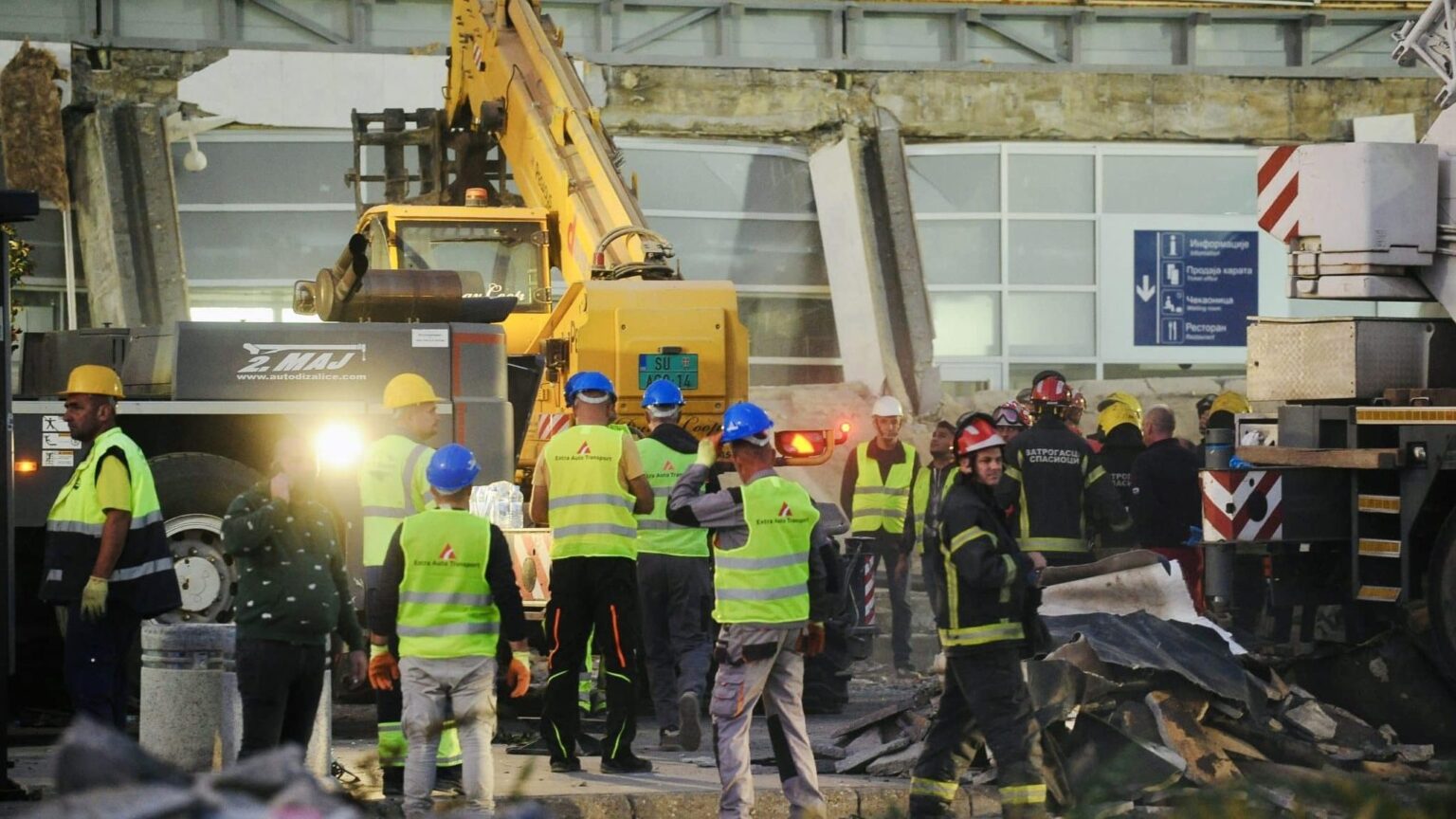
The Novi Sad station reconstruction was part of a project to revitalise the Serbia-Hungary railway line. The main contractors were Chinese companies, while domestic firms acted as subcontractors, with international firms as supervisors.
Currently three cases are ongoing regarding the disaster itself and the railway line renovation project. No Chinese citizens are under investigation, only Serbians. None of these three cases is ready for trial yet, and some of them have been delayed by legal complications.
In the first case, Serbia’s Minister of Construction, Transport and Infrastructure at the time of the disaster, Goran Vesic, was originally charged by prosecutors in December 2024 alongside 12 other people including top officials from Serbian Railways Infrastructure, the state railtrack company.
Vesic and the others are accused of endangering public safety in connection with the partial collapse of the canopy, allowing the station to be used although the works were not complete and the licence for its use had not been issued, and failure to properly maintain the building.
In addition, Jelena Tanaskovic, who was acting director of Serbian Railways Infrastructure at the time, Anita Dimovski, then acting assistant construction minister, and Nebojsa Surlan, director of Serbian Railways Infrastructure when Novi Sad station was being rebuilt, were charged. Others charged include representatives of construction design companies, construction contractors, and technical and expert supervisors.
The Higher Court in Novi Sad initially rejected the indictment and sent it back for more investigation. Vesic and the others were then charged again in September this year. None of the suspects is being held in custody and the new indictment has yet to be confirmed by the court.
The second case was instigated in Belgrade by the Special Department for the Suppression of Corruption of the Higher Prosecution Office. Three people were named in this indictment filed in March 2025 – an investments manager at Serbian Railways Infrastructure, the head of a technical review commission at a company that was engaged as a subcontractor by the Chinese contractors, and a member of the commission.
All three were accused of corruption. The prosecution said in a statement that there was “justified suspicion that their failures contributed to and were causally related to the [Novi Sad] tragedy”. It said that if they had been working conscientiously to inspect the work on the concrete canopy, “they would have been able to visually observe signs of breakage and increased aberration in the canopy in the days preceding its collapse”.
The indictment was confirmed by the Higher Court, but the Court of Appeal cancelled this decision and returned the indictment to the prosecution in July 2025, saying that it wasn’t proven that the indictment was actually filed by the prosecutor’s office in charge of the Novi Sad case.
Bojan Papic, the defence lawyer for one of the accused, Milutin Savovic, the head of the technical review commission, claims the purpose of the accusation against his client was to protect state officials.
“A misconception has been created amongst the public that he [Savovic] was the one who made the decision to put the railway station into operation in Novi Sad, which is completely incorrect, and which was supposed to lead to the exculpation of the high-ranking state officials who really made it possible to put the railway station into operation,” said Papic. “The only goal of initiating proceedings against Savovic is to leave state officials free of accountability.”
In the third case, police in August arrested former trade minister Tomislav Momirovic, who was construction minister when the station was being revamped. His arrest is part of an investigation handled by Serbia’s Special Prosecution for Organised Crime into the financial aspects of the railway line upgrade project. Ten other people were arrested alongside Momirovic.
The Special Prosecution for Organised Crime said the arrests were “the result of the work of the Task Force for the Investigation of Financial Flows Related to the Project ‘Modernisation and Reconstruction of the Hungarian-Serbian Railway Line on the Route Novi Sad-Subotica-State Border (Kelebija)’”. Only minor details about the work of this task force have been made public so far.
Former construction minister Vesic, his former assistant Dimoski and former Serbian Railways Infrastructure official Surlan are again accused in this third case too.
Police also arrested Nikola Trivic, director and co-owner of a company called Starting, one of the main subcontractors during the renovation of the station, and Sinisa Jokic and Veljko Novakovic, from the Institute for the Protection of Cultural Monuments of the City of Novi Sad.
Vesic, who was also a top official with the ruling Serbian Progressive Party, has been undergoing medical treatment since the day before the arrests in the third case. He is due to be questioned by prosecutors for the first time in November.
The Special Prosecution for Organised Crime declined to send BIRN documents regarding the investigation, claiming that “the interests of continuing the proceedings significantly outweigh the interest in accessing information of public importance”.
BIRN also requested records of the initial hearings for all the suspects. This request was rejected by the Special Prosecution because one of the suspects, former minister Vesic, has not yet been interviewed.
The Higher Prosecution Office in Novi Sad also refused to answer BIRN’s request for the initial hearing records, giving a similar explanation that the process is ongoing, so that “at this moment, giving the requested information would lead to the formation of certain prejudices among the public, which would have an impact on the integrity and efficiency of the procedure”.
The Higher Courts in Belgrade and Novi Sad did not respond to BIRN’s requests for comment by the time of publication.
Goran P. Ilic, professor of Criminal Procedural Law at Belgrade University’s Faculty of Law, said that expert assessments related to the construction work at the station, and what might have gone wrong with the canopy that collapsed, have mostly been completed by the prosecution.
However, Ilic cautioned that the financial costs of the reconstruction, which might indicate corrupt activity within the project, have yet to be properly explained. He cited “a significant increase in the price of the undertaken works in relation to the originally determined costs and the inclusion of a large number of subcontractors in the canopy reconstruction project”.
“All of this gave grounds for suspicion of corruption, and this required the hiring of experts who would examine the justification for the increase in costs and investigate financial flows,” he added.
One of the first demands of the student-led protests was the publication of all the documentation regarding the renovation of the train station. The authorities insist they have done this. However, Ilic remains sceptical.
“We should not forget that, under public pressure, documentation was published several times that we [were told] was complete, only to then see another document appear that shed new light on the whole case,” he said, intimating that some important documentation may still be unpublished.
Ilic noted that over-long legal processes are a major problem in contemporary criminal justice systems. But he said that in the case of the Novi Sad disaster, what has happened with the prosecution shows that Serbia has its own specific problem. “The collapse of the canopy reminded us that the judiciary is overshadowed by politics,” he said.
Conspiracy theories