Inadvertent geoengineering experiment may be responsible for ‘80% of the measured increase in planetary heat uptake since 2020’
https://www.nature.com/articles/s43247-024-01442-3

Inadvertent geoengineering experiment may be responsible for ‘80% of the measured increase in planetary heat uptake since 2020’
https://www.nature.com/articles/s43247-024-01442-3
1 Comment
### Abrupt Reduction in Shipping Emissions Leads to Substantial Radiative Warming
In 2020, the International Maritime Organization (IMO) implemented a significant regulation, known as IMO2020, which drastically reduced the sulfur content in shipping fuel by about 80%. This regulation aimed to improve public health by decreasing sulfur dioxide (SO2) emissions from international shipping. However, a recent study published in *Communications Earth & Environment* reveals that this abrupt reduction in emissions has inadvertently created a geoengineering termination shock, leading to substantial radiative warming.
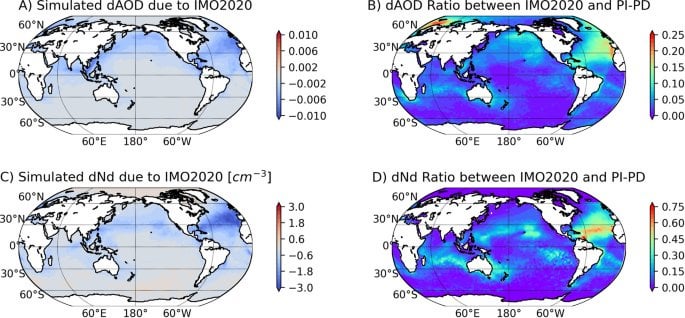
Researchers from University College London and the International Institute for Sustainable Development conducted an in-depth analysis using satellite observations and chemical transport models to quantify the impact of IMO2020 on maritime aerosol concentrations. They discovered that the reduction in aerosols, which had previously been reflecting sunlight and cooling the atmosphere, resulted in a radiative forcing of +0.2 W/m² averaged over the global ocean. This level of radiative forcing is equivalent to 80% of the measured increase in planetary heat uptake since 2020.
The study found that the reduction in aerosols led to fewer cloud droplets, making clouds less reflective—a phenomenon known as cloud dimming. This effect was particularly pronounced in regions with heavy shipping traffic, such as the North Atlantic, where radiative forcing peaked at 1.4 W/m². The researchers estimate that this could double the global warming rate in the 2020s compared to the rate since 1980, potentially increasing the global mean temperature by approximately 0.16 K over seven years.
The reduction in aerosols also created a strong hemispheric contrast in radiative forcing. The northern hemisphere, with its higher baseline of ship emissions, experienced a more significant warming effect compared to the southern hemisphere. This differential impact has important implications for precipitation patterns and interhemispheric contrast in absorbed solar radiation.
To validate their findings, the researchers compared their model’s predictions with satellite observations, noting a strong alignment in specific regions like the South Atlantic. These consistent results underscore the significant warming effect caused by the reduced aerosol emissions from shipping.
The study highlights the complex trade-offs involved in environmental policy-making. While reducing sulfur emissions improves air quality and public health, it also accelerates global warming by decreasing the cooling effect of aerosols. This situation serves as a real-world example of the challenges associated with geoengineering and climate intervention methods, such as marine cloud brightening (MCB), which aim to enhance the reflectivity of clouds to temporarily cool the climate.
In conclusion, the IMO2020 regulation, while beneficial for air quality, has inadvertently led to a substantial increase in radiative warming.
The researchers conclude:
> Our result suggests marine cloud brightening may be a viable geoengineering method in temporarily cooling the climate that has its unique challenges due to inherent spatiotemporal heterogeneity.