
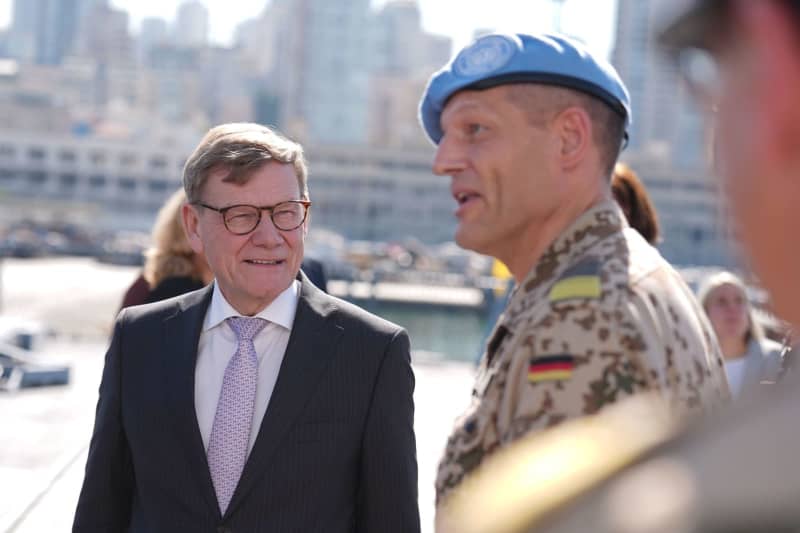
Germany plans to push for a follow-up mission in Lebanese waters after UN-led peacekeeping efforts expire in 2026, Foreign Minister Johann Wadephul said during a visit to the country on Friday.
“Stability in this region is a prerequisite for security and stability in Europe and in the Federal Republic of Germany,” Wadephul said as he visited a German frigate that monitors the waters off Lebanon as part of the United Nations Interim Force in Lebanon (UNIFIL).
One of the oldest UN observer missions, UNIFIL was established in 1978 to monitor the withdrawal of Israeli troops from Lebanon.
Its mandate is set to expire next year, and Wadephul said Berlin was already pondering possible further commitments.
“New refugee crises always originate in this region, which is why this is a worthwhile commitment on the part of our soldiers,” the minister said.
After holding talks with Foreign Minister Youssef Rajji, President Joseph Aoun and Prime Minister Nawaf Salam, Wadephul said the Lebanese government welcomes continued international involvement.
Talks are needed on how the EU and Germany could contribute, he added.
Some 200 German soldiers are currently stationed in Lebanon as part of UNIFIL.
Wadephul also called on Israel and the Iranian-backed Hezbollah militia to observe the ceasefire in place for nearly a year.
He urged the Shiite group to demilitarize, a step he said was vital for permanent peace in the region.
Wadephul said he had encouraged the Lebanese government to “move forward now and ensure that there is a credible, transparent and rapid process of disarming Hezbollah.”
The militia began attacking Israel following the start of the Gaza war, prompting retaliatory airstrikes and an Israeli ground invasion.
A ceasefire between Israel and Hezbollah has been in effect for nearly a year, but both sides accuse each other of violations.
Hezbollah was severely weakened by the recent war with Israel and is under pressure both domestically and internationally to surrender its weapons by the end of the year, a plan which the militia never agreed to.
Disarming Hezbollah is a sensitive issue for the government, as the militia still enjoys widespread popular support, especially among Shiites.
But Wadephul also stressed the importance for Israel “to withdraw from southern Lebanon and respect Lebanon’s sovereignty” in order for the ceasefire to prevail.
While he conceded that Israel has an interest in protecting its northern border against Hezbollah, he said the country must also give the Lebanese state and its army the opportunity to regain control of the south of the country.
“This is the only way to achieve lasting peace.”
Germany’s foreign minister is currently on a tour of the Middle East to shore up support for the US-led peace plan for Gaza. Following his visit to Lebanon, he is set to travel on to Bahrain later on Friday, where he is set to dine with Crown Prince Salman bin Hamad Al Khalifa, the Gulf state’s prime minister.
On Saturday, Wadephul plans to address a regional security conference hosted by the kingdom.
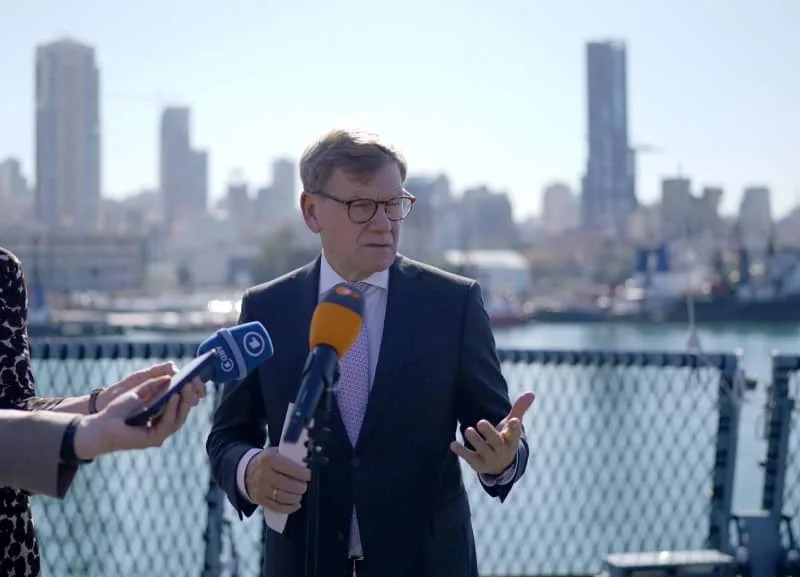
German Foreign Minister Johann Wadephul visits the German frigate “Sachsen-Anhalt” and answers questions from journalists. The crew members of the “Sachsen-Anhalt” are to monitor the sea area off the Lebanese coast and train the Lebanese navy as part of the UN observer mission Unifil. Marcus Brandt/dpa