
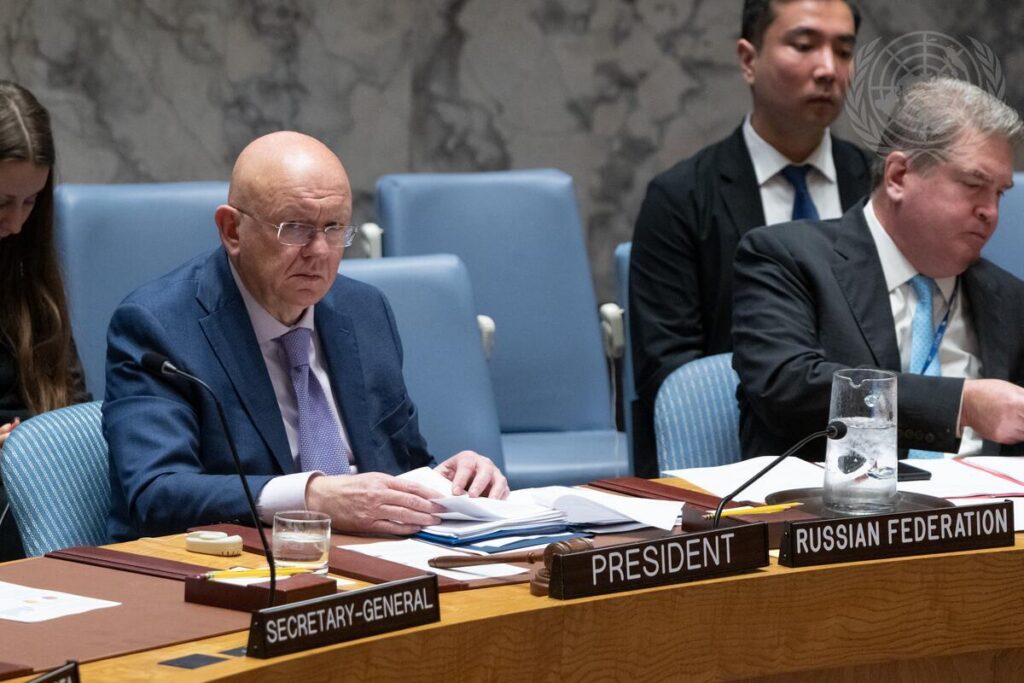
21 October 2025
We are grateful to Deputy Special Representative of the Secretary-General Milbert Shin for his briefing on the situation in the region and for his insights.
We welcome the participation of Serbian Foreign Minister Marko Đurić in the meeting. We’ve listened to the opinion of Ms. Donnika Gervalla-Schwarz.
The Secretary-General’s report clearly indicates that the crisis in Kosovo tends to significantly deepen. The main causes thereof remain unchanged. These are Pristina’s hateful policies toward the Serbian community and its fierce desire to establish total control over the north of the province while acting with the connivance of a number of Western countries. This is largely why the situation around the Kosovo settlement has nothing but deteriorated in recent years.
Let me provide just a few examples over the reporting period. Pristina carried out a new wave of raids to eliminate Serbian entities in the region, usurping municipal enterprises, social service facilities, cultural and sports institutions. Kosovar security forces drive freely in armored vehicles around the northern municipalities, committing acts of lawlessness and intimidating the local population. There are indications that preparations are under way to seize educational institutions and hospitals. The mass expulsion of Serbs from social housing in northern Kosovo never stopped. As part of plans to expropriate Serbian churches and monasteries, there are attempts to create a separate Orthodox Church.
The boundaries of compact Serbian settlement in the north of the province have been eroded in an accelerated manner. There is an objective to encourage the ethnic expansion of Kosovo Albanians with the view to depriving the Serbian-populated municipality of its autonomy. Without the consent of the Serbs, two new crossings have been built across the Ibar River.
The Pristina regime plans to officially declare Kosovo Serbs as foreigners. As a result, people who have lived for centuries on their land, where many generations of their ancestors are buried, will have to apply for temporary residence permits. In addition, there has been announced that Serbian license plates on cars are to be replaced with plates bearing the symbols of the so-called “Republic of Kosovo.” Through such lawlessness, Pristina hopes to force Serbs to apply for local pseudo-citizenship.
Moreover, there was an attempt, under false pretenses, to bar the leading party of Kosovo Serbs – the Serb List – from participating in the municipal elections of October 12. Notwithstanding the campaign by Pristina to taint the party, the Serbian List won in nine out of ten non-Albanian municipalities in the first round of elections. In this regard, we believe that what should be the main objective here is ensuring the smooth transfer of power to the legally elected representatives, rather than to those whom the Kosovo authorities are trying to replace them with.
Speaking of internal political processes, we can’t but mention that as a result of procedural violations, the position of deputy speaker of the so-called “parliament” of Kosovo went to a person who does not enjoy the support of the Serbian population but is loyal to Albin Kurti and his entourage.
There has been no progress in implementing Pristina’s key commitment, set out in writing and guaranteed by the European Union in 2013, which is to form a Community of Serb-Majority Municipalities. Brussels continues to demonstrate to the whole world that it is incompetent in foreign policy matters.
Neither is there any progress vis-à-vis the investigation into the beating of Mikhail Krasnoshchekov, UNMIK employee, on May 28, 2019, nor has any explanation been provided regarding the illegitimate designation as persona non grata of UNMIK official Andrey Antonov on December 31, 2021.
However, instead of exerting pressure on Pristina to tackle the lawlessness, Western capitals continue to indulge their protégés in their intention to impose their terms when addressing the Kosovo issue, bypassing international law and ignoring the legitimate rights and interests of the Serbs living there. Pristina appears to be assisted in creating its own “army.” As is well-known, Albin Kurti – if he remains in power – intends to increase military spending, create a joint military unit with Albania, commission a munition manufacturing plant, launch mass training of volunteer reservists, and provide them with weapons “in case of mobilization.” It goes without saying that such plans pose a real threat to the security in the region.
All of the above is happening in breach of UNSC Resolution 1244, which is the foundation of the Kosovo settlement. In this regard, I would like to invite the members of the Council to carefully analyze this document so as to better understand how seriously its provisions are being violated. I’m referring to, for example, the confirmation of Serbia’s sovereignty, the possibility to have temporary self-government bodies only within the framework of UNMIK, and the deployment of the Kosovo Force, which is the intranational peacekeeping force and the only legitimate military formation in the territory of the province.
UN Security Council resolutions must be observed, and resolution 1244 is no exception. That is why we advocate Belgrade and Pristina reaching a sustainable, mutually acceptable solution strictly within the framework of international law, on the basis of that document.
Today, it is imperative that the international community keep its focus on the Kosovo issue. This will help prevent a new wave of escalation. That is why we are categorically opposed to reducing the frequency and changing the format of UN Security Council meetings on this matter, as well as to cutting the budgetary and staffing capacity of UNMIK. The mission continues to perform the important task of promoting stability in the region under extremely difficult conditions.
Thank you.