
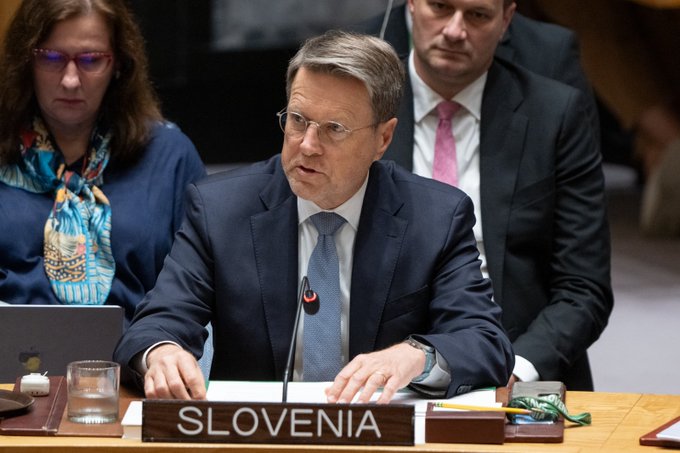
21 October 2025
Thank you Mr. President,
I thank Deputy SRSG Milbert Shin for his briefing and I welcome the Ministers to the Chamber.
Slovenia commends EULEX–EU Rule of Law Mission, KFOR, UNMIK, and the EU-facilitated Dialogue for their ongoing efforts to maintain stability, normalize relations and promote sustainable governance and regional cooperation in Kosovo.
I also want to express my appreciation to former SRSG Caroline Ziadeh for her work.
Colleagues,
There are many lessons learnt from the 26 years of existence of UNMIK in Kosovo. Lessons learned for our dealing with Kosovo as well as for other situations, like the one in Gaza.
UNMIK was established after the conflict in Kosovo ended.
Serbian forces and Serbian civilian administration withdrew from Kosovo. As the name suggests, UN Interim Administration in Kosovo, the Security Council authorized UNMIK to govern Kosovo in an interim period. UNMIK was vested all legislative and executive authority.
Responsibilities were shared between the UN and regional organizations.
Apart from overall responsibilities, UNMIK was in charge of civilian administration, including law and order. UNHCR took over the humanitarian part.
The Organization for Security and Cooperation in Europe worked on institution-building and democratization, the EU on economic development, civil society and normalization of relations.
NATO was the security provider and led the process of disarming KLA fighters.
Apologies for venturing into the history of UNMIK. Looking back at its early years, we can identify two key takeaways.
First, how much the situation in Kosovo has changed, has progressed in the past 26 years and that’s the need for UNMIK to adjust.
Second, how much UNMIK experience from the early years can be informative for reflection on the best model for future interim governance and security in Gaza.
On the first point, the progress of Kosovo.
The overall security situation in Kosovo remains stable. We welcome the recent formation of the Kosovo Assembly, which we see as an important step in resolving institutional uncertainty.
We are encouraged by the successful conduct of local elections with participation from Kosovo Serbs. This represents one of the crucial steps toward inclusive, citizen-oriented local governance necessary for long-term stability.
Equitable representation of non-majority communities in public institutions—especially judiciary, police, and local administration—is vital for building confidence in governance.
Equal access to services, justice, education, and social welfare is a cornerstone of stability.
The Association/Community of Serb-majority Municipalities should be established to promote inclusion and empowerment.
Accountability for violence, including the September 2023 Banjska attack, must be ensured with due process.
Our messages are consistent, and we continue to call for mutual acceptance, strategic patience, dialogue, restraint from unilateral actions, and harmful rhetoric.
What we need is a political will to fully and unconditionally implement the EU facilitated Brussels Agreements and its Ohrid Annex. Further spirit of compromise will be needed for the long-term normalization of relations.
Second, on UNMIK. Reflecting on the past should inform us about the future.
Many things have changed in Kosovo since the end of the conflict. Kosovo declared independence in 2008 and took control of its affairs with regular cycle of elections and functioning institutions. European led dialogue on normalization of relations between Priština and Belgrade continues since 2011. And Kosovo is now first security provider in Kosovo with EULEX and NATO as backup forces.
For many years now, UNMIK is not implementing its initial mandate.
We believe it may soon be the right moment for a thoughtful and realistic discussion — perhaps a strategic review — on the future of UNMIK’s engagement.
Colleagues,
As we learned from the SG’s report and today from the Deputy SRSG and the two Ministers, there are still many issues that Kosovo and its communities need to deal with to rebuild trust and dialogue, and to provide a better and reassuring future for many communities, especially the Serb one.
The European path of peace, reconciliation, and cooperation is the key to open those doors.
Thank you.