
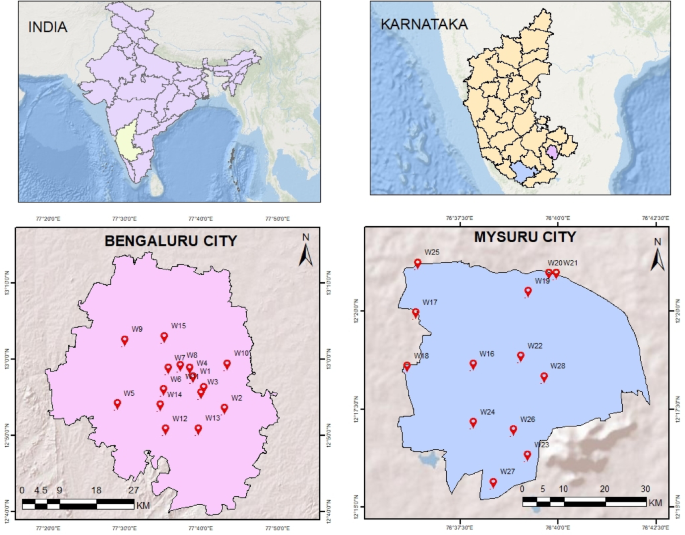
Table S6 illustrates the physicochemical characteristics of the water collected and analyzed in this study. Samples from Bengaluru have pH values between 6.8 and 7.8 ranging from acidic to slightly basic. Contrarily, all the samples drawn from Mysuru showed a pH in the range of 7.2–9.3. The turbidity of the water samples also had a variation with a range between 155 and 297 NTU in Bengaluru samples and between 109 and 269 NTU in Mysuru samples. The COD values also had a range between 100 and 600 mg/L for the Bengaluru samples and 100 and 900 mg/L for the samples in the Mysuru area. The chloride samples from Bengaluru were between 142.5 and 231.6 mg/L while the samples of Mysuru ranged between 22.7 and 133.3 mg/L. BOD levels ranged between 0.2 and 0.8 mg/L in Bengaluru samples and between 0.1 and 0.6 mg/L in Mysuru samples. Agar plate counts, on the contrary, showed a significantly higher microbial load, ranging from 70,000 to 90,000 CFU/mL in Bengaluru and from 60,000 to 90,000 CFU/mL in Mysuru.
Quantitative analysis of antibiotics
The HPLC analysis of antibiotic concentration in the water samples covering Bengaluru from sampling sites W1 to W15 and Mysuru from sampling sites W16 to W28 indicates a notable level of antibiotic pollution across diverse water bodies, such as groundwater, STPs, and surface water bodies. Table S7 shows the PNEC values of the targeted antibiotics while Table 1 depicts the detected Measured Environmental Concentration of antibiotics in water bodies. High levels of sulfamethoxazole were found in Bengaluru, specifically in sites (W6, W8, W10, W11; 3.34–20.19 µg/L) and STP effluents (W2, W3; ciprofloxacin 5.60–8.85 µg/L). Concerns with the safety of drinking water and groundwater were raised by the contamination found in hospital tap water (W1, W14) and borewell water (W13). Trimethoprim and sulfamethoxazole contamination was found in surface waters (W16, W19) in Mysuru, while groundwater sites (W17, W18) had significant trimethoprim residues (up to 14.87 µg/L). Additionally, detectable levels of antibiotics were found in municipal tap water sources (W27, W28), indicating that drinking water may be a potential source of human exposure27,28. These levels are several degrees of magnitude higher than the safe thresholds (≤ 0.01 µg/L) recommended by WHO to prevent selection for resistance, as well as the PNEC thresholds suggested by the European Medicines Agency (EMA) and the AMR watch list (usually < 0.1–1.0 µg/L for environmental protection). The detected concentrations are significantly higher than values reported in previous Indian studies from surface waters (< 1 µg/L), indicating a growing contamination burden, even though India does not currently have legally enforceable antibiotic discharge limits. The potential for ecological disruption and the pressing need to include antibiotics in Indian water quality standards and discharge regulations are highlighted by this comparison. The persistent usage of antibiotics in water supplies and treated effluents draws attention to the potential risks of the development of AMR and its harmful consequences to the environment and necessitates the need for urgent infrastructure and regulation29,30.
Risk evaluation of antibiotics
Tables S8 and S9 evaluate the RQ values and risk categories of all 5 antibiotics in water samples. Figure 2 illustrates the ecotoxicological risk assessment of the detected antibiotics. The assessment indicates the widespread contamination of pharmaceutical contaminants that may pose significant ecotoxicological risks to aquatic ecosystems and public health, with antibiotic pollution levels varying from Medium Risk to High Risk. The outcomes highlight the necessity of rapid mitigation measures and the possible contribution of pharmaceutical pollution to the rise of AMR.
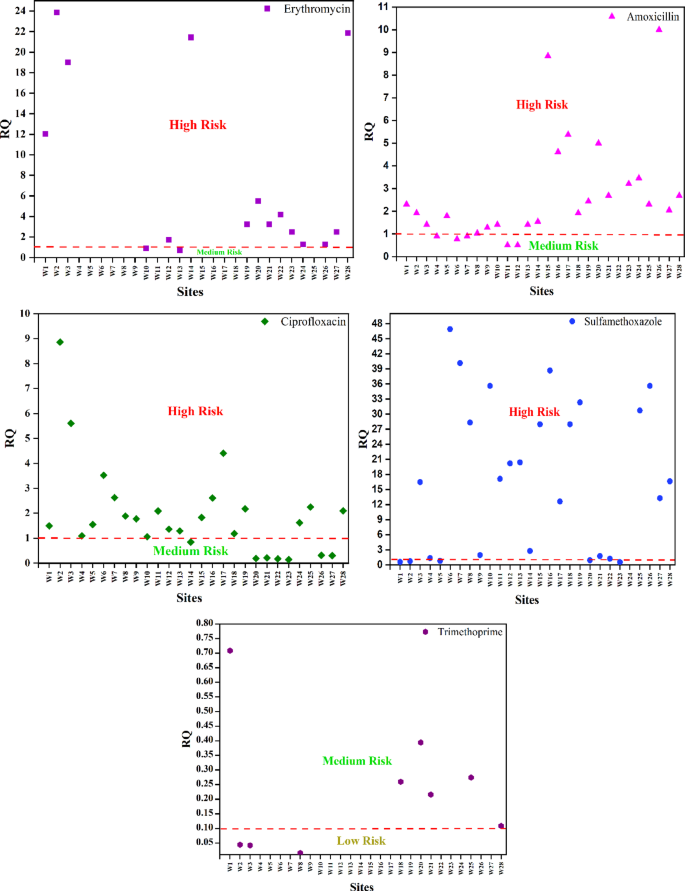
Ecotoxicological risk assessment of detected antibiotics.
Erythromycin was detected at High-Risk Quotient values in W1, W2, W3, W12, W14, W19–W24, and W26–W28; the maximum concentrations were identified at W2 (23.86), W14 (21.43), and W28 (21.86), while in W4–W9, W11, W15–18, and W25, it remained undetected (n.d.), exhibiting location-specific contamination fluctuation. In W15 (8.85), W16 (4.62), W17 (5.38), W20 (5.00), and W26 (10.00), amoxicillin repeatedly exhibited High-Risk Quotient levels, reflecting ongoing contamination from the pharmaceutical sector, agricultural runoff, and municipal wastewater. Due to its persistence in the aquatic environment and potential to induce AMR, the fluoroquinolone antibiotic ciprofloxacin was detected with consistent High-Risk Quotient values in all locations except one, and the levels were extremely high in W2 (8.858), W3 (5.603), and W17 (4.403). The level of contamination is further underscored by the presence of trimethoprim and sulfamethoxazole. W11 (171.16), W17 (126.08), and W24 (58.57) all showed very high levels of sulfamethoxazole, which were High Risk. Trimethoprim was seen less often but showed Medium Risk at W1, W18, W20, W21, W25, and W28 and low Risk at W2, W3, and W8.
Owing to High-Risk exposure to a large number of antibiotics, many locations were confirmed as pollution hotspots. W1, W2, W3, W19, W24, and W28 were High Risk to over three antibiotics, reflecting heavy toxicity from hospital effluents, the pharmaceutical sector, and untreated wastewater outfalls. The ubiquity of antibiotics at high-risk levels gives rise to critical environmental and human health issues. Drug-resistant infections are threatened due to the environment caused by the high levels of erythromycin, ciprofloxacin, amoxicillin, sulfamethoxazole, and trimethoprim. Since such antibiotics alter microbial communities and lower biodiversity, prolonged exposure could disturb aquatic ecosystems. Also, residues from antibiotics have the potential to bioaccumulate within aquatic organisms, possibly enabling them to enter their way into the food chain and leading to individuals exposed to contaminated seafood and potable water31,32,33. Figures 3 and 4 represents the hotspots of antibiotics based on the risk assessment in waterbodies of Bengaluru and Mysuru region.
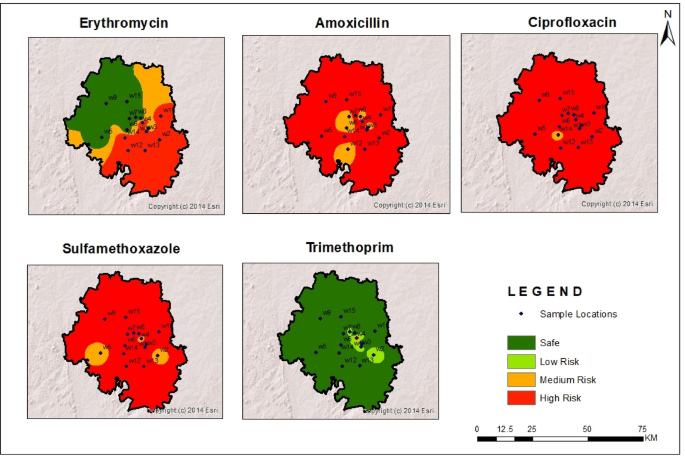
Representing the hotspots of antibiotics based on the risk assessment in waterbodies of Bengaluru urban area.
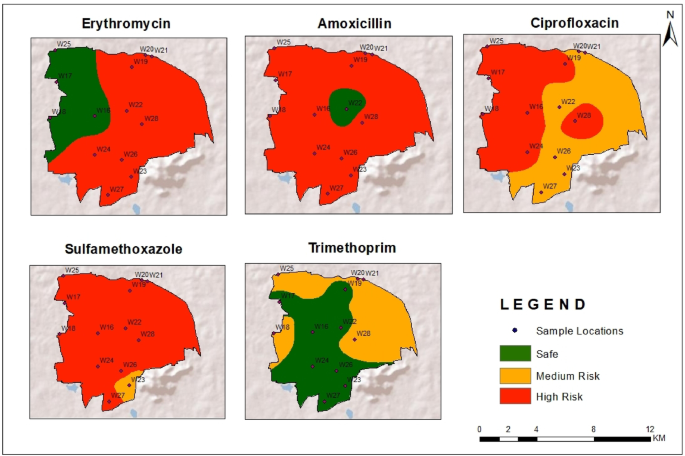
Representing the hotspots of antibiotics based on the risk assessment in waterbodies of Mysuru region.
Risk of antimicrobial resistance
One of the adverse effects of antibiotics on instinctive microbial populations is the suppression or lack of certain microbial populations engaged in key ecosystem processes owing to the bactericidal and bacteriostatic effects of antibiotics. Conversely, other populations of bacteria might become resistant through low antibiotic concentrations below the MIC34. The results indicated that water samples had an extremely high potential for drug contamination and AMR. The PNEC-ENV/MIC values of the chosen antibiotics are listed in Table S10, which provides details about their lowest PNEC values. Erythromycin, Amoxicillin, and Ciprofloxacin’s AMR evaluation is displayed in Table S11, and Sulfamethoxazole and Trimethoprim’s AMR is shown in Table S12. High AMR risk levels of Erythromycin were detected in some sites, particularly at W2, W3, W14, and W28. Ciprofloxacin also illustrated medium to low AMR risk in all the sites. Amoxicillin was also mostly placed in high AMR risk at the sites of W15, W16, W17, W20, W22, W23, and W25. Though high values of AMR risk by Sulfamethoxazole were indicated throughout the locations, including W11, W17, and W24, Trimethoprim illustrated high AMR risk values by W1, W18, W20, W21, W25, and W28. Figure 5 displays the prevalence of AMR, which shows the level of environmental risk that these pollutants generate. Figures 6 and 7 represents the Hotspots of AMR risk the in waterbodies of Bengaluru and Mysuru region. The current study found a significant spatial overlap between regions with high population density and close proximity to significant sources of antibiotic discharge and areas with high AMR risk. In Bengaluru and Mysuru, two heavily populated urban centres under significant anthropogenic pressure, hotspots of AMR risk were particularly noticeable in the urban and peri-urban areas. According to the site-specific risk mapping, these locations closely match those with substantial hospital effluent, pharmaceutical discharge, and untreated municipal wastewater input (e.g., sampling sites W1, W2, W3 in Bengaluru; W17, W18, W24 in Mysuru). MEC of antibiotics and the estimated risks of AMR development were found to be highly correlated by quantitative analysis. PNEC–MIC ratios regularly identified AMR risk hotspots as having the highest concentrations of significant antibiotic compounds, such as trimethoprim, sulfamethoxazole, and ciprofloxacin.
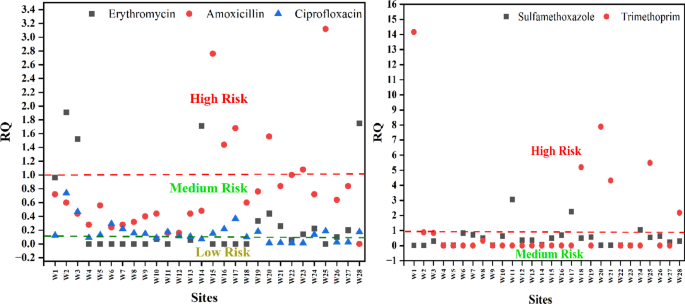
Prevalence of AMR among the selected antibiotics.
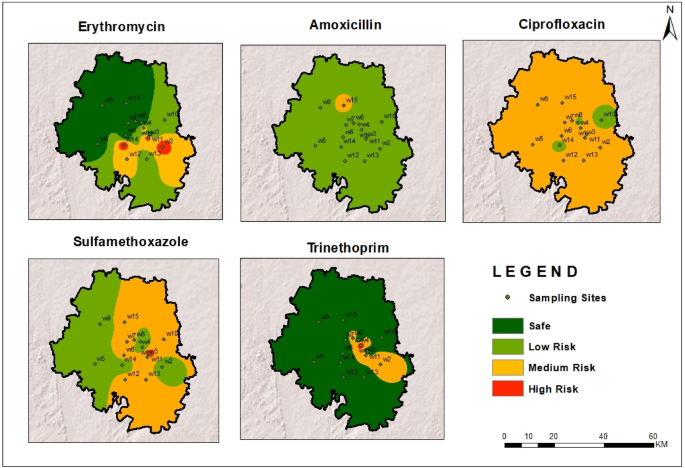
Hotspot showing the AMR risk the in waterbodies of Bengaluru urban area.
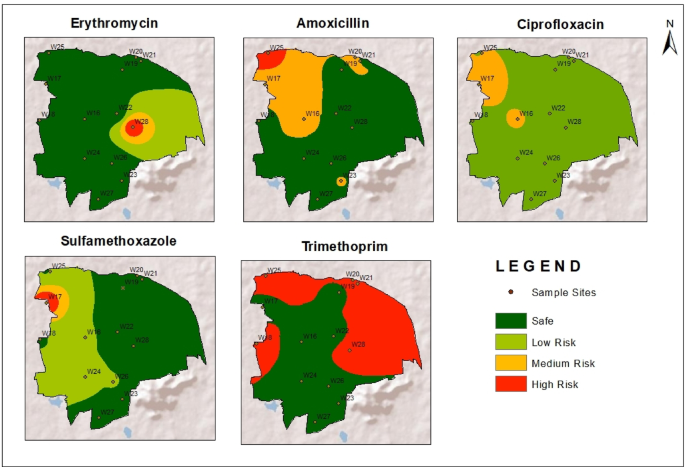
Hotspot showing the AMR risk the in waterbodies of Mysuru region.
Environmental risks
The persistence, bioaccumulation tendency, and microbial ecological impact of antibiotics such as erythromycin, amoxicillin, ciprofloxacin, trimethoprim, and sulfamethoxazole constitute their occurrence in aquatic environments an extreme risk to the environment35. In multiple sampling locations, the results demonstrate mid to high-risk concentrations of these antibiotics, suggesting persistent anthropogenic pollution due to pharmaceutical effluents, hospital waste, wastewater effluent, and agricultural runoff36. Through selective inhibition of susceptible bacterial populations and stimulating the development of resistant populations, antibiotics in water ecosystems can potentially disrupt microbial communities35.
High concentrations of antibiotics may exert selective pressure in favour the persistence of resistant bacteria and possibly promote the horizontal transfer of AMR genes. Although these mechanisms were not directly evaluated in our study, prior research has shown such associations37. The stability of an ecosystem can be affected by such shifts in microbial diversity since they can harm essential biogeochemical cycles, e.g., the carbon and nitrogen cycle. Antibiotic bioaccumulation at higher trophic levels threatens higher-level species in aquatic life, which transcends microbial ecosystems38,39. Trimethoprim and sulfamethoxazole have also been associated with endocrine disruption in aquatic organisms, which affects growth and reproduction. Aquatic organisms exposed to sub-lethal concentrations of the drugs over a long period can suffer from physiological stress, lowered survival rates, and population reduction, all of which can contribute to a negative impact on ecosystem function and biodiversity40.