
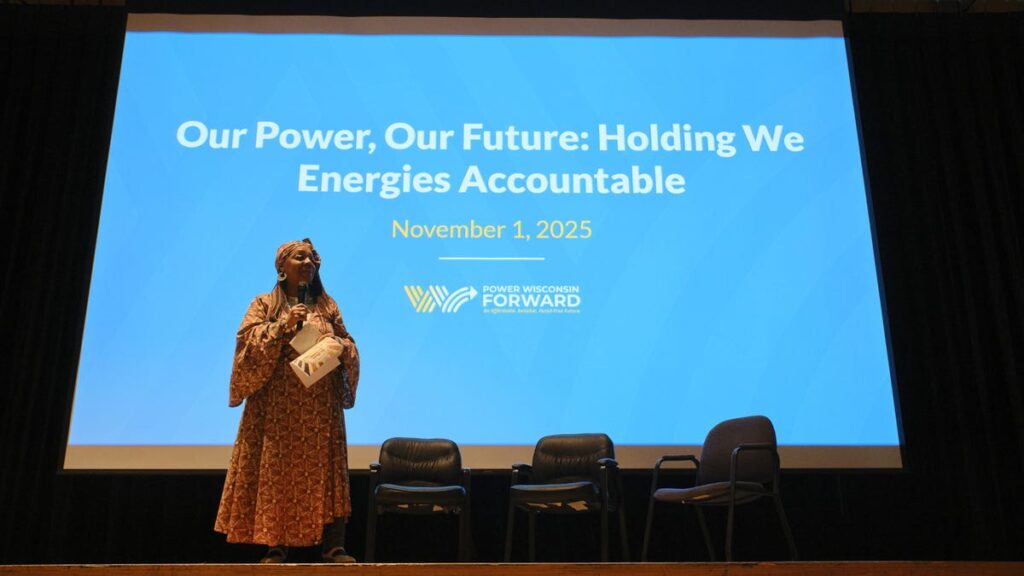
On Nov. 1, Milwaukee residents braved the rain and assembled in the auditorium of North Division High School to attend the first discussion about transparency from We Energies, the state’s sole utility provider.
Residents and organizations like Citizen Action of Wisconsin, Power Wisconsin Forward and Walnut Way, along with others, want We Energies to be more transparent by compiling zip-code specific energy rate data and to be up front about how future projects could affect Wisconsinites’ bills.
We Energies tracks rates and other data across the state, but not by zip code, according to Brendon Conway, media relations manager for the company.
Organizations and residents meet to discuss transparency
Maria Beltran, a Lindsay Heights resident, has struggled with rising utility costs and service disconnections in the past.
A mother of seven, Beltran was pregnant with her youngest son when the family’s service was cut off in the middle of winter.
She told the Journal Sentinel of a time she corralled her children into her bedroom at night so they could all sleep on her mattress together to conserve heat.
“They were like, ‘Mama, we can see our breath,’” Beltran recalled her children telling her.
The meeting was focused on including testimony from residents like Beltran, but the effort for transparency has gained the attention of representatives like Ald. Sharlen Moore, from Milwaukee’s 10th aldermanic district and Sen. Chris Larson, of Wisconsin’s Senate District 7.
Moore and Larson spoke in support of the event organizers’ efforts to pressure We Energies to compile highly specific data. According to organizations like Citizen Action of Wisconsin, elected officials will be important in putting pressure on We Energies.
Neither official specified if they would use their offices to pressure We Energies to compile the data, but expressed their support for the organizations’ mission at the Saturday event.
The organizers said there was not a set timeline of when they would like to see the data compiled but said the first step was for residents to sign a petition backing the request dubbed, “The People’s Audit.”
Kat Klawes, climate action policy coordinator of Citizen Action of Wisconsin, said We Energies has been asked to make data like this accessible in the past, but did not respond.
We Energies says it does track costs, just not by zip code
The Journal Sentinel reached out to We Energies and asked for zip-code level data. We Energies said it does not record data by zip code but does track gas and electric bill costs across the state. Rates are approved by the Public Service commission, and those reports are publicly available.
We Energies also acknowledged the financial difficulty of rate increases on its customers and referenced low-income energy bill assistance programs.
One of the main drivers for the rate increase is to fund a push for renewable energy sources across the state, according to Conway.
The company announced its new Capital Investment Plan on Oct. 30 — a $36.5 billion total investment between 2026 and 2030. A new investment of $11.6 billion will go towards renewable energy and it will add a $3.4 billion investment to natural gas energy generation.
It also reduced carbon emissions by over half and have the goal of being carbon neutral in Wisconsin by 2050, Conway said in an email.
Part of this includes creating a more durable power grid to reduce the number of outages. We Energies is purchasing hundreds of miles of power lines, adding new equipment and maintaining trees around the lines.
Renewable energy projects, including increasing battery storage and modernizing natural gas plants across the state is meant to create a higher level of energy security, according to Conway.
Finding energy assistance in Milwaukee
Energy insecurity can be difficult to combat, especially with winter on its way, but some resources are available to help ease financial strain.
Riverworks Development Corporation is holding a housing and resource fair at Kumba Juice and Coffee, 274 E. Keefe Ave., on Nov. 6 from 2 to 4 p.m. It will have information on weatherization and energy upgrades available for homes, business energy saving incentives, tax credit and critical home repair information and information on energy equity efforts within the community.
Registration is required, but interested residents can sign up here.
Anyone who is having trouble paying heating and electric bills can also apply for energy assistance through the Wisconsin Home Energy Assistance Program. The program assists eligible households and is funded by the Low Income Home Energy Assistance Program and the Public Benefits program through the State of Wisconsin.
Applications for the program can be submitted online.
Everett Eaton covers Harambee, just north of downtown Milwaukee, for the Journal Sentinel’s Neighborhood Dispatch. Reach him at ejeaton@gannett.com. As part of the newsroom, all of Everett’s work and coverage decisions are overseen solely by Journal Sentinel editors.
April Quevedo covers Metcalfe Park for the Journal Sentinel’s Neighborhood Dispatch. Reach her at aquevedo@gannett.com. As part of the newsroom, all April’s work and coverage decisions are overseen solely by Journal Sentinel editors.
Support for this effort comes from the Zilber Family Foundation, Journal Foundation, Bader Philanthropies, Northwestern Mutual Foundation, Greater Milwaukee Foundation and individual contributions to the Journal Sentinel Community-Funded Journalism Project. The project is administered by Local Media Foundation, tax ID #36‐4427750, a Section 501(c)(3) charitable trust affiliated with Local Media Association.
Learn more about our community-funded journalism and how to make a tax-deductible gift at jsonline.com/support. Checks can be addressed to Local Media Foundation with “JS Community Journalism” in the memo, then mailed to: Local Media Foundation, P.O. Box 85015, Chicago, IL 60689.