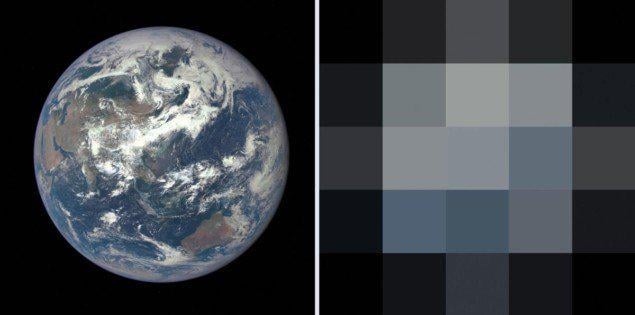
Earth, despite being teeming with life, might actually be “hidden” from much of the galaxy due to sheer geometry and observational constraints.
https://hive.blog/space/@kur8/earth-a-well-hidden-planet

Earth, despite being teeming with life, might actually be “hidden” from much of the galaxy due to sheer geometry and observational constraints.
https://hive.blog/space/@kur8/earth-a-well-hidden-planet
21 Comments
Our atmosphere has been roughly the same for the past 500 millions years and we’ve orbited the whole galaxy twice during that time. That leaves plenty of time and opportunities for anything out there with our current technology level to discover us
That’s a big plus if the dark forest theorists are right.
Is there a reason why this sub does not allow discussion of the current discussions happening in the US congress with regard to this matter? I would love to talk about this topic but it seems rather hush hush.
I believe this has been pretty well known, as many planets as we’ve found with Kepler and the transit method in general, we can decude that we’ve missed many more because they just don’t transit.
That’s why astronomers are looking into direct imaging technology to get around that. JWST, Nancy Grace Roman, ELT, and others can or will be able to directly image planets with better accuracy than in the past, and ELT may be able to image rocky planets like Earth.
So if we can do this today, or in the near future, it’s not unlikely for advanced civilizations spanning their solar system, if not beyond, to employ similar methods, with greater ease and accuracy than we could get. Trying to tie fermi paradox solutions to the limitations of current technology does not work, because those limitations will be overcome eventually.
Surely the transit method isn’t the last word in planetary detection. It’s basically the first method humans have developed for observing planets in other solar systems, and it seems very unlikely that it will be the last. If an alien civilization is still looking for planets using the transit method, they are probably like us and do not have the ability to confirm the existence of life on a far away planet anyway, let alone the capacity to visit or communicate with that planet.
To the article’s credit, the author does make note of this point, stating “advanced civilizations could use alternative methods such as direct imaging , gravitational lensing, or atmospheric biosignature detection to identify us.”
They’re lucky. They don’t have to put up with this.
So if an alien pointed their telescope directly at us, they’d see nothing out of the Oort-inary?
We’re a potato that rolled out of the bag and got lost at the back of the cupboard.
It’s the big sign outside the solar system warning travelers to stay away
But that is… exactly what extraterrestrial observers would say, isn’t it??
I’m not going to claim interstellar predation makes any sense…but if it did, it could also be that predators prefer more docile prey like Sagan’s Jupiter hot air balloon types. https://www.reddit.com/r/StupidFood/comments/1oe9ctv/edible_balloon_with_helium
Acronyms, initialisms, abbreviations, contractions, and other phrases which expand to something larger, that I’ve seen in this thread:
|Fewer Letters|More Letters|
|——-|———|—|
|[ELT](/r/Space/comments/1omo7r7/stub/nmqwwpd “Last usage”)|Extremely Large Telescope, under construction in Chile|
|[JWST](/r/Space/comments/1omo7r7/stub/nmqwwpd “Last usage”)|James Webb infra-red Space Telescope|
|NRHO|Near-Rectilinear Halo Orbit|
|[NRO](/r/Space/comments/1omo7r7/stub/nmrrp4y “Last usage”)|(US) National Reconnaissance Office|
| |Near-Rectilinear Orbit, see NRHO|
Decronym is now also available on Lemmy! Requests for support and new installations should be directed to the Contact address below.
—————-
^(3 acronyms in this thread; )[^(the most compressed thread commented on today)](/r/Space/comments/1omrs1h)^( has 9 acronyms.)
^([Thread #11826 for this sub, first seen 2nd Nov 2025, 21:19])
^[[FAQ]](http://decronym.xyz/) [^([Full list])](http://decronym.xyz/acronyms/Space) [^[Contact]](https://hachyderm.io/@Two9A) [^([Source code])](https://gistdotgithubdotcom/Two9A/1d976f9b7441694162c8)
Keep telling yourselves that. You Earthlings never cease to crack me up.
Maybe that’s why we are still here to discuss the problem….
What about the fact that the Sun is actually one of the more rare types of stars (7-8%) in the universe? And the fact that stars like the Sun may be the best overall environment for life as we know it.
They have steady light output, moderate radiation, a large habitable zone with mild temperature swings and a long enough lifetime for intelligent life to evolve (~5 billion years left)
Wouldn’t aliens be more likely to check for life on our type of star rather than something like a red dwarves which are 75% of the universe and planets are tidally locked (one side always facing the star), constantly bombarded by flares and stellar winds and at risk of losing their atmospheres entirely.
Eh, that’s an overblown “finding” in my opinion. We’ve been able to detect exoplanets for about 30 years, since the mid-90s, using various techniques. And Earth won’t be super easy to detect using the transit technique because of the requirement of having a lucky orbital plane alignment. But there are other techniques which are theoretically capable of detecting Earth-like planets such as direct imaging and next generational radial velocity with higher precision. We’re likely to get into the era of detecting small rocky planets reliably using those techniques within the next few decades, so the period of time for us and maybe for other technological civilizations where exoplanets would be detectable but Earth itself would be unlikely to be detected is likely to be a tiny blip in time compared to the civilizational longevity required to, for example, explore other planetary systems or engage in conversations (via radio) with other technological civilizations. So in practice I don’t think it’s actually anything meaningful.
Or aliens came during dinosaurs and labeled us a monster, stay away planet. Or they came again and were crucified after doing miracles 😉
Sir, the “humans” have escaped prison planet again…
Might be the reason why our ancestors picked this planet to colonize!
Oh, so now this sub believes extraterrestrial life is possible? 🤣
If the dark forest theory is to be believed then that’s probably a good thing.