
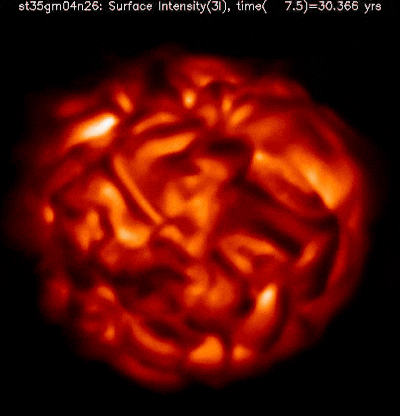
Based on data collected over 7 years, astronomers Bernd Freytag and Pierre Kervella created this simulation of convection cells boiling on the surface of Betelgeuse – the largest of which can measure over 1 billion km, or a distance extending beyond Jupiter’s orbit in our solar system
https://i.redd.it/u55uqmc06vyf1.gif
15 Comments
So is this mean to be interpreted as betelguse actually looking like that and not as a solid ball like we picture a star? Or am i reading it wrong?
This is just so amazing to me, I remember talking to my science teacher in the sixth grade and how he was confident we would never know anything about planets outside of the solar system and the surfaces of stars. It’s amazing how much technology and our knowledge can change in a few decades.
Worth pointing out that the gif is a simulation of almost 2 years of activity in just like 3 seconds. So it’s not happening this fast in real time, but still, the scale of this star means there’s billions of tons slushing around at some ludicrously high speeds.
Can I get a source for this? Very interested in how they modelled this
That’s honestly crazy to see. Kudos to the astronomers who were able to simulate this. Even if it’s not 100% accurate, it definitely gives a pretty clear idea that this is star that is ready to retire as a neutron star. And by retire i mean Betelgeuse spreading its glorius metallic seed in every direction that will be formed once its core collapses when it goes supernova
So obviously the motion would be imperceptible to the human eye (of a hypothetical human in the system… maybe far enough that the apparent angular diameter of Betelgeuse is that of our sun from the Earth). But… would any of the structure/variation in brightness be visible to the naked eye, or would it all just be “about as bright as our sun, don’t look at it directly.” Noticeably redder? Noticeably fuzzy around the limb? Or would it be as dim as, say, our sun on a very smoky day in wildfire season, when you can *just about* make out sunspots if you look carefully?
Which instrument did they use to get the data?
I pressume some of the imaging instruments that we have at VLT, but which one/ones?
Cant wait for it to go off. I hope it happens in our lifetime
Wow, just wow. Glad it’s very far away from us…it’s amazing to think that considering how far away it is it might have gone super nova already. I hope the light from that event reaches us in my lifetime…
Its just mind boggling to imagine the space between the Sun and Jupiter being filled. With hot boiling plasma of all kinds of elements and just sloshing around like this over the years. Our minds were not made for this. We just can’t imagine that scale and even if we were able to somehow see it from comfortable distance to appreciate the movement, our lazy ass brain would just approximate it to what it “thinks” is the closest aporoximation.
Guessing that’s not a standard RANS turbulent model. Wonder how the CFD gets described
…that looks incredibly unstable. I doubt there even is a habitable zone around that star with so much volatility in the surface.
So space engine’s pretty accurate for these stars?
It’s still wild to me to just imagine things that are so big that they make our sun look tiny by comparison
Are they really that big? The ones on Sol are infinitesimal by comparison