
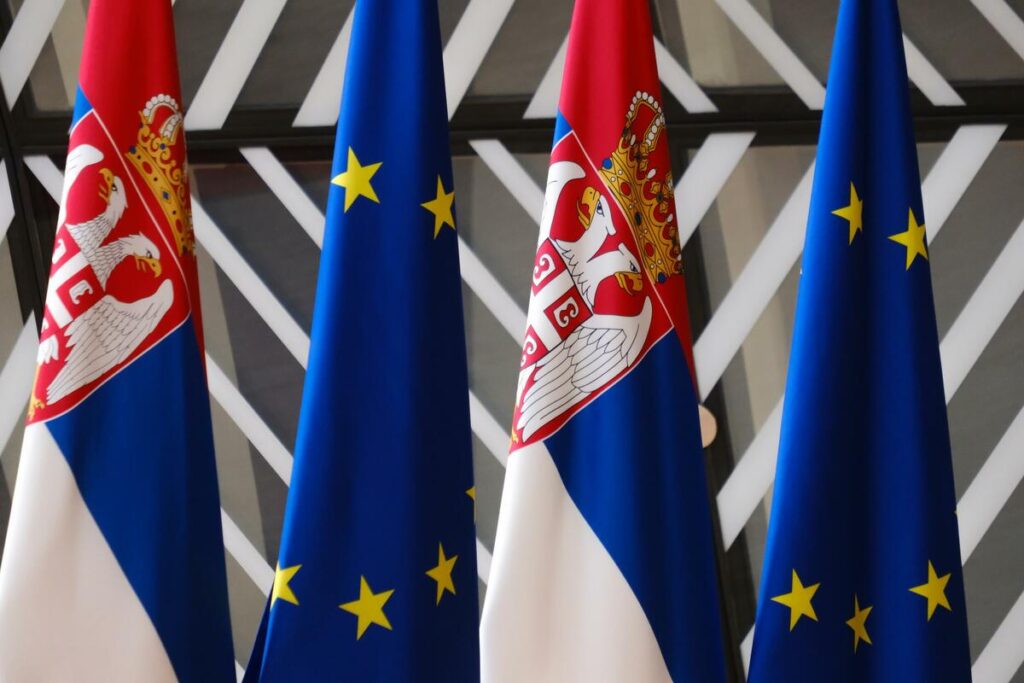
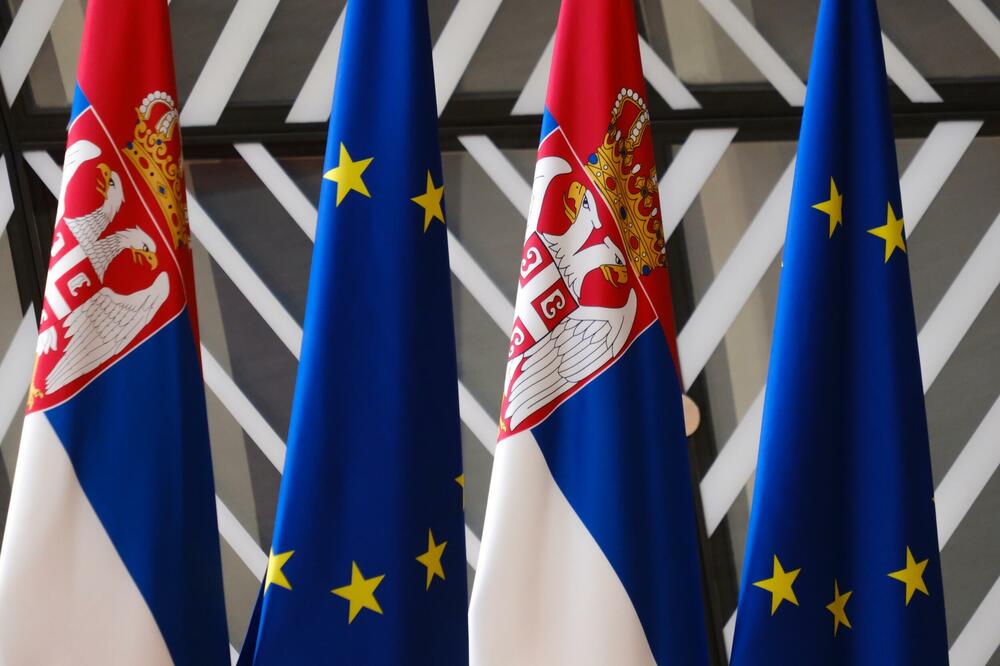
Flags of Serbia and the EU (Illustration), Photo: Shutterstock
03.11.2025. 12:27h
The dialogue on the normalization of relations, which is also part of the accession negotiations for both countries, remains crucial for Serbia and Kosovo, according to a report covering the Western Balkan countries, according to the European Commission’s report on the progress of candidate countries for membership in the European Union (EU), Radio Free Europe (RFE) reports.
Serbia continues to lag behind in terms of alignment with the EU’s foreign and security policy, having failed to impose sanctions on Russia over its invasion of Ukraine. The report also points to growing polarization in the country following a wave of mass protests that have been ongoing for a year.
In Serbia and Bosnia and Herzegovina, as stated in the report, there are different risks of “state capture” in the context of the fight against corruption.
“Corruption remains a significant challenge that enlargement countries must address as a matter of priority,” the report says.
The report also states the general assessment for all candidate countries that “the enlargement process is now moving faster than in the last 15 years.”
Serbia has opened 22 out of 35 negotiation chapters, two of which have been temporarily closed.
The European Commission assessed that the Serbian authorities “continued to proclaim EU membership as their strategic goal, but the actual pace of reform implementation has slowed significantly.”
The EU points out that “Serbia needs to implement credible reforms in all areas”, especially in the field of harmonization with the EU’s foreign and security policy.
“Serbia also needs to take much greater responsibility for proactive and more objective communication about Serbia’s EU accession process and should avoid anti-EU rhetoric,” the report states.
The EU has repeatedly stated that it expects a greater degree of alignment of Serbia with the Union’s foreign policy, including sanctions against Russia.
Serbia is one of the few countries in Europe (along with Turkey and Belarus) that did not join the European Union’s sanctions against the Russian Federation, after the Kremlin launched an invasion of Ukraine in 2022.
“Serbia’s compliance rate with the EU’s Common Foreign and Security Policy remains low,” the report states, adding that Serbia needs to significantly improve its compliance rate in order to progress on its path towards the EU.
The report also states that it poses a security risk for the EU that Russian citizens in Serbia are rapidly gaining the right to “visa-free travel to the EU” by granting Serbian citizenship.
The report also indicates that there has been a deepening of “polarization in Serbian society” due to “mass student and civic protests taking place across Serbia since November 2024.”
“(It) reflects citizens’ disillusionment with corruption and a perceived lack of accountability and transparency, along with cases of excessive use of force against protesters and pressure on civil society,” the report said.
Mass anti-government protests have been ongoing in Serbia for a year, demanding that the authorities be held accountable for the collapse of a canopy at the Novi Sad Railway Station, which killed 16 people.
It is also emphasized that in Serbia, during demonstrations, arrests and other coercive measures are applied that “have a terrifying effect on civil society.”
This, it points out, has been exacerbated by “verbal attacks and smear campaigns, including those by senior officials.”
When it comes to the independence of the judiciary, the report states that to some extent “undue influence (by the authorities) and attempts to limit the independence of the judiciary have undermined the rule of law and democracy in Serbia.”
Serbia, along with Turkey and Georgia, is one of the countries where “freedom of association, assembly and expression” has deteriorated.
When it comes to the dialogue between Serbia and Kosovo, the report also states that both Serbia and Kosovo are expected to fulfill all their obligations arising from the agreement.
Kosovo declared independence from Serbia in 2008, but is not recognized by official Belgrade. The two sides have been holding talks on normalizing relations since 2011, mediated by the EU.
“For both Kosovo and Serbia, progress on their EU path remains dependent on significant progress in the normalization of their relations… In the absence of constructive engagement, both sides risk missing major opportunities,” the report says.
Serbia, as stated in the report, is one of the countries that has used part of the money from the Growth Plan for the Western Balkans.

News