
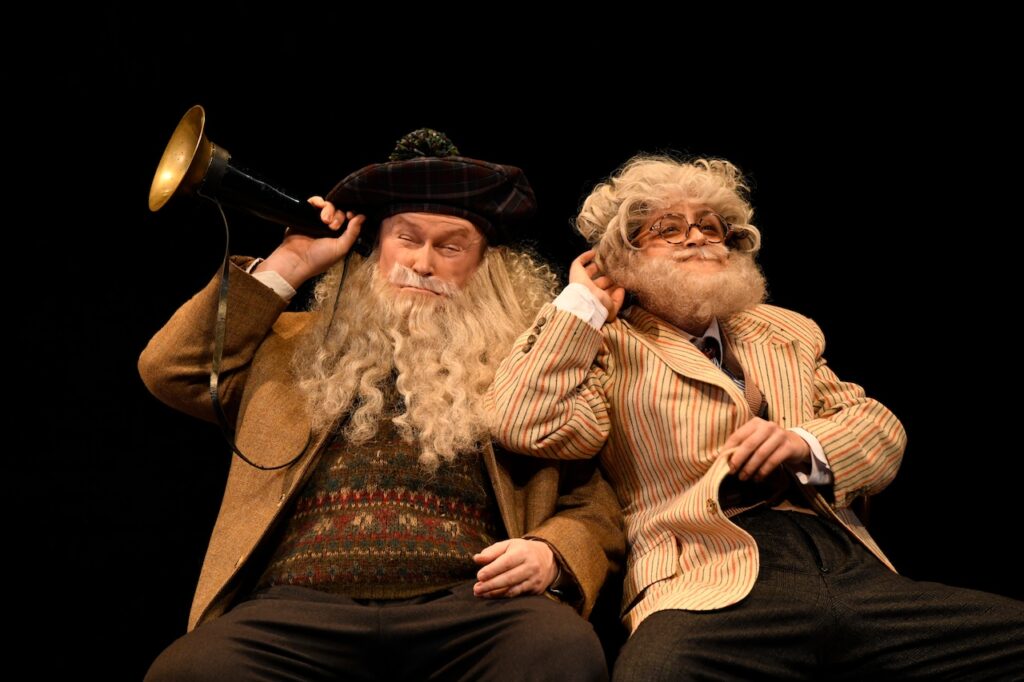
Ema Zivkovic and Michael Stewart Allen account for 50% of the cast of “The 39 Steps,” the thriller/mystery/spy-story spoof playing through November 9 at Syracuse Stage, yet collectively the two play 95% of the roles.
Within the first 15 minutes of the show, audiences will see Zivkovic and Stewart Allen—described as simply “Clown 1” and “Clown 2” in the script—portray a West End compere, a variety show performer, a milkman, a pair of seedy gangsters, two traveling salesmen, a newspaper boy, and a train conductor. Before the evening’s through, they’ll each add dozens more characters to that list.
“The 39 Steps” comically remixes Alfred Hitchcock’s classic film into a full-fledged theatrical hurricane, filled with quick changes and even quicker banter. The show requires athletic performances from all of its actors (Jürgen Hooper is leading man-on-the-run Richard Hannay; Tyler Meredith does triple-duty as a trio of romantic interests), but Zivkovic and Allen carry a good share of the weight—sometimes literally, as is the case with the inventive, DIY set pieces—of this fleet-footed tale.
From afar it might look like the pair is just clownin’ around, but ask Zivkovic and Allen to recount their lighting-fast work on the show and they’ll admit astonishment at their ability to pull it all off.
“It’s wild stuff, and you’re amazed that you’re actually doing it,” Zivkovic said.
This interview has been lightly edited for length and clarity.
Syracuse Stage: Between rehearsals, running the play at Indiana Repertory theatre, and now here in Syracuse, you’ve been with this show for almost two and a half months. What’s that been like?
Michael Stewart Allen: I think it’s been good. Moving the show from Indianapolis to Syracuse, you get to see what jokes land, what jokes are regional, and how people respond. You also get to live with the show for a while, which is not something you usually get with regional theater. It’s normally three weeks, and then it’s over. But this time, there’s a chance to try it again, and to sort of reinvent and grow the show in a different city.
Ema Zivkovic: Yeah, I fully agree. It’s so exciting to know that it’s just gonna keep getting better, and that you have the time for that to happen. And because we trust each other as actors, I can’t wait to see what little changes happen within the smaller moments of the play, where we figure out a new rhythm to something, or a new way to say something. And then we go backstage and we say, “That was good, right?!” Or, it’s like, “Oh, that won’t work at all. No, definitely not.”
MSA: There was a moment the other night that I told my wife about, and it was when your fake mustache flew off, and we had the exact same response at the exact same time, and the audience loved it—you couldn’t have planned it any better. The audience roared. It was just an impulse moment, because we had been able to work so long together.
EZ: And even Jürgen, who plays Richard in the show, said, “I thought that’s something that you staged!” Because we did it so perfectly.
SS: And that’s not something you could recreate.
MSA: We could never recreate it!
EZ: The mustache got sweaty, and it flew in a beautiful trajectory down to the floor.
MSA: And we did the exact same thing at the exact same moment—it was really great.
SS: So for your roles, especially, there’s so much physicality, so much comedy, so much slapstick, so much movement. I just wonder, what is your background? I believe you’re a dancer, Ema?
EZ: Yeah, I started off with music and dance back in Croatia, and then started doing theater later in life when I moved to America. So everything that I do in theater is so deeply informed by rhythm and by physicality.
During my audition for this show, the director Ben Hanna asked me about myself as a performer, and I said, “Everything starts from the toes and ends at the top of the head, and every single inch of my skin and my bones is included in every character, every decision that I make.” And that’s where I always start from, because English is not my first language—so I’m not starting from language, because I need to work to get there.
SS: And Michael, you come from a classical background?
MSA: I do a lot of Shakespeare, and I think it lends itself to this process, because you have to be so facile with the words, and use the language to find the clues in the text to figure out certain things. That’s the way I’ve approached a lot of these characters, by finding the words that activate something in me. For every one of these characters I play in this show, I have to create a new voice, a new dialect, a new everything.
EZ: Yeah, and what’s so fascinating to me is having Michael, with such a strong understanding of the language and such a clear focus and minute things in the text and the way that he approaches it. That compliments my way of working, because I’m like, “Oh, that’s so helpful. I wasn’t thinking about it. Okay, I’ve got this physical stuff, but I really need to listen here.”
MSA: Yeah, and I had the exact same experience in rehearsals, thinking, “Oh, I gotta step up my game. I gotta do more with this!”
SS: It’s like you’re two halves of the same brain…
EZ: And then we go onstage, and we sweat a lot!
MN: So, the audience sees this mayhem on stage that’s obviously very precise and calculated. But what’s it like backstage?
MSA: There’s a whole other show taking place backstage. Onstage, it feels like we’re in control of something. Offstage, it’s like complete chaos. When we were building the show in Indianapolis, we were just creating what had to happen in the moment. You know, if a police jacket comes off and a sweater goes on, we had to create the formula for that.
I equate it to a NASCAR race. It’s like, you pull into a pit stop and there’s a system. It’s all timed out. We know where we can breathe. We’ve gotten so good and so fast that we are actually able to sit down now. We were sitting next to each other the other night, and I said, “Did you ever think we’d have time to sit?”
EZ: Yeah, we were able to actually chill for a few seconds! And the NASCAR reference is so on point. We’ve gotten so much faster and more specific through just having conversations with the crew.
When you’re in that chaos, you have to find that person and say, “The way that we put that sleeve on, it wasn’t working. Can we do it the other way?” Or, “I’m in that corner, and I can’t do that because I’m going to hit a light!”
I have five costume changes in the last 10 minutes of the show, and they used to be absolute hell, to be honest. I was dreading it, but now we know exactly what to do: “What about this snap on this shirt? Are we going to skip that snap? We’re not going to do that snap, ok, cool!” So it’s very, very prescriptive. But it’s fun. It’s like an amusement park ride.
Show details:
What: “The 39 Steps,” a play adapted from Alfred Hitchcock’s 1935 film
Where: Syracuse Stage, 820 E. Genesee St., Syracuse
When: October 22 through November 9. Tickets at SyracuseStage.org/39Steps.
Length of performance: 1 hour, 45 minutes, including a 15-minute intermission
Family guide: Nothing objectionable, but suited to mature high school students due to rapid pace and dialogue.
Tickets and information: 315-443-3275 and syracusestage.org
If you purchase a product or register for an account through a link on our site, we may receive compensation. By using this site, you consent to our User Agreement and agree that your clicks, interactions, and personal information may be collected, recorded, and/or stored by us and social media and other third-party partners in accordance with our Privacy Policy.