
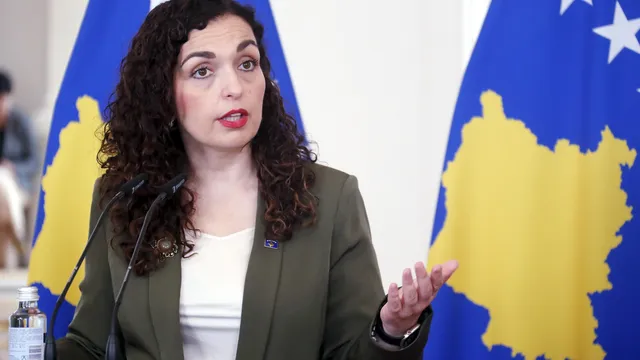
According to Osmani, the Constitutional Court’s rulings state that if the Kosovo government is not elected after two attempts, “then early elections will be called.”
President Vjosa Osmani has given Glauku Konjufcu of the Vetëvendosje Movement a mandate to form Kosovo’s new government.
According to the Constitution, the mandate holder has 15 days to present the new composition of the executive branch to parliament and must receive the support of at least 61 MPs to be elected.
Osmani said at a press conference that she had held meetings with the leaders of other parties, who told her that they did not want to propose a candidate, Radio Free Europe reported.
She said that the Constitution states that if a name is proposed for another term, the president must appoint it and there is no room for rejecting the appointment.
According to Osmani, the Constitutional Court’s rulings state that if the Kosovo government is not elected after two attempts, “then extraordinary elections will be called.”
“It is in the interest of citizens to have institutions and to make every effort to form them, so that at least important decisions are taken in the interest of citizens,” Osmani said, citing as examples the vote to extend the budget or even the new budget for 2026, as well as the ratification of international agreements.
“As president, I believe it is in Kosovo’s interest to try to form a government so that these decisions do not have to wait another few months,” the president said.
The Vetëvendosje (Self-Determination) Movement, led by Albin Kurti, proposed on November 4 the vice-chairman of that party, Konjufcu, as representative for the new government of Kosovo. Kurti was previously the mandate holder, but his proposal for the composition of the government did not receive support in parliament.
Konjufcu said he wanted cooperation with the Albanian parties represented in parliament, but not a coalition.
He pointed out that the election of a new government led by him would avoid the possibility of elections in December, so that the country would not have two election cycles in a short period of time, given that a new president must be elected in April.
Konjufcu added that his government would approve the country’s new budget, ratify the agreement on the European Union’s Growth Plan, and resolve other pressing issues.
Vetëvendosje leader Kurti said he saw no “theoretical possibility” of forming a government coalition with other Albanian parties due to their “uncooperativeness.”
“Some opposition elements have built up a hybrid hatred against me. Now it’s not me anymore. Let them prove that the interests of the state are above the interests of the party,” Kurti stressed.
Other Albanian parties, the Democratic Party of Kosovo, the Democratic Alliance of Kosovo, the Alliance for the Future of Kosovo, and the Social Democratic Initiative asked Osmani to organize new elections.
They expressed the same position after a meeting with Osmani on October 31, at which Vetëvendosje requested several days to attempt to form a new government.
Kurti, as leader of the party that won the February 9 elections, failed on October 26 to gain support for forming the executive branch.
His party won the February 9 elections but did not secure enough seats in parliament to form a government on its own.
In the February 9 election, the Democratic Party of Kosovo won 24 seats, the Democratic Alliance of Kosovo won 20, the Alliance for the Future of Kosovo won five, and the Social Democratic Initiative won three seats. The latter two parties participated in the elections together.
The Serbian list has nine of the ten seats guaranteed for the Serbian minority, Nenad Rašić’s party has one, and the remaining ten seats were won by representatives of other minorities. | BGNES