
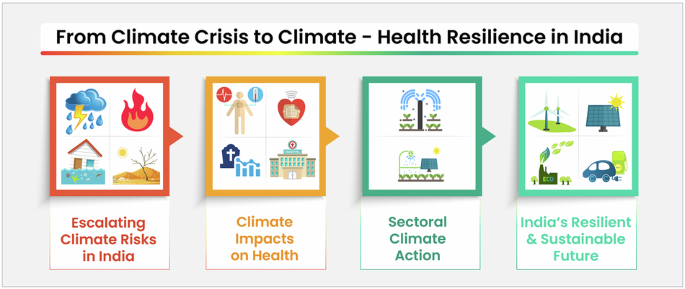
India is at the forefront of global climate adaptation efforts. The country launched Lifestyle for Environment (LiFE), an international initiative, highlighting the need for people-centric, collective action to address the climate crisis6. However, focused intervention and localized resilience-building are required in strategic sectors, including water resources, agriculture, urban development, non-renewable energy, and health.
India has already initiated modernizing weather forecasting under the Mission Mausam, which could be prioritized for mobile-based heatwave and flood advisory systems. In agriculture, climate-smart practices such as localized forecasting, crop diversification (e.g., millets promotion), insurance schemes, and flexible subsidies for solar irrigation and micro-drip systems can boost resilience and productivity. India promotes climate-resilient agriculture through key missions like the National Mission on Sustainable Agriculture7 and National Innovations in Climate Resilient Agriculture8, focusing on productivity, sustainability, and enabling technology in farming. These initiatives promote climate-smart practices to reduce vulnerability and support farmers’ livelihoods. However, there is a need to scale up technology access, improve climate data dissemination, and strengthen local capacity building to ensure widespread adoption and impact. Further, water resource governance needs to be strengthened in agriculture9. For instance, overexploitation of groundwater can be managed by regulating extraction in priority areas or by promoting less water-intensive crops and implementing a groundwater metering system.
Additionally, flood management needs upgrading localized forecasting systems with artificial intelligence (AI)-based precision and displaying the real-time alert system with district-level disaster dashboards, including efficient stormwater infrastructure. Protecting Himalayan ecosystems must be prioritized by declaring glaciers and river basins as eco-sensitive and restricting construction around glacial lakes. Further, developing glacial lake outburst flood (GLOF) risk maps is essential. Arabian Sea is showing an increasing trend of marine heatwaves10. Hence, to mitigate rising ocean and coastal climatic risks, India must establish a robust monitoring and alert system for marine heatwaves and rising sea levels, alongside mangrove restoration and coastal buffer zones.