
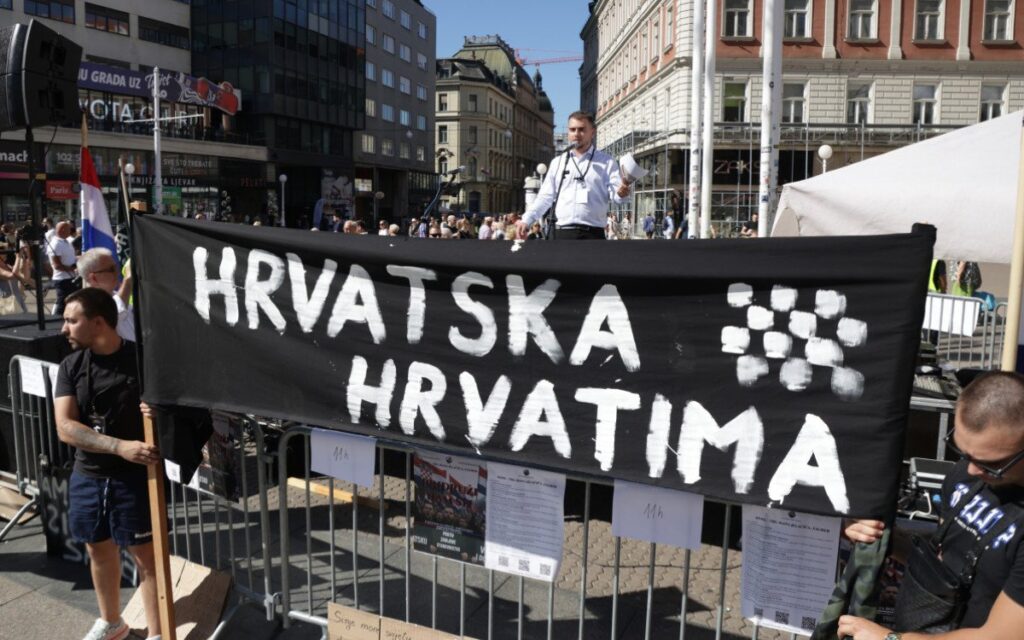
A group of 50 young men dressed in black, shouting the Ustasha (Croatian collaborators of Nazis in WWII) salute “For the Homeland – Ready!”, disrupted the “Days of Serbian Culture” event in Split last night. The attackers told the organisers, the Prosvjeta Serbian Cultural Society, that they could not perform “because this is the month in which the fall of Vukovar is commemorated.”
The organisers, who had planned to host young participants from Novi Sad and other cities, quickly ended the event and left the city premises to avoid endangering the safety of the performers and guests, among whom were children.
In the video footage of the disturbing scenes, the voice of one of the masked men can be heard “advising” those present to leave, promising that no harm would come to them, while another voice shouts “Serbian trash”. Ilija Borković, vice-president of the Split branch of Prosvjeta, who was present at the scene, told the Serbian weekly in Croatia, Novosti, that some of the young men were raising their right hands in the air and shouting “For the Homeland – Ready!” and “Croatia, Croatia!”, even though they were mostly very young.
“There were also two older men among them, who were clearly directing the rest. It happened about an hour before the cultural event, where the women’s choir of the SKD Prosvjeta from Split, its drama section, our young violinist, and the folk ensemble ‘Veliko Kolo’ from Novi Sad were supposed to perform. People had just started arriving; there were about thirty to forty of us. A member of the drama section burst into tears because she was frightened for her safety,” said Borković.
One member of the audience said that the group had been chanting the Ustasha salute and that some wore masks over their faces.
“Five of them entered that small hall, asking who the organiser was. They told one of the members of the subcommittee that they shouldn’t be organising that event, since it was All Saints’ Day, and that doing so would desecrate the memory of the defenders,” he said.
The president of the Prosvjeta Serbian Cultural Society, Nikola Vukobratović, said that there had been no indication that such an incident might occur.
“How could the police not have known that over a hundred people would gather in such an organised way, wearing masks, and expel people from a city-owned space – that’s something we cannot answer. But it deeply surprises and worries us,” Vukobratović remarked.
He added that what was particularly distressing in this case was that the participants of the event had, in effect, to negotiate their safe exit from the city premises as if they were hostages. Such incidents, he believes, would not be possible if the social atmosphere were not already prepared for them. Asked whether anyone from the government had contacted them, he said that there had been communication between the authorities and representatives of the Serbian community.
“We don’t doubt that there is an interest in allowing us to carry on our activities. But in practice, I believe more decisive action is needed so that the Serbian minority can exercise its most basic rights,” he told N1 Zagreb.
Some media outlets report that the perpetrators were members of the Torcida football supporters’ group. Earlier this year, the streets of Split echoed with organised Ustasha salutes, just one day before the 80th anniversary of the liberation of Auschwitz. Those same chants were heard this summer at the Hippodrome in Zagreb during a concert by Croatian singer Marko Perković Thompson, and more recently even in the Croatian Parliament during a controversial session on Jasenovac – for which not a single sanction or reprimand was issued.
It is precisely this turning of a blind eye by the ruling structures to the growing radicalisation of parts of Croatian society that has, among other things, led to its normalisation – and in some cases, even encouragement. This has created fertile ground for incidents such as yesterday’s, merely the latest in a series of similar events.
Pupovac in Split under police escort
Milorad Pupovac, president of the Independent Democratic Serb Party (SDSS), who arrived in Split accompanied by the police, stated that last night’s incident was just one in a series of similar events in recent months – manifestations of hatred towards culture and ethnic differences. He added that such occurrences should concern everyone and require serious political engagement.
“We expect the Government and the Parliament to take steps in that direction – to put an end to the growing tolerance of violent behaviour and hate speech towards people who have done nothing to deserve it. This city, in particular, does not deserve it, as it has carried the banner of freedom throughout its long history. I am certain that this city, together with others across Croatia, will know how to defend that banner of freedom,” Pupovac emphasised, adding that he had spoken with Prime Minister Plenković and several other members of the Government.
Expressing solidarity with the organisers, participants, and audience, Croatia’s Minister of Culture and Media, Nina Obuljen Koržinek, stated that she supports the continuation of the programme. But in an atmosphere dominated by submissive nationalism, who can guarantee the safety of the Serbian national minority? It is, among other things, deeply troubling that the police must provide protection at a cultural event simply because its participants are of Serbian origin.
How did it come to this?
“There is a climate of fear in Croatia for members of minorities, particularly for Serbs.”
Aleksandar Popov, Director of the Centre for Regionalism, explained in an interview for NIN that the Croatian Democratic Union (HDZ), together with its previous coalition partners, had been a party of the moderate right until the most recent elections. Then, HDZ, led by Plenković, entered into a coalition with the Homeland Movement, and the Croatian government made a sharp turn to the right.
“That was when the legalisation of the ‘For the Homeland – Ready’ salute began. Thompson had used it before – sometimes he was punished, sometimes not –
but for a court now to allow the use of the salute with the justification that it is part of the song ‘Bojna Čavoglave’ is utterly absurd. Imagine Germany justifying a song that begins with ‘Sieg Heil’ on the grounds that it is simply part of the lyrics. Such reasoning is deeply cynical. ‘For the Homeland – Ready’ gained momentum after Thompson’s concert in Zagreb, when thousands of voices echoed with that salute. This is dangerous for Croatian society as a whole, dragging it back to dark times – not only those of the 1990s, but also to the fascist NDH,” Popov noted.
He believes that a climate of fear prevails in Croatia for members of minorities, especially Serbs. This, he stressed, has emboldened extremists and nationalists who have already caused several incidents. Split, Popov added, has been known for such occurrences in the past, but they are now becoming more frequent.
“What happened with the interruption of the Serbian Culture Day is unacceptable. It could have been known in advance that this was a higher-risk event and that the police should have been securing it from the start. But that didn’t happen, so masked individuals with hoods were able to disperse the attendees, leaving the police to work out afterwards who did what. This irresistibly reminds me of the case of the Mirdita, Good Day festival, which was supposed to be a step towards reconciliation and better understanding, but was eventually banned, and had previously always been accompanied by incidents. It’s as if we are persistently copying what’s wrong from one another, instead of fostering good neighbourly relations, protecting minorities, and preserving democracy and culture,” adds Popov.
He also points out that in the first decade of this century, the region saw a positive trend that resembled the beginning of confronting the past. There were, says Popov, positive steps on the path to leaving the nineties behind us, and then a turnaround occurred.
In the middle of the last decade, things went wrong. This can be linked to one thing – namely, that in Croatia, after Milanović’s SDP, the HDZ came to power. And in Serbia, the SNS and SPS. On both sides, options that were in power during the war came to the fore. The good thing here is that a large part of Serbian society does not accept the government’s narrative. Young people who don’t know history and who didn’t live through the nineties, not to mention the forties when so much of it was sown, don’t fall for such things. On the contrary, that “brotherhood and unity” is precisely what is being fostered. We see that it’s different in Croatia,” he says.
Asked about the direction of relations between Croatia and Serbia, considering the recent incidents, Popov replies that ‘we are, in fact, living in a cold peace’.
“Sometimes a positive event happens, like the opening of the Ban Jelačić House and its handover to the Croatian community for use, or a meeting between our high-ranking officials and theirs in Croatia on Orthodox Christmas, exchanges of visits at a higher level… But there have also been incidents, because our government has pushed the narrative that the student revolt was organised by the Croatian intelligence service, the expulsion of Croatian citizens, the turning away of people at the borders – all of this disrupts our mutual relations,” he adds.
He points out that in Croatia, ‘things are not going as well as they could’. “Things shouldn’t be generalised, because there are plenty of people who oppose this. Zoran Pusić’s Anti-Fascist League and the people gathered around them have even filed a complaint against Thompson. Fortunately, research shows that in the cultural and economic spheres, outside of official channels, life goes on its own way and there is cooperation. But it’s not good that here we are seeing a wider trend that is slowly gaining ground in the EU, and that is the right gaining more and more momentum. We’ve always been champions at that, so in that respect, it’s better to take some better examples,” Popov concludes for NIN.
(NIN, 06.11.2025)
Photo credits: Tanjug/HINA/Admir Buljubašić