
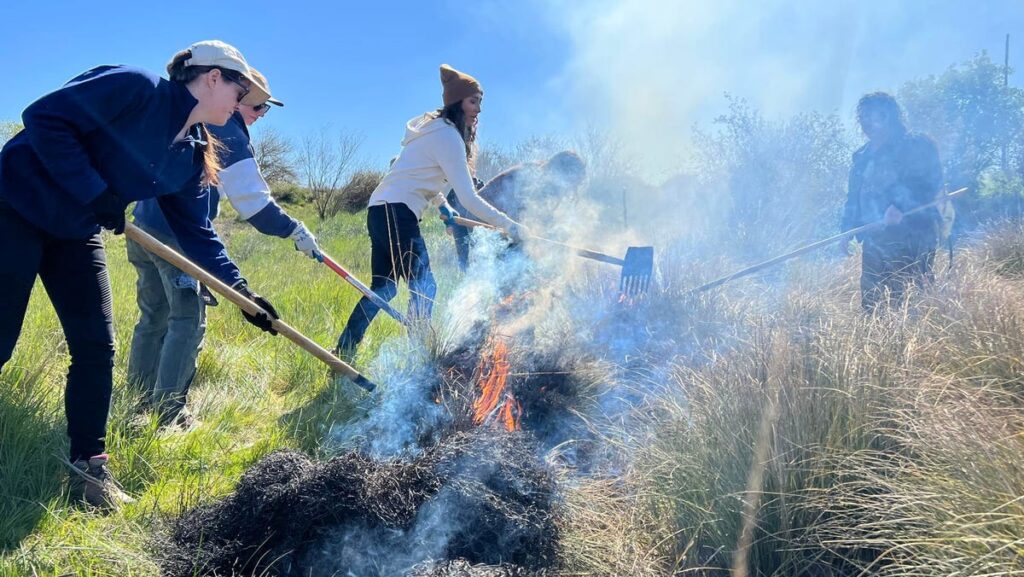
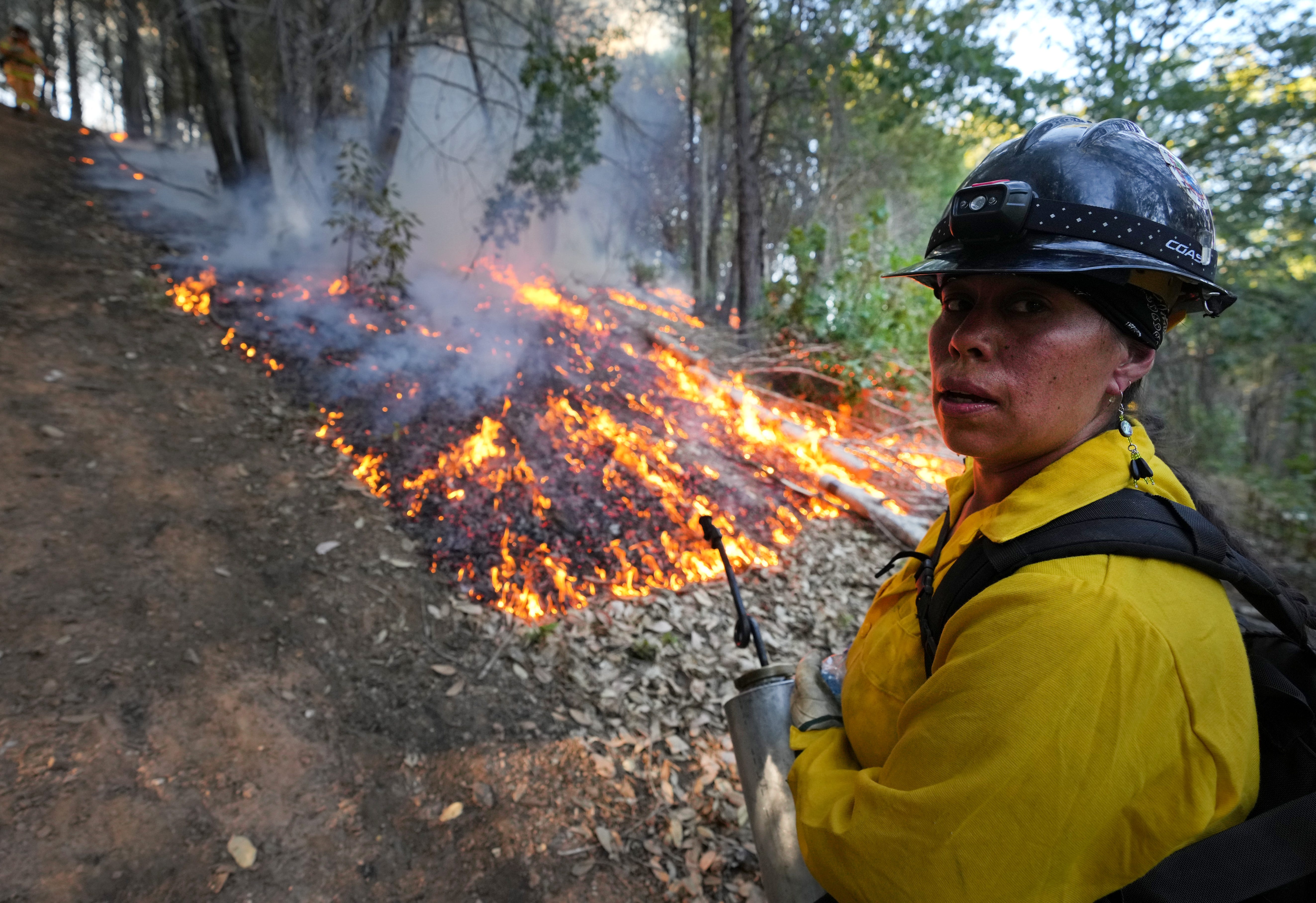

Indigenous Women participate in Fire Training Exchange in California
About 50 women from Indigenous communities converged on Karuk country to train and learn more about bringing fire back to the land.
Joe Rondone, Arizona Republic
- Prescribed burns are common tools for land managers, but researchers say Indigenous burning went beyond that, using fire as a land stewardship tool to care for the environment.
- Tree rings are revealing the extent of burning by the Western Apache, who learned to use fire based on the needs of the people and the land.
- In more recent years, fire policies have been based mostly in suppression, researchers say, which have led to bigger wildfires. Smaller, regular burning would help restore damaged ecosystems.
For those who can read them, tree rings offer a glimpse into the past. Christopher Roos is one of those people, and he’s using them to shed light on a story that reveals how Western Apache tribes have long used fire to shape their environment — insights that offer a strategy for fire management practices today.
“The Apache record is really amazing,” said Roos, who has a Ph.D. In anthropology and is an environmental archaeologist and professor of anthropology at Southern Methodist University in Texas.
The burn scars evident on the spiraling rings of ponderosa pines and conifers in Arizona forests show an approach that fundamentally altered the landscape: The way the Western Apache burned significantly reduced the effect drought and other climatic factors had on fire activity.
“They disconnected the whole machine of climate driving fire,” he said.
Looking at tree ring records dating back to the 1600s, Roos partnered with researchers in Kansas and California to study how the Western Apache used small and frequent fires to clear foliage on the forest floor and mitigate large-scale wildfires.
Fire has always played a role in forests. It recycles nutrients, promotes plant growth and supports habitats, according to Peter Fulé, a professor in the department of forestry at Northern Arizona University.
Prescribed fire, as we think of it now, is part of that system — but fire as a tool for stewardship goes beyond that. Indigenous tribes have long used fire to care for the land through cultural burnings, but in the 1800s, that practice was banned by restrictive and discriminatory laws in places like California. Now, fire researchers, managers and practitioners are looking to it for answers.
“Indigenous fire stewardship is a bridge between history and the present. It’s both an ancient practice and a viable, current wildfire mitigation tool,” said Melinda Adams, Ph.D, a San Carlos Apache fire scientist at the University of Kansas and author on the study.
An approach like the Western Apache’s is one that is increasingly important now, as climate change spurs warmer and drier conditions that make for more active wildfire seasons. Small and fragmented burns, what Roos calls a mosaic of fire, could be more effective at diminishing risk and buffering the effects of climate than bigger, cohesive prescribed burns. But the research also echoes what Indigenous communities have known for centuries — that fire management isn’t just about avoiding disaster, it’s about cultivating the land.
Where there’s thunder there’s lightning, and fire, and people starting fires
Climate-fueled wildfires in Arizona aren’t uncommon. Drought and lightning pose significant risk and always have. Fires in the central and eastern regions of Arizona were so frequent, Roos said, that it’s difficult to pinpoint on tree rings exactly which fires were started by people and which weren’t.
“The most troubling part about that to me was the idea that if you wouldn’t be able to see it, it probably didn’t matter,” he said. “I didn’t agree with that second statement.”
If it was impossible to tell the difference between human-made fire and climate-made fire, then the team would approach the problem in a new way — by looking at the effects of historic Indigenous burnings.
“That’s where we would learn some really important things about contemporary fire management,” he said. Researchers examined 649 fire-scarred trees from unpublished fire history work done 25 years ago across the traditional Western Apache territory.
Looking at alternating variation in wide and narrow tree rings, they were able to date fire events to the year, to the growing season and sometimes even to the month. What they found was that during times when the land was used by native people most intensively, climate had very little influence on fire activity.
The Western Apache were mainly foragers and hunters, Roos said. They moved across the region with the seasons to gather food. The tree ring data shows that fires in the Apache territory during this period followed their schedule, not a schedule driven by drought or lightning.
The study builds on Roos’ previous research examining how “good fire” can be used to abate climate-fueled wildfires today.
Returning fire to the land restores health to the ecosystem
As catastrophic megafires become more common in the West, a different approach to managing fire — and a different relationship to fire — might just be what forests need.
”We live in a culture of fire suppression,” Adams said. Now, agencies, landowners and everyday people are grappling with what that means and looking to rebuild a more holistic fire culture. ”Historic public campaigns have convinced the public that all fire is bad fire.”
Think of Smokey Bear, Roos said, the furry, friendly, warning face seen across the west.
But a long history of suppression hasn’t just led to the wildfires that rage across California and other states, it also stifled native fire stewardship, and those effects can be seen far and wide.
Cultural burns, carried out by Indigenous practitioners, fulfill a myriad of needs.
“Management fires, what we think about as prescribed fires, really only have one goal–to reduce hazard,” Roos said. Cultural burns are usually conducted for positive reasons rather than removing something negative, he said.
Burning small patchworks not only helps temper the effects of climate on wildfire events, it can also foster forest diversity.
”When fire is returned to landscapes, it creates a heterogeneous ecosystem and lots of plant diversity,” Adams said. In turn, that diversity makes forests more resilient to wildfire.
Now, temperatures are increasing, summers are getting longer and rain is coming less frequently. Like the “prescription” of conditions that makes a day right for a burn, these are the ingredients that make a recipe for wildfire— and those fires are felt across the country. Smoke from major fires carries on the wind over state boundaries. That smoke contains fine particulate matter that can lodge in the lungs and create issues for people with underlying respiratory problems.
“Either way, our future is fire,” Adams said. “We have an opportunity to approach how we rebuild our relationship with fire. Suppression to stewardship. We have to change.”
A different approachto fire management
Across the state this month, fire managers with the U.S. Forest Service and the state forestry department are taking advantage of a Goldilocks-kind of “just right.” Conditions have aligned for the perfect opportunity to burn.
”We really try to utilize our time and these windows of opportunity to put some good fire on the ground and reduce the wildfire risk across this area,” said Tiffany Davila, who works as the public affairs officer at the Arizona Department of Forestry and Fire Management. They have to jump on the chance because they aren’t sure when it might come again.
Climate change is shrinking the window of time agencies are able to carry out prescribed fires. A 2023 study showed that longer, warmer summers could axe suitable days for burns by 17%, and that states in the Southwest will bear the brunt of that loss.
“There are some real constraints for federal and state agencies. Anytime they get an opportunity to burn, they want to get acres,” Roos said. “That’s most easily done in a contiguous fashion. But that’s not the geography or spatial pattern by which cultural burns happen.”
Prescribed burns like those done by state and federal agencies are beneficial, he emphasized. They protect homes and help manage fire severity, and he said, there needs to be a lot more of it. But there’s a benefit to cultural burns that the tree rings reveal — greater climate resiliency.
“Fire stewardship lend itself to being a current and adaptable practice. It’s also a prime example of how Indigenous knowledge is a science,” Adams said.
The stakes are high. “If we continue on the trajectory we’re on, we are going to lose our forests,” Roos said.
Still, he and Adams are hopeful that what the tree rings show, and what Indigenous tribes have known, could help reimagine the way we interact with fire today.
Sarah Henry covers environmental issues for The Arizona Republic and azcentral. Send tips or questions to sarah.henry@arizonarepublic.com.
Environmental coverage on azcentral.com and in The Arizona Republic is supported by a grant from the Nina Mason Pulliam Charitable Trust.
Follow The Republic environmental reporting team at environment.azcentral.com and @azcenvironment on Facebook and Instagram.