
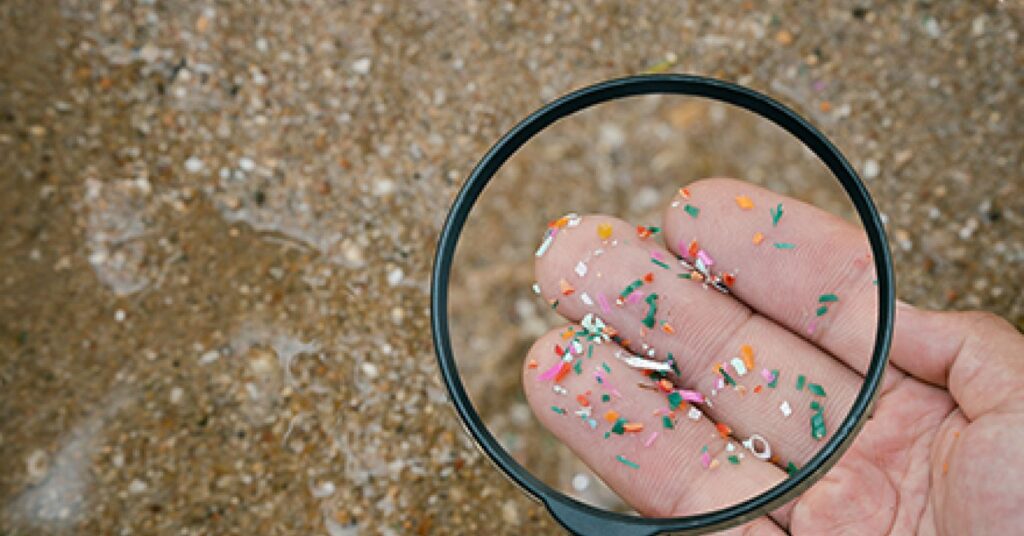
Every few weeks, a new headline appears saying that our food, water, or even our bloodstream is being contaminated with tiny plastic fragments. Virtually unheard of in popular media before 2023, the term “microplastics” now appears in major media publications regularly alongside fearsome phrases such as “billions of particles,” “plastic rain,” and “nanoplastics invading our bodies.”
While I have spent most of my career studying the dangers from invisible micro-organisms, I have been wondering: How much should I also worry about the dangers of invisible plastic particles?
What Are Microplastics and Why Do We Worry About Them?
Microplastics are small plastic pieces less than five millimeters long. They are either purposely manufactured to be small, such as in cosmetics, or they result from larger plastic items breaking down, such as how wood breaks down into sawdust.
We worry about microplastics because studies have found these particles end up inside people’s bodies and are associated with a risk of different diseases. One often-quoted study found that microplastics were found in almost 60 percent of people who had carotid artery disease, and that the presence of these particles was associated with a more than four times greater risk of a heart attack, stroke, or death within three years.
The European Food Safety Authority recently released a comprehensive review of how much we are exposed to microplastics through food, such as from plastic cups, tea bags, infant feeding bottles, and takeaway containers. The document is technical, but its conclusions helped me understand what we know and what we do not know about our daily exposure to microplastics.
What Does Research Say About the Exposure to Microplastics?
The European review confirmed that microplastics from food packaging are real. In well-designed studies, researchers have found that tiny plastic fragments develop when plastic is exposed to heat, friction, or repeated use. Twisting a bottle cap, stirring a hot beverage in a plastic cup, and microwaving leftovers in an old container can cause particles to break away from the rest of the plastic.
They found, though, that the overall mass of these breakaway particles is very small. When trying to decide whether an exposure is toxic to health, the total mass matters far more than the number of particles. Think of it like the total amount of water you drink in a day; the total amount you drink matters more than the number and size of glasses you drink from. Studies found that the total mass of microplastics exposure tends to fall in the nanogram-per-liter range, an extraordinarily low quantity. When you translate particle counts into mass, even “thousands” of microscopic fragments add up to far less than a grain of salt. And critically, when researchers use more stringent identification methods, particle numbers drop substantially compared to flashy early studies.
Some Studies Overcount the Amount of Microplastics
The European review then describes carefully and clearly why media reports about microplastics may not accurately reflect the real risk. Out of 1,711 publications reviewed over the past decade, only 7 percent (122) were valid enough to be analyzed in the review.
First, many studies could be over-counting microplastics because of contamination from dust and fibers. The air around us carries constant debris from clothing fibers, paper dust, and environmental particles. Without clean-air hoods or rigorous handling protocols, laboratories can inadvertently deposit foreign particles onto filters. When these samples are later examined under a microscope, it becomes impossible to determine which particles came from the packaging and which drifted in from the room.
Second, the methods used to identify microplastics in labs may be overcounting the amount of exposure. Popular techniques to detect microplastics rely on fluorescent dyes, but those same dyes can react with fatty acids, pigments, and other organic residues. Temperature changes can create particles that can be falsely counted as plastic.
The European review concludes by arguing that the actual release of microplastics is “much lower” than many publications report, and that current evidence is insufficient to estimate real-world exposure from food packaging. It is important to note that this review only focused on whether exposure occurs and how much occurs. It did not evaluate whether these exposure levels cause harm to human health.
Environment Essential Reads
What We Still Don’t Know About Microplastics Exposure
One of the most common phrases we use in public health is that the absence of evidence does not mean evidence of absence. That is, just because you do not have the data yet does not mean there is not a problem.
Some important questions include:
- Do microplastics cross biological barriers and impair our organs in everyday life?
- Could long-term exposure contribute to immune or metabolic changes?
- Do certain populations, such as infants and pregnant women, face a higher risk?
What You Should Do About Microplastics
Given all this, here are simple, reasonable precautions that I recommend:
- Replace scratched or worn plastic containers. Surface grooves increase abrasion and the shedding of plastic particles.
- Avoid microwaving food in plastic. Heat accelerates the breakdown of plastics.
- Use glass or stainless steel for hot beverages. Takeaway lids are more likely to shed under heat.
- Choose loose-leaf teas when possible. Some single-use tea bags contain polymer mesh that degrades under heat and agitation.
- Wash plastic gently. Abrasive scouring pads can generate small particles.
What You Should Not Do About Microplastics
Equally important is what not to do based on the quality of evidence we have about microplastics:
- Do not buy “microplastic detox” kits or supplements. There is no evidence that these help.
- Do not assume items labeled as “compostable” automatically mean no exposure to microplastics. Some biodegradable plastics can still fragment under stress.
- Do not overhaul your kitchen cabinet overnight. Based on what we know, it makes sense to gradually reduce your plastic use, rather than try to replace every plastic item in your kitchen immediately.
Environmental Risks Are Growing and Need More Research
I am excited to see more attention being paid to how our physical environment affects our health. Plastic pollution of the environment is a real and urgent problem. Microplastics are widely documented in oceans, soils, and sediments, and they accumulate in wildlife and may affect ecosystems in ways we do not yet fully understand. The European review helps us understand that we need better quality studies on microplastics to understand their risk, and that there are simple steps we can take now as a precaution, as we learn more.