
{This story was updated because an earlier version included an inaccuracy.}
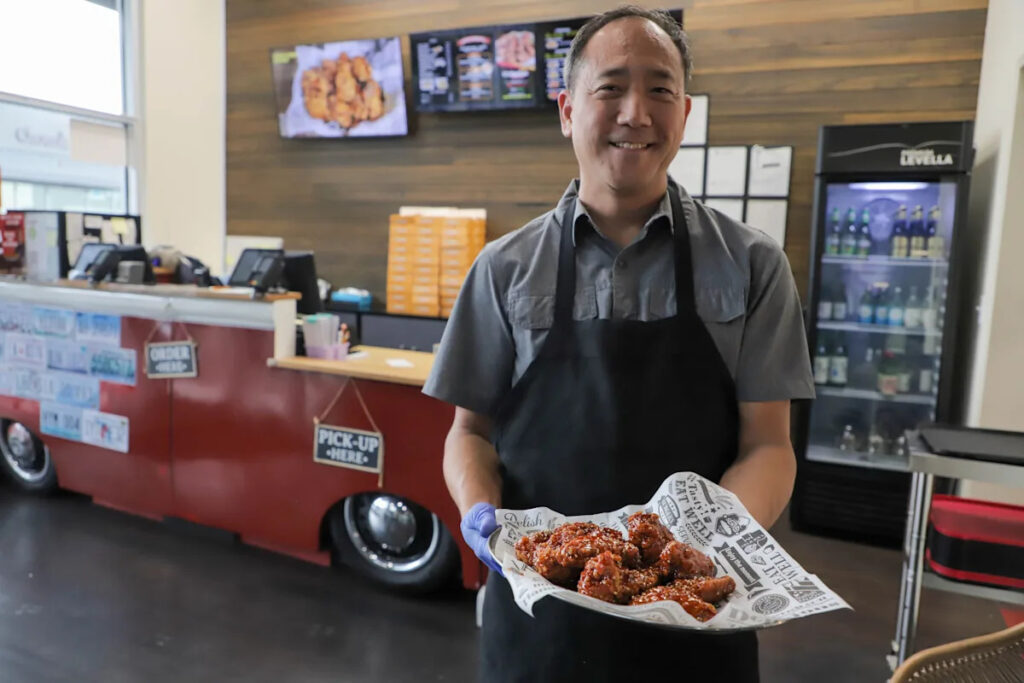
Daniel Lee prepares fried chicken the Korean way, mostly. He batters chicken thighs and drumsticks in a blend of wheat, corn starch and soy flour. The result is a lighter crust than American fried chicken. After the thighs and drumsticks are crisped, Lee brushes them with a soy-garlic, sweet chili or spicy gochujang sauce and tops them with green onions. A crunchy bite yields a sweet, salty and spicy stream that runs over fingers and wrists. Some people opt to eat with plastic gloves provided at the table.
When Lee first opened his own franchise of the national 92 Chicken chain in Pooler, Ga., this year, tables filled at least once during the week and several times on the weekends. But in September, 475 people, about 300 of whom were South Koreans, were detained and deported by Immigration and Customs Enforcement (ICE) at the Hyundai-LG plant near Savannah.
“Ever since then, it dropped dramatically,” Lee said. “It’s not recovering at all.”
Once Lee crunched his numbers, he found business declined by at least 20 percent. While it might not sound like much, the strain means incoming competition could put him out of business, he said. And it’s something that not just his restaurant is seeing. More than a dozen Korean businesses around Pooler have popped up since the Korean-based Hyundai plants arrived in Bryan and Effingham counties―many of which relied on a Korean clientele.
Hyundai fuels immigration
Lee is Korean-American. He was born in Philadelphia, and after spending stints in Korea as a child, attended the University of Pittsburgh before working at the Hyundai Motor Manufacturing plant in Montgomery, Ala. for over 13 years in various roles as a specialist, assistant manager and engineer.
Then in October 2022, Hyundai Motor Group Metaplant America (HMGMA) broke ground in Ellabell as the company’s first dedicated mass-production Electrified Vehicle (EV) plant, with the first cars rolling off the assembly line in October 2024. The more than $8 billion dollar investment is expected to produce 500,000 vehicles per year, generate 8,500 jobs, and not only alter the economic fabric of Savannah, but also the entire region.
Lee sought a new challenge in Ellabell, and wasn’t the only Korean or Korean-American to do so. Other experienced workers taught new employees Hyundai’s proprietary building and operating technologies, and how to work more efficiently. South Koreans had also come over to Alabama 20 years ago when the plant opened in a similar fashion, he said.
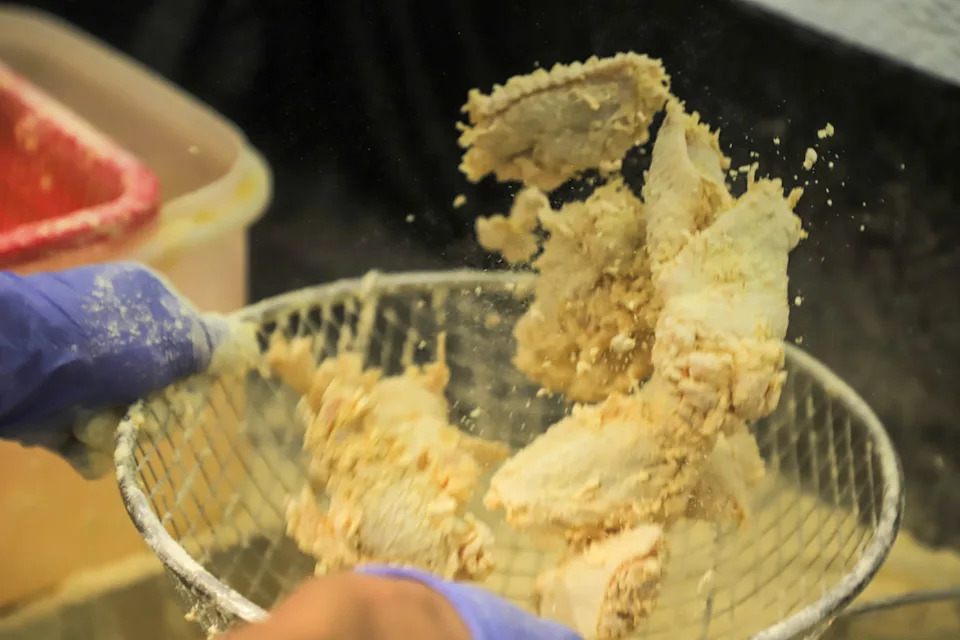
Daniel Lee, owner 92 Chicken, flips chicken wings as he tosses them in the breading before deep frying them on Tuesday, October 7, 2025 at his restaurant in Pooler Ga..
As Korean and Korean-Americans came to the area though, more and more restaurants and services began to crop up around them, particularly in Pooler.
Owner of Big Bon Bodega in Savannah and Pooler and 34-year resident of Savannah, Kay Heritage said there had always been a bit of a Korean population in the area—mostly because of Korean partners with military spouses at Fort Stewart and Hunter Army Airfield.
“There are actually four [Korean] churches in this area, two in Pooler, two in Savannah,” Heritage said. “A lot of military spouses attended there, but now it’s a lot of Hyundai families, but the churches were all established before 2023.”
Heritage remembered a time when there was only one Korean restaurant in Pooler, Bewon Korean BBQ, which opened in 2019-2020. When Lee moved there in 2023, only Zip Bob had been added.
Now, there are about seven, with MooBongRi Korean Restaurant on the way. Not only did new restaurants blossom with the arrival of South Koreans to the region, but so did other services like estheticians, physical therapists, grocers and realtors.
‘I don’t think anybody would come back after that’
But all the traffic coming to these new ventures came to a halt in September.
On the nearly 3,000 acres where the plant sits is also HL-GA Battery Company, a partnership between Hyundai and LG Energy Solutions, slated to open at the end of this year or early 2026 to produce Hyundai Ioniq 5 or Ioniq 9 EV SUV batteries. It was still under construction when nearly 500 South Koreans were detained by ICE on Thursday, Sept. 4, in a raid the Department of Homeland Security called its largest single-site operation in history.
But it seemed like ICE was mistaken.
In a copy of a warrant obtained in previous reporting by the Savannah Morning News, ICE’s original targeting of four Hispanic people, assisted by 400 state and federal officers, led to an unintended sweep of 300 South Koreans, many of whom carried business travel B-1 visas, according to Reuters.
While President Donald Trump offered to allow detainees to stay in the United States after the raid, only one did—and that individual ended up leaving anyway. Although the trip was planned prior to the raid, Gov. Brian Kemp travelled to South Korea in October, aiming to strengthen the relationship between Georgia and the country.
Still, Lee is skeptical these amends will do much to bring Koreans back.
“I don’t think I’ll see them ever because I don’t think anybody would come back after that,” Lee said.
When the raid happened, 92 Chicken was just starting to reach its peak in August.
“I thought America was like my mother country, and Korea was like my father country,” Lee said. “So, it’s like my parents are fighting.”
And it’s not just 92 Chicken’s customers thinning out.
At Zip Bob, one of the only restaurants that had been open from the start of the influx of South Korean immigration, a Saturday afternoon was nearly empty save for two tables. An employee there said they felt like the clientele has been halved since the raid.
Heritage said Koreans were different from Americans—they didn’t usually gather in homes, but went out to restaurants to connect and for community. So, at most of these restaurants, everyone had become repeat customers, relationships were built between staff and patrons.
The dip was more than loss of revenue. The employee at Zip Bob, who spoke with each group that came in that Saturday, said she had seen the repeat customers as friends.
A fusion of flavors
The change doesn’t mean Korean businesses will roll over. In fact, Koreans have been adapting for quite some time.
When Heritage began Big Bon Bodega as a food truck in 2016, she introduced Korean food with flavors the locale was already familiar with. She created a Korean kimchi pizza, topping the fermented chili cabbage on top of fresh mozzarella cheese.
The kimchi adds “a whole other dimension,” said Heritage. And people were willing to try. “It’s not as popular as pepperoni or meat one, but it was definitely top three.”
When she opened up a storefront a few years later, she developed a kimchi-flavored cream cheese and bulgogi sandwich.
Similar to Heritage, Lee is taking the hit as a challenge with menu changes that might appeal to a broader customer base.
“I have to improve,” said Lee. “I gotta diversify my menus.”
Lee also plans update to his own menu by mingling American and Korean flavors. He’ll turn up the sweetness and add more variety, he said.
“Local people like it more, a little more saltier, and a little more sweeter,” Lee said. “We’re gonna have to make things a little less spicy on the menu.” What that will look like will soon be revealed, he added.
As for what he feels about losing much of his former customer base, “It’s hard to say that [I felt] anger or anything,” Lee said. “I can’t do anything [about] the decision makers.”
Destini Ambus is the general assignment reporter for the Savannah Morning News, covering the municipalities, and community and cultural programs. You can reach her at DAmbus@gannett.com. Jillian Magtoto covers climate change and the environment in coastal Georgia. You can reach her at jmagtoto@gannett.com.
This article originally appeared on Savannah Morning News: Korean restaurants get creative to fill tables after Hyundai raid