
Europe’s largest 3D printed housing project has completed its 3D printing phase in Holstebro, Denmark, where 36 student apartments are being built using large-scale 3D printing.
Named Skovsporet, the development was built by 3DCP Group for Danish non-profit housing association NordVestBo. Located near VIA University College’s Holstebro campus, the project forms a small student community surrounded by landscaped courtyards and paths.
Each containing six apartments, the six buildings together cover a total printed area of 1,654 m². Individual apartments measure between 40 m² and 50 m² and include a kitchen, bathroom, study area and sleeping space.
Mikkel Brich, Co-Founder of 3DCP Group, said, “Skovsporet proved that 3D construction printing can meet the strict requirements of subsidized housing while delivering high precision and productivity. As we deepened our understanding of the technology, we increased productivity from one building to the next, and are confident we can build even faster in future projects.”
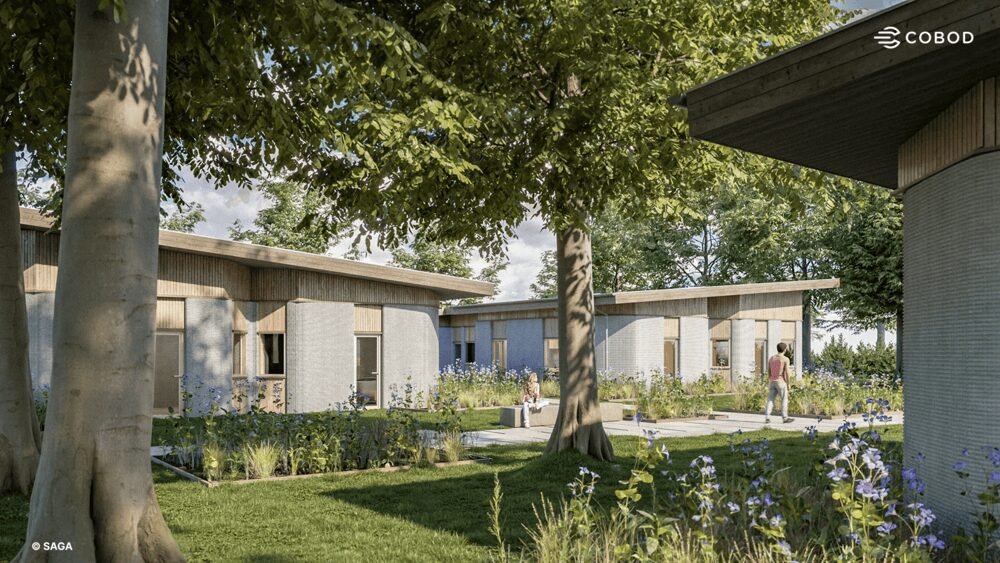 A render of the completed Skovsporet (the forest trail) in Holstebro, Denmark Image via COBOD.
3D printing streamlines student housing project
Construction was carried out on site with a BOD3 3D printer developed by Danish company COBOD, the firm’s third-generation system designed to improve speed and efficiency in large-scale, low-rise projects. The printer uses an extendable ground-based track that enables continuous printing along the Y-axis, allowing several buildings to be produced in sequence without repositioning.
It features an Advanced Hose Management System for steady concrete flow, a unified control and monitoring stand, and a Universal X-Carriage that can support future tools for insulation and finishing.
A three-person crew operated the 3D printer throughout the build, gradually shortening production times. The first block of apartments took several weeks to print, while the final one was completed within five days. The printer’s guided track system kept the process steady and accurate, producing consistent wall sections suitable for residential use.
Each of the six buildings combines printed concrete walls with timber structures and was designed by SAGA Architects. The apartments feature slanted ceilings and large roof windows that bring in natural light, and the buildings are arranged around shared courtyards to encourage a sense of community while maintaining individual living space for residents.
The project used a concrete mix containing FUTURECEM, a low-carbon cement produced by Aalborg Portland. The printing method placed material only where it was needed for structural purposes, reducing waste compared with conventional construction. The site plan was also designed to preserve about 95% of the existing trees.
Henrik Lund-Nielsen, Founder and General Manager of COBOD International, added, “The results at Skovsporet show how 3D construction printing can deliver large-scale projects faster and more efficiently than ever before.”
Having now finished the 3D printing phase, Skovsporet is moving on to interior construction that will provide affordable student apartments when complete.
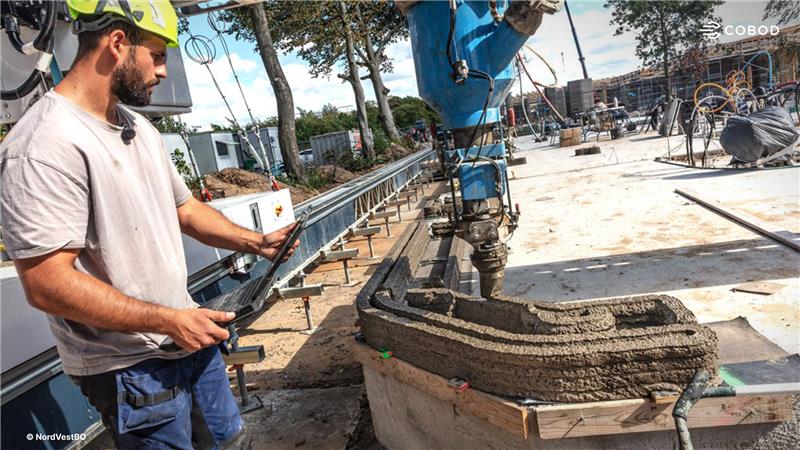 The BOD3’s ground-based track system allows uninterrupted printing for a long wall sections. Image via COBOD.
3D printing expands role in housing
The growing use of construction 3D printing is cutting costs and build times by reducing labor and material waste while improving design flexibility, energy efficiency, and accessibility across different housing types.
In August, the University of Windsor (UWindsor) received CA$2 million in federal funding to build a net zero student residence using 3D printing technology. Planned for California Avenue and set to open next summer, the project is part of a CA$12 million national initiative supporting new approaches to construction and housing affordability.
It also introduced a training program for 60 participants to gain practical experience in 3D printing and automation, supported by a public website to share progress and insights. Funding came through the Regional Homebuilding Innovation Initiative, which promotes novel building methods across Canada.
Elsewhere, Texas-based construction 3D printing company ICON released three one-bedroom homes for sale in Austin’s Mueller community as part of the Mueller Affordable Homes Program. Each 650–651 sq. ft. unit was built with ICON’s CarbonX material to enhance thermal insulation and energy efficiency.
Designed by Michael Hsu Office of Architecture and developed with Catellus, the homes feature open-plan ground floors with private upper-level bedrooms. Priced from $195,000, they form part of a broader development adding two- and three-bedroom 3D printed houses to Mueller’s 700-acre master-planned neighborhood.
Help choose the 2025 3D Printing Industry Awards winners – sign up for the Expert Committee now!
To stay up to date with the latest 3D printing news, don’t forget to subscribe to the 3D Printing Industry newsletter or follow us on LinkedIn.
While you’re here, why not subscribe to our Youtube channel? Featuring discussion, debriefs, video shorts, and webinar replays.
Featured image shows a render of the completed Skovsporet (the forest trail) in Holstebro, Denmark Image via COBOD.