Detection of organic compounds in freshly ejected ice grains from Enceladus’s ocean
https://www.nature.com/articles/s41550-025-02655-y

Detection of organic compounds in freshly ejected ice grains from Enceladus’s ocean
https://www.nature.com/articles/s41550-025-02655-y
2 Comments
The complete article is available.
A portion of the abstract:
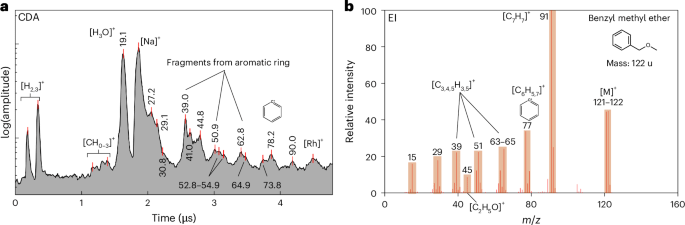
> Here we present a comprehensive chemical analysis of organic-bearing ice grains sampled directly from the plume during a Cassini fly-by of Enceladus (E5) at an encounter speed of nearly 18 km s−1. We again detect aryl and oxygen moieties in these fresh ice grains, as previously identified in older E-ring grains. Furthermore, the unprecedented high encounter speed revealed previously unobserved molecular fragments in Cosmic Dust Analyzer spectra, allowing the identification of aliphatic, (hetero)cyclic ester/alkenes, ethers/ethyl and, tentatively, N- and O-bearing compounds. These freshly ejected species are derived from the Enceladus subsurface, hinting at a hydrothermal origin
A few things I didn’t appreciate about Cassini until reading this article.
1. This study uses data from 2008.
2. The ice grains were freshly ejected from Enceladus, providing a clearer view of subsurface chemistry than other fly-bys that analyzed ice that had been in space much, much longer.
3. At 17.7 km/s, the spacecraft’s impact velocity was 100–1000× higher than in typical lab mass spectrometers, producing plasma-like fragmentation instead of intact molecular ions.
Several missions are proposed for exploring Enceladus but none are funded.