
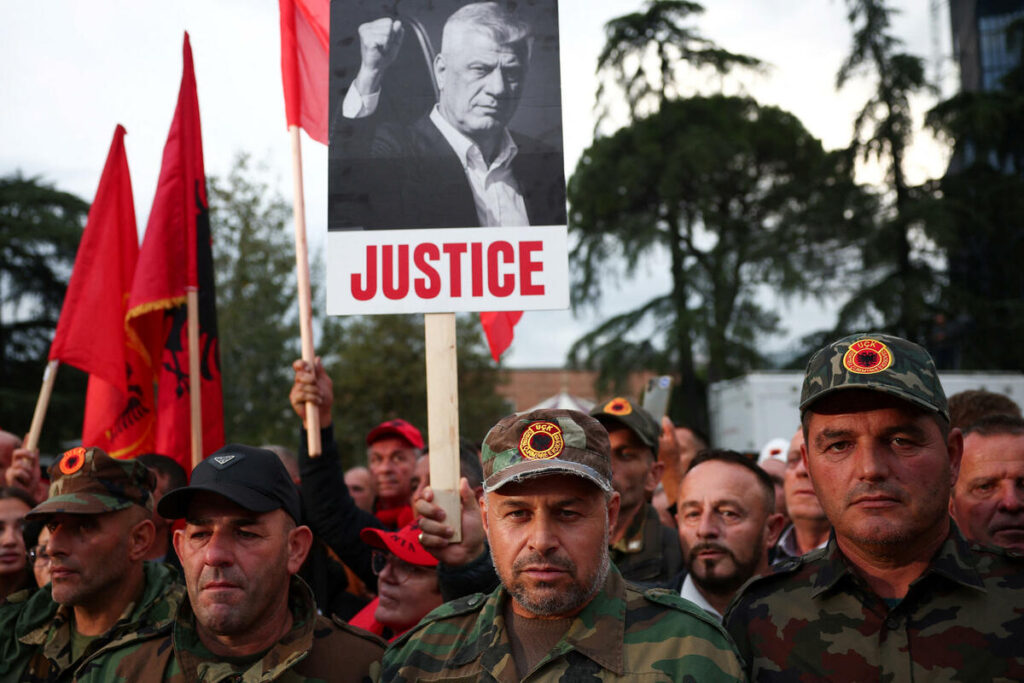
Testifying in defense of former KLA leader Hashim Thaci, accused of war crimes in Kosovo and Albania in 1998-99, then-US envoy to Kosovo Christopher Hill claimed today before the Hague tribunal that Thaci was not a military commander of the KLA in the fall of 1998, nor did he control the Albanian paramilitary.
At that time, according to Hill, the KLA was neither an organized army nor did it have a headquarters.
The American diplomat thereby confirmed the main theses of Thaci’s defense.
Hill testified that during his first meeting with Thaci in Kosovo, in November 1998, he did not get the impression that Thaci was a military commander, nor that he had control over the KLA.
“He spoke quietly and thoughtfully, more like someone from a university than from the military… There was no basis to conclude that Thaci controlled the KLA, he was the leader of a three-man delegation, not a large organization,” Hill said.
While being questioned by Thaci’s defense attorney, Luka Misetic, the retired American diplomat also said that no one had ever told him that Thaci was “involved in torture and human rights violations,” except that the then Serbian President Slobodan Milosevic described Thaci in a conversation as a “fierce warrior” who had allegedly personally killed many people.
According to Hill’s testimony, Thaci “was not that kind of person, he was not a fierce warrior, but a political figure.”
Asked if he had discussed allegations that the KLA was kidnapping, detaining and torturing people with Thaci, Hill said no, explaining that he was then focused on the US plan to restore Kosovo’s autonomy.
The witness, however, mentioned that there was discussion about the kidnapping of ten Serbian workers from the Belaćevac coal mine, who were abducted by the KLA in the summer of 1998 and who, according to the indictment against Thaci, were never seen alive again.
Hill also said that at the time he “did not believe that there was a KLA headquarters,” assessing that the KLA did not even have a vertically organized command structure, although his Albanian interlocutors at the time tried to portray the KLA as a real army.
According to Hill, the KLA wanted to fight for Kosovo’s independence and “hoped that the US would help it do so,” even though Washington’s goal at the time was to restore Kosovo’s autonomy.
In his meeting with Hill, Thaci, according to his recollection, spoke badly about the then leader of the Kosovo Albanians, Ibrahim Rugova.
“They didn’t want Rugova to speak on behalf of Kosovo and they wanted to get rid of him,” Hill said.
According to the indictment, the KLA’s targets included, in addition to Serbs and Roma, Rugova’s supporters, whom the KLA declared “collaborators”.
Hill indicated that he was “frustrated” that, despite his efforts, he could not find a person with the authority to speak on behalf of the KLA in negotiations with the Serbian authorities, which the US intended to facilitate with the aim of achieving a “political solution (…) by restoring Kosovo’s autonomy and establishing Kosovo’s self-government” that would be “much broader than that under the 1974 Constitution of the SFRY.”
“Our operational conclusion is that such a leadership (of the KLA) did not exist, that there were only local groups,” the witness said.
Hill attributed the first meeting between American diplomat Richard Holbrooke and a uniformed KLA member in the village of Junik, in the summer of 1998, which he himself attended, to “coincidence.”
He stated that the significance of that meeting had been “significantly exaggerated”, describing that Holbrooke and he were actually visiting the villagers of Junik when a soldier in a KLA uniform with a “thick beard” entered the room.
“Holbrooke said, ‘Here’s Che Guevara.’ The soldier made room next to Holbrooke and sat down, it looked like he was sitting on Holbrooke’s lap. A picture was taken, which went around the world as Holbrooke’s first contact with the KLA. We concluded that this man could not in any way represent the KLA,” Hill described.
Not even the “political declaration of the KLA General Staff” in August 1998, which authorized Thaci, Jakup Krasniqi and others to negotiate on behalf of the KLA, convinced Hill, as he himself put it, to “accept that they could speak on behalf of the KLA.”
Hill also suggested that Thaci was not the decisive leader of the Kosovo Albanians at the Rambouillet negotiations in early 1999 because he had to seek the approval of local KLA commanders and Adem Demaći to accept the agreement.
When the Albanians accepted the agreement and the Serbian delegation did not, “violence increased in Kosovo and we knew that this would probably lead to NATO intervention,” Hill said.
Hill, who is the fifth witness for Thaci’s defense, will continue his testimony tomorrow.
Along with Thaci, Kadri Veselji, Rexhep Selimi and Jakup Krasniqi are also accused of crimes against Albanians, whom the KLA declared “collaborators”, Serbs and Roma in more than 40 detention centers in Kosovo and Albania.
In addition to Thaci, only Krasniqi will present defense evidence, while Veselji and Seljimi will not defend themselves against the charges, as they assessed that the prosecutors had not proven their guilt.
The indictment charges Thaci (56), Veselji (57), Selimi (53) and Krasniqi (74) with persecution on political and ethnic grounds, imprisonment, unlawful arrest and detention, other inhumane acts, cruel treatment, enforced disappearance, torture (two counts) and murder (two counts).
KLA members committed crimes against approximately 407 detainees, of whom at least 102 were killed, from March 1998 to September 1999, the indictment states.
The indictment identified 75 victims, 51 Serbs, 23 Albanians and one Roma.
Six counts of the indictment charge Thaci, Veselji, Selimi and Krasniqi with crimes against humanity, and four counts of war crimes.
According to the indictment, Tača, Veselja, Seljima and Krasnić were participants in a joint criminal enterprise.
The goal of this criminal enterprise was to take control of all of Kosovo through violence against all those whom the KLA considered opponents.
KLA officers Azem Sulja, Ljah Brahimaj, Fatmir Ljimaj, Sulejman Seljimi, Rustem Mustafa, Shukri Buja, Ljatif Gashi and Sabit Geci are also listed as accomplices in the criminal association.
All defendants pleaded not guilty.
They have been in custody in The Hague since their arrest in Kosovo in November 2020.
The trial of Thaci and the co-accused began before the court in The Hague on April 3, 2023, and the prosecutors finished their evidentiary proceedings on April 15 of this year.
125 prosecution witnesses testified in the Hague courtroom, and the prosecutors introduced the statements of dozens of other witnesses as evidence in written form.
The prosecution’s evidence includes 3.000 documents in Albanian, Serbian and English.
More than 150 victims are also participating in the process, who, according to court rules, are entitled to compensation if the defendants are found guilty at the end of the process.
The Kosovo Specialized Chambers, as the court is officially called, were established in 2015 by the Kosovo Assembly under international pressure caused by the report by Council of Europe rapporteur Dick Marty on KLA crimes in Kosovo and Albania, which was published in 2011.
The court is formally part of the Kosovo judicial system, but operates in The Hague.
In its judgments and other documents, the court found that there was a “persistent climate of intimidation and harassment of witnesses” against accused members of the former KLA in Kosovo.

News