
From the October 2025 Issue
In a competitive environment, manufacturers have focused their efforts on how to retain clients for multiple generations. Through competitive pricing and consistent innovation, manufacturers have churned out products after products for their customer bases, hoping that once their product reaches the end of its lifecycle, the client would return to replace it.
“We’ve sort of grown up under this premise that we’re going to use a product, and then we’re going to get rid of it,” says Mark Buckley, Founder of One Boat Collaborative and a board member of the REMADE Institute. “The planet can’t afford that anymore.”
Buckley notes that many businesses for durable goods have built their businesses on the fact that there’s a certain planned obsolescence. However, in an era of increased awareness about our environmental footprint and the return of the “making do with what you have” mentality, more manufacturers recognize the potential of taking a circular approach to products and the product lifecycle.
“What’s interesting is that companies and organizations starting to embrace circular systems are actually finding ways to keep retail customers for longer periods of time,” says Buckley.
Many industries are embracing, and have been implementing, circular economy principles over the years. Buckley shares a few examples, including how GE Healthcare is remanufacturing imaging units for healthcare MRI machines or Philips Lighting is helping to retrofit buildings that in turn will pay for the lumens used per hour. Other companies, like John Deere and Caterpillar, have collected their used equipment from customers for remanufacturing purposes.
There is a delicate balance to maintain when it comes to reusing product materials and remanufacturing, because creating a high-quality product will always be the first priority. “You didn’t want to sacrifice quality,” adds Buckley. “You want to make sure quality is maintained.”
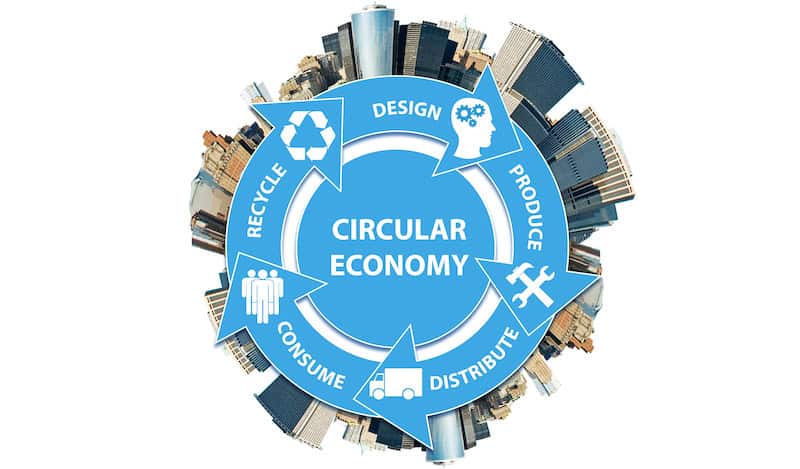 (Credit: Adobe Stock / Elnur)
The Potential For Product-As-A-Service Models
Now, imagine going into a car dealership: one of the first questions you may be asked is about whether you’d like to buy or lease a car. Depending on circumstances and who you ask, this answer can vary greatly. But, looking at the future of the circular economy and the potential for organizations to pay for access to a service, there are many sustainable benefits to using a product or service until it’s at the end of its useful life for your purposes.
From streaming services to clothing subscriptions, the prospect of a product-as-a-service is becoming more prevalent within society. There’s a need for a product or service only for a given time, and this model allows people to get rid of what no longer serves them, without the hassle of figuring out what to do with the product next. Buckley notes that when manufacturers are creating products that can be used as a service, they have a vested interest in ensuring products are durable and capable of lasting for a long time—reducing the need for “planned obsolescence.”
For instance, Davies Office provides a product-as-a-service option for clients who are looking for high-quality, durable remanufactured furniture. The client pays in to use the product for a given time, but they’re not locked in to owning the asset, having to figure out what to do with the furniture if the company moves locations or is looking to refresh the space. Since its inception, Davies Office has focused on remanufacturing products for customers, transforming older furniture into new creative and high-quality products.
From Buckley’s perspective, when he was working as the Director of Sustainability for Staples, he saw an opportunity to enter into a third-party agreement for a solar array for their buildings. With thousands of locations and a desire to not to spend capital on the solar array, the company decided to sign a contract for the energy the solar array produced instead. This gave Staples the ability to use the product that the solar array was using, without putting its own capital into it. If the company decided to end a lease within the next five-to-10 years, it could move on without worrying about being responsible for the solar arrays.
“Whether we paid the utility or we paid the third party that owned the solar array, we were going to use the electricity,” says Buckley.
As concerns about the tariffs rise, embracing the circular economy is one way to increase supply chain resilience, along with U.S. economic growth and job creation.
For facility executives interested in learning more about the transition into the circular economy, the REMADE Consortium, which consists of more than 150 manufacturers, universities, trade organizations and natural labs, is working on large-scale initiatives in circular design, full EV use and remanufacturing, plastics and textile recycling, among others.
Do you have a comment? Share your thoughts by sending an e-mail to the Editor at [email protected].
Read all about the circular economy and facility management on Facility Executive.