
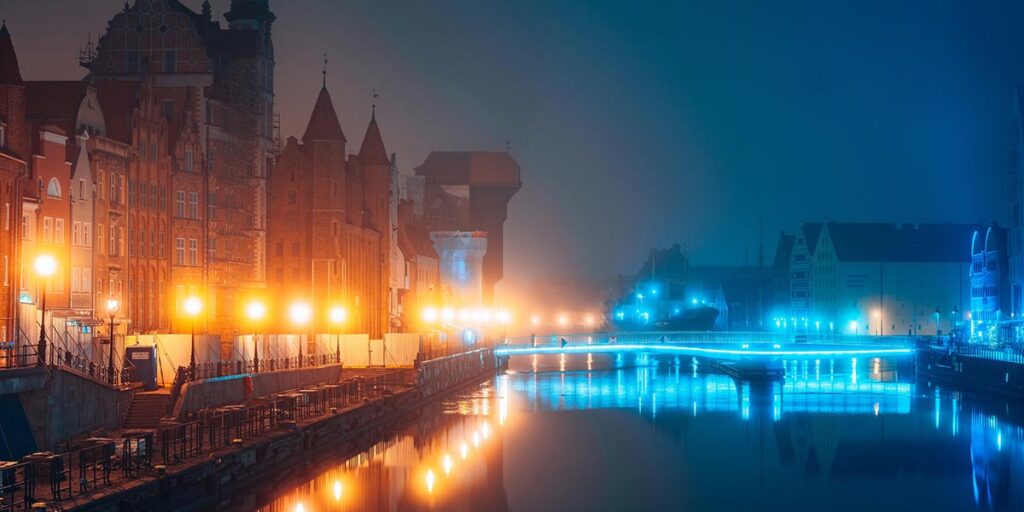
A city of 490,000 inhabitants that played a leading role in important events
Founded in 930, Gdańsk is the most important commercial port on the Baltic Sea and one of the most beautiful cities in Poland.
The monument commemorating the heroes of the Warsaw Uprising of 1944
The Chapel of Saint Kinga of Wieliczka: a spectacular underground church in Poland
With nearly 490,000 inhabitants, it is the sixth most populated city in the country. It is located on the estuary of the Vistula River (called Martwa Wisła or Dead Vistula) and has two canals: the Port Canal and the Kashubia Canal.

Gdańsk belonged to the Kingdom of Poland between the 10th and 14th centuries, then came under the dominion of the Teutonic Order until the middle of the 15th century, when it became part of Poland again, until in 1793, with the partition of the country, it came under the Kingdom of Prussia, receiving the German name of Danzig, which became a free city under the protection of the League of Nations between 1920 and 1939, although Poland maintained a post office and a military arsenal on the Westerplatte peninsula.

It was in this city that World War II began on September 1, 1939, when German Schleswig-Holstein fired its cannons at the Polish fortress of Westerplatte. During the war, the city was annexed to the German territory of West Prussia. In 1945 the city became part of Poland again.

90% of the city’s historic center was destroyed during World War II. After the war, extensive reconstruction resulted in the city we see today. During the communist dictatorship, Gdańsk was the epicenter of many pro-freedom protests. It was in this city that the Catholic trade union Solidarity was founded in 1980, an organization that played a pivotal role in the fall of communism in Poland.

In 2019, Gdańsk received the Princess of Asturias Award for Harmony. Its importance as a commercial port is evidenced by the fact that this city is home to 29 foreign consulates (5 of them consulates general and 24 honorary consulates, including one from Spain).

Thanks to its proximity to the sea, Gdańsk has milder winters than other Polish cities, although its canals do freeze over and snow is not uncommon, something unusual in other European port cities. Today it has a reputation as a pleasant city to live in, or at least that’s what some people have told me.

If you want to see what this city is like at this time of year but you’re far away, almost a year ago MyGemPictures published a beautiful video showing aerial images of Gdańsk in winter, mostly taken during the day:
Four years ago, Poland On Air published this beautiful video showing Gdańsk at night, also with aerial footage:
—
Main photo: Egor Komarov.