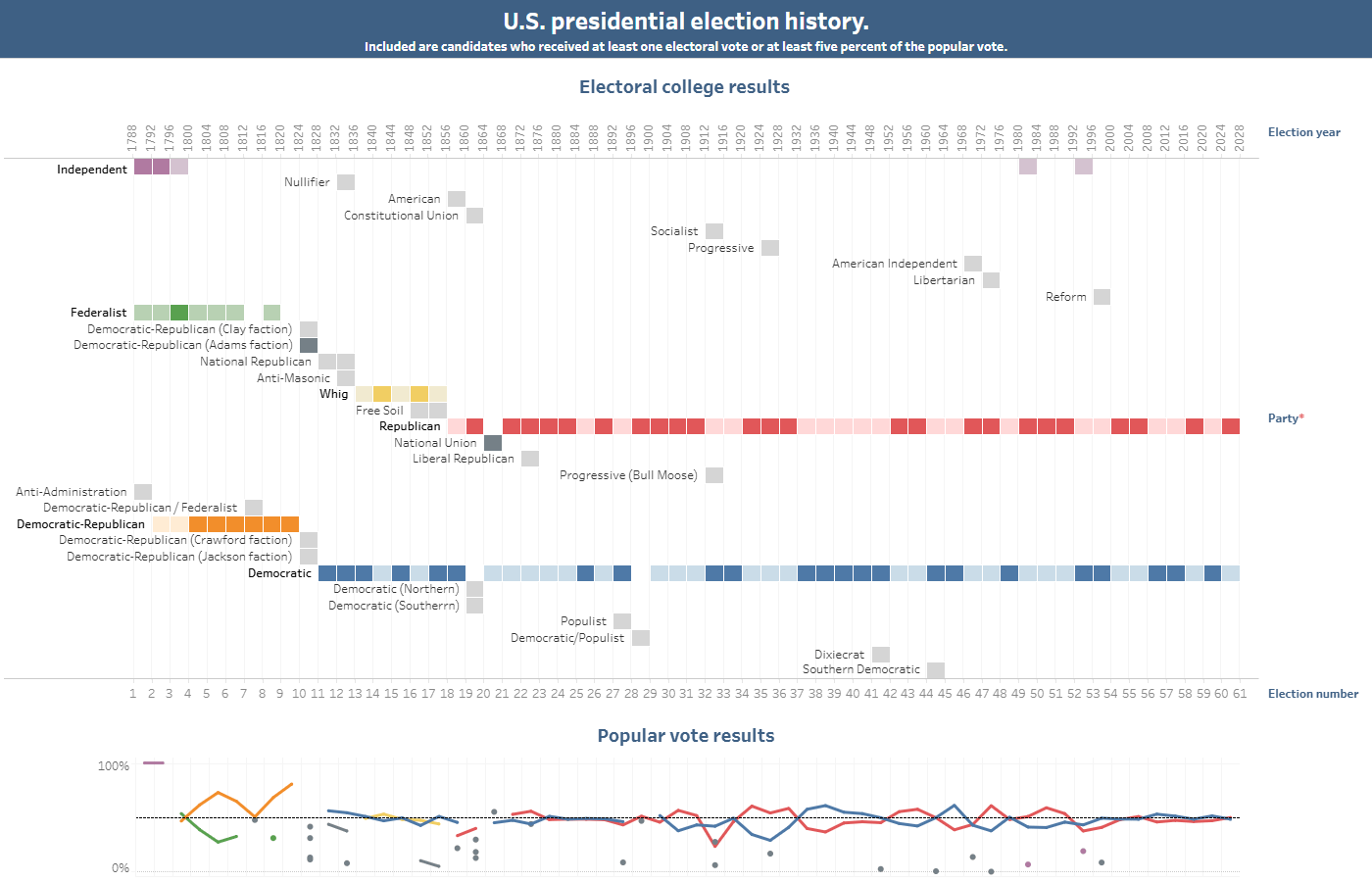
Interactive Tableau visualization of Wikipedia article "United States presidential election" (table "Electoral college results"): link.
Posted by Half-Man-Half-Potato

![[OC] United States presidential election history](https://www.byteseu.com/wp-content/uploads/2025/11/lj9g2pckxm0g1-1024x658.png "[OC] United States presidential election history")
Interactive Tableau visualization of Wikipedia article "United States presidential election" (table "Electoral college results"): link.
Posted by Half-Man-Half-Potato
9 Comments
[OC] Re-upload (updated).
**Interactive Tableau version:** [https://public.tableau.com/app/profile/yury.ulasenka/viz/PoliticalpartiesintheU_S_presidentialelectionhistory/Politicalparties](https://public.tableau.com/app/profile/yury.ulasenka/viz/PoliticalpartiesintheU_S_presidentialelectionhistory/Politicalparties)
Made in: Tableau + MS Excel
Main data source: [https://en.wikipedia.org/wiki/United_States_presidential_election#Electoral_college_results](https://en.wikipedia.org/wiki/United_States_presidential_election#Electoral_college_results)
Data file: [https://github.com/half-man-half-potato/US-election-history/blob/main/parties.xlsx](https://github.com/half-man-half-potato/US-election-history/blob/main/parties.xlsx)
The parties had a platform switch and this kinda fails to account for that. Not sure how to account for the platform switch, though. This is really satisfying to look at!
That’s a great chart. Easy to understand and gives a lot of information. Well done!
That tightening is almost certainly an effect of the information age. Candidates don’t generally run losing elections anymore. If a candidate stunk historically you didn’t have much choice but to run them. Now you can see in real time what people think about candidates, Biden would have never dropped out 40 years ago after his political career died on stage at a debate, they would have ran him into the ground without modern polling.
Look how tight it has been since 1996.
I see you Eugene Debs. 6% of the popular vote in 1912 (socialist party), the following election had 3.2% of the popular vote FROM A PRISON CELL.
Independents got some electoral votes in 2016
Its really cool to see Ross Perot on there twice. Once as an independent and then again as part of the Reform party.
does the y axis on the upper part mean anything? like why is progressive bull moose between the two paries, and progressive is way above?