
The United States and two prominent trading partners are reportedly steps away from closing on trade deals that would bring down President Donald Trump’s steep tariffs significantly.
Trump told reporters at the Oval Office on Tuesday that he was amenable to working on a new agreement with Switzerland, which he called “a very good ally.” The country’s imports into the U.S., from jewelry to chocolate, watches, pharmaceuticals and electronics currently face 39 percent tariffs.
“I haven’t set any number, but we’re going to be working on something to help Switzerland,” Trump said, acknowledging that the nation’s imports were hit “very hard” with some of the highest double-digit duties in his “reciprocal” tariff regime.
Various media outlets have reported that the tariffs could come down to as little as 15 percent—the same rate that was imposed on the European Union. According to a report from Bloomberg, the framework could take shape within weeks.
Swiss officials were circumspect, with a spokesperson at the country’s economy ministry opting not to offer up details about “ongoing discussions.” However, he said that Swiss Economy Minister Guy Parmelin has been in “regular contact” with U.S. Trade Representative Ambassador Jamieson Greer and other relevant American trade authorities.
Swiss leaders were taken aback when, in late July, Trump announced that the country would be slapped with some of the highest duties in the world. The president justified the move by pointing to the trade imbalance between the U.S. and Switzerland, which exports about $38 billion more to the American market than it takes in.
Since then, Trump has reiterated that the nation hasn’t done enough to rebalance trade with the U.S., though the country’s government has clarified that the U.S. has a surplus of services exports to Switzerland and most American products are allowed to enter duty free.
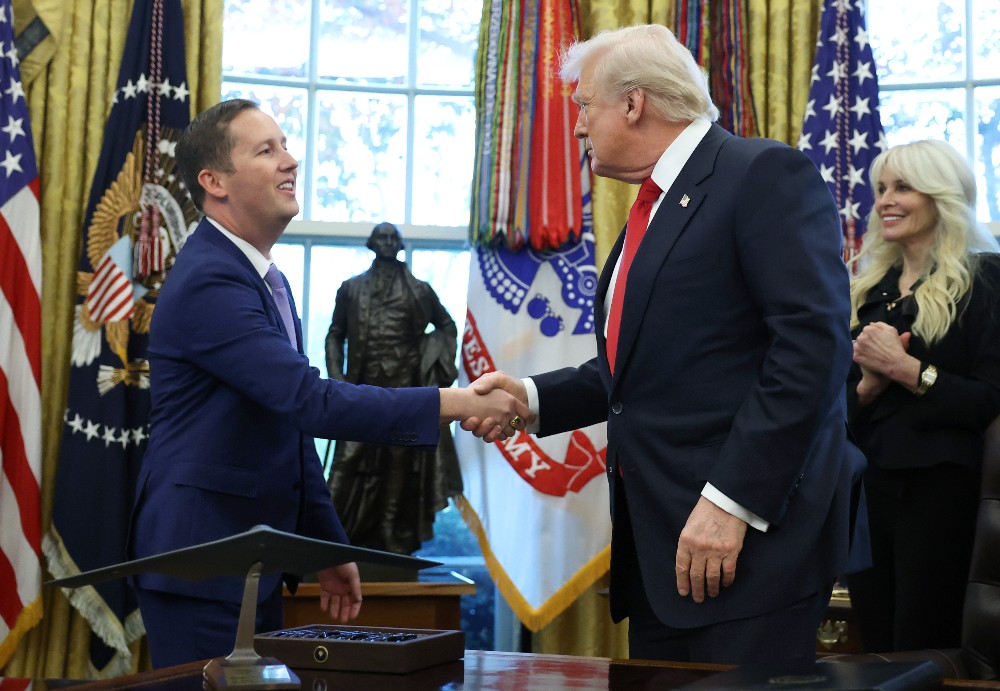
Meanwhile, at a Monday swearing-in ceremony for U.S. Ambassador to India Sergio Gor, Trump told reporters that the administration plans to lower punishing 50 percent duties, saying that the country has complied with demands related to drawing down purchases of Russian oil. New Delhi news outlet Mint reported that the tariffs could come down to just 15-16 percent.
“The tariffs on India are really high because of the Russian oil, but they have now substantially reduced Russian oil, so we will be bringing the tariffs down,” he told reporters from the Oval Office. During the ceremony, Trump said he was trusting Gor to “help strengthen one of our country’s most important international relationships.”
“We have a fantastic relationship with Prime Minister Modi, and Sergio is only enhancing that because he’s already become friendly with the Prime Minister. It’s a very important relationship, but it’s also the fastest-growing middle class, and an important economic and strategic security partner in the Indo-Pacific region,” he added.
Despite a steep plunge in exports to the U.S. (they fell more than 20 percent in September after a decline of over 14 percent in August) India’s overall exports have proven durable against Trump’s tariffs as India picks up business in other markets.
With China, bilateral trade has increased greatly, with China owning the lion’s share. Still, India’s exports to China between April and September grew by 22 percent, jumping from $6.9 billion in 2024 to $8.41 billion in 2025, according to the India’s Ministry of Commerce.
After U.S. tariffs doubled in August from 25 percent to 50 percent—a punitive action taken to address the country’s continued funding of the Russian war machine, Trump said—exports to China grew by 34 percent to $1.47 billion in September, compared to $1.09 billion during the same period last year.
While Trump praised the country’s government for supposedly divesting from Russian oil, a large delegation of Indian exporters traveled to Moscow on Tuesday looking to forge new ties as it continues to diversify export markets.
The collective includes dozens of leaders from the country’s engineering sector, who plan to stay for four days and take meetings, a senior trade official told Reuters. Export growth has been steady over the course of the past year. Indian exports to Russia grew 14.6 percent during fiscal 2024-2025 to $4.9 billion.
That’s far less than India is taking in from Russia, however. During the same period, India’s imports from the country (made up mostly of oil and other energy products) grew 4.3 percent to a whopping $63.8 billion, the Commerce Ministry reported.