
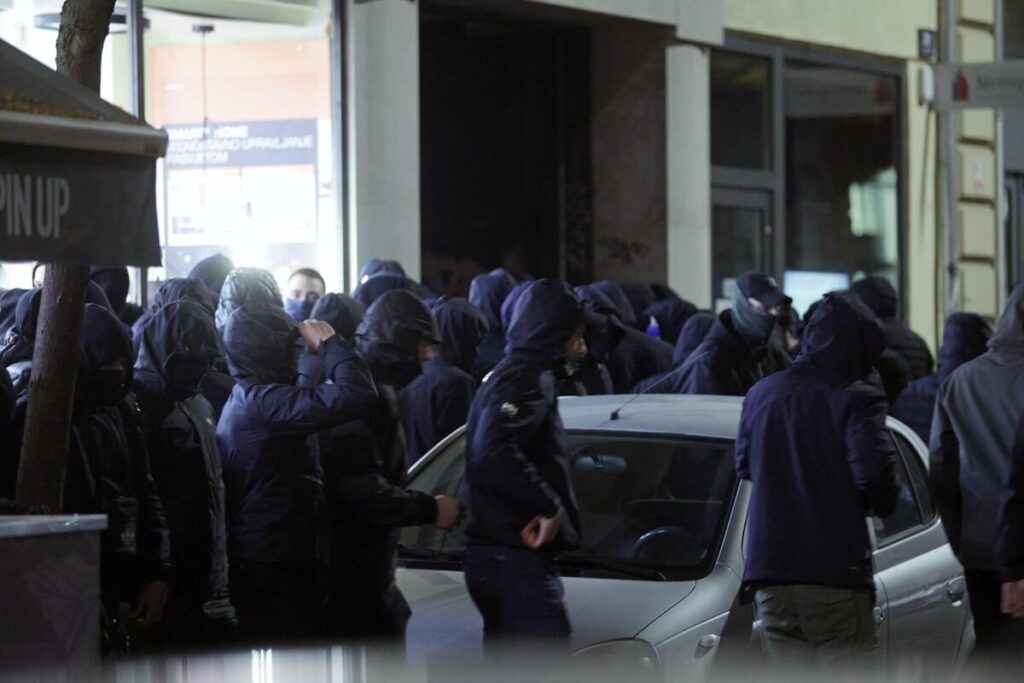
There is no connection between the “Ustasha rampage” in Croatia and the possible “softening” of that country’s relations with Montenegro because of it, so it is to be expected that Zagreb will continue to firmly insist on resolving disputes with Podgorica that are important to it.
This was stated by some of the interlocutors of “Vijesti”, while others assess that in this case we should not talk about the categories of “leniency” and “tightening” in relations between the two countries, but about the criteria that all candidates for membership in the European Union (EU) go through.
The interlocutors conveyed this by answering the questions: can, and if so, how, the recent unfortunate events in Croatia influence a change in its relationship with Montenegro, i.e. can they force it to take a more lenient stance towards Podgorica in resolving bilateral disputes.
Over the past twenty days, there have been several events in Croatia that have led some local chroniclers to claim that the country is undergoing a complete rightward shift, or rather its “Ustashaization.” Among other things, a rally was held in the Croatian Parliament (Sabor) at which the crimes in the Jasenovac concentration camp from World War II were denied or relativized, the program of the Serbian Culture Day in Split was interrupted, and a protest was held by fans of the Hajduk Football Club from that city (due to the arrest of people who participated in incidents during the Serbian Culture Day) at which Ustasha chants were heard…
Markovina: There will be no change in relations
Historian and publicist Dragan Markovina told “Vijesti” that he does not see any correlation between the “Ustasha rampage” and a potential change in Croatia’s relationship with Montenegro.
“Realistically, Croatia does care about Montenegro joining the EU, and it will not cause serious problems. But it wants to insist on what has already been agreed in some way. Regarding the concentration camp inmates, the return of property to Croats, the name of the swimming pool, etc.,” he said.
Croatian authorities prevented Montenegro from closing Chapter 31 (foreign, security and defense policy) in negotiations with the EU at the end of last year, and a month later, bilateral consultations between the two countries began with the aim of overcoming open issues.
Markovina assessed that, in this case, there is cynicism, which is facilitated by Croatia’s more favorable position, “about making people crazy about ‘Lora'”, but that is the situation.
“So I don’t really expect any changes, nor has anyone mentioned it,” he said.
“I don’t expect any changes, nor has anyone mentioned it”: Markovinaphoto: Screenshot/Youtube
As “Vijesti” wrote in early September, an agreement between Montenegro and Croatia on resolving the disputed issues is close and should include the payment of compensation to Croatian citizens detained in the Morinje camp, the non-removal of the memorial plaque at that location, and the change of name of the Kotor basin, while the issue of ownership of the ship “Jadran” will be left for a later agreement or international arbitration. The issues of the maritime border and the case of the Split “Lora” camp also remain open, and will not be included in this partial agreement.
Bačanović: Croatia’s pressure will grow
Historian Vuk Bačanović told the editorial staff that he does not see why Croatia would “soften up” in its relationship with Montenegro “because of something it organizes itself.”
“Anyone who thinks that all this is happening randomly is naive – like some spontaneous reaction of an ‘angry people’ who suddenly got upset because grandma Milojka, grandma Rada and grandma Stanimirka decided to go see folklore or an exhibition,” he said, adding that what was seen on the streets of Croatia “is not a coincidence, but an agenda.”
“What we are seeing is not a coincidence”: Bačanovićphoto: Printscreen / Youtube
He claims that this is about decades of semi-covert activity by “neo-Ustasha circles who are now coming out to show their muscles,” assessing that global circumstances are working in their favor.
“This phenomenon, known as the ‘Croatian silence’ in the 1970s, was spawned by Tuđman’s (Franjo) HDZ (Croatian Democratic Union) in the 1990s, and today, after the collapse of de-Tuđmanization, it is bringing to the surface an open neo-Ustasha action in which the remaining Serbs are merely collateral damage – a passing target in a broader showdown with anyone in Croatia who thinks differently than those who believe that the Ustasha were just slightly more temperamental anti-communists and that Jasenovac was some kind of prison in which they, possibly, shot the disobedient,” the interviewee assesses.
Bačanović said that he therefore sees no reason for Croatia, “in this accelerated transition into a society of historical revisionism,” to suddenly stop “torturing and humiliating Montenegro.”
“On the contrary, the pressures will only grow. From the ‘problematic names’ of the swimming pools in Kotor, we will reach far more drastic gestures, such as the rehabilitation of the Ustasha collaborator Sekula Drljević, who, in the new narrative, will turn out to be a ‘fighter for better relations between Croatia and Montenegro’. And no, that is not an exaggeration,” he adds.
Denial of Jasenovac and the fans’ rampage
Some participants in the roundtable discussion on Jasenovac, held in late October in the Parliament, claimed that the camp was not a death camp, but a “labor camp.” The footage of that gathering was removed from the Parliament’s channels after harsh public reactions and accusations of revisionism and denial of the crime.
The rally was organized by two smaller, right-wing parties in the Parliament, from the parliamentary caucuses Dom i nacionalno okupljanje (Domino) and Croatian Sovereignists.
Left-wing parties, led by the Social Democratic Party (SDP), demanded that local institutions investigate possible criminal liability, because, as they stated, this was a case of genocide denial.
The event has provoked strong reactions since its announcement – the SDP asked the head of the Parliament, Gordan Jandroković, to ban it, but Jandroković responded that there was no legal basis for this, that he was “not a censor” and that the gathering was not being held on behalf of the Parliament, but solely under the responsibility of the organizers.
Croatian Prime Minister Andrej Plenković (HDZ) assessed that the round table on Jasenovac was “a political provocation by the parties that organized it.”
Several human rights NGOs, including Documenta and the Anti-Fascist League of Croatia, called the gathering a shameful example of historical revisionism in the legislative building and a new contribution to the rehabilitation of the NDH (Independent State of Croatia) and the Ustasha.
Then, on November 3, dozens of hooligans, mostly masked and dressed in black, prevented the opening of a cultural event for the Serbian national minority in Split. Some of them shouted the Ustasha salute “For the homeland, ready.” Among them were several members of the fan group “Torcida,” and they told the crowd at the event that they could not perform because this was the month in which the suffering of Vukovar was commemorated.
The incident in Split was strongly condemned by Plenković and Croatian President Zoran Milanović, expressing their belief that the perpetrators will be quickly found and punished.
The court in Split sentenced nine suspects in the incident to one month in pretrial detention. After that, several thousand members of the fan group “Torcida” and the Association of War Veterans from the Split area protested on the Split waterfront demanding the release of the nine suspects. The rally was also heard chanting the Ustasha salute “For the homeland ready” and “Croatia, an independent state”, Croatian media reported.
Then, on November 7th, in Zagreb, riot police prevented masked men with hoods from entering the premises where the opening of the exhibition “Ephemeris, the legacy of Dejan Medaković” was taking place, which kicked off the Days of Serbian Culture.
Croatia is a member of the EU, and in July, the European Commission, reacting to the chanting of “For the homeland, ready” and the display of Ustasha symbols at Marko Perković Thompson’s concert in Zagreb, said that member states are obliged to prosecute for public approval, denial or gross minimization of crimes such as genocide, crimes against humanity and war crimes.
Music: Montenegro is progressing in Europe, but is regressing internally
Political consultant and political scientist Aleksandar Music told “Vijesti” that Croatia must solve its domestic political problems first, foremost and exclusively for the sake of itself – its citizens, its society, its health. He stressed that at the same time, he would be cautious in drawing easy parallels and conclusions regarding foreign policy.
“Namely, if you look at Croatian foreign policy towards Montenegro in the last 10 years – it is characterized by two different approaches. Until 2020, Croatian foreign policy towards Montenegro was unconscious, lulled, on ‘autopilot’, and the events of August 2020 caught it completely by surprise,” he explains.
Music added that after that, Croatia’s position is a combination of sincere, at times perhaps uncritical, support for Montenegro’s European path for the sake of a “higher goal”, and at the same time a growing awareness that there are actors in Montenegro, often directed from outside, who are using Montenegro’s European path to “under the table” remodel Montenegro from within.
“While Montenegro is progressing in Europe, it is regressing internally, its internal content is rapidly changing – and for the worse,” the interlocutor assessed.
Music said that this means that foreign policy should be conducted on the basis of clear principles, and not be reduced to the personal and emotional, looking for shortcuts. According to him, this applies to Montenegro, Croatia, and every country.
Montenegro, he notes, must look at itself, accelerate towards the EU for itself, its economy, its society, and not for Croatia or the EU.
“Montenegro must look at itself”: Musićphoto: Private archive
“That’s why I wouldn’t speak in the categories of ‘leniency’ and ‘tightening’, but about the criteria that all member states go through,” concluded Music, adding that some neighboring countries are not changing their policies towards Montenegro, but in moments of unrest on their streets “they are further increasing the export of instability to Montenegro, in order to gain additional leverage at the negotiating table and buy room for maneuver in international affairs.”
Bačanović: An opportunity for Montenegro to reflect
Vuk Bačanović claims that cooperation “with open pro-Ustasha circles in Zagreb” was not foreign to the former Montenegrin government.
“There is no doubt that many from these ranks, with appropriate grants and promises, would be willing to meet similar demands again,” he says.
The interlocutor said that, in this sense, this is primarily an opportunity for Montenegro to reflect – to reconsider what has been going on under the slogans of “building Montenegrin homeland identity” and “protecting anti-fascist achievements” since the restoration of independence.
“Because, it is strange how these very self-proclaimed bastions of anti-fascism do not find it appropriate today to react harshly to the marches of the blackshirts in Zagreb and Split. It is as if they are oblivious to the fact that precisely such phenomena can directly influence the destabilization of Montenegro,” Bačanović assesses.
He said that Montenegro is also a state of the Serbian people, and therefore, in addition to being obliged to protect the dignity of that people, that is, its citizens, it must first of all think about its “internal social cohesion, which is threatened by Croatian right-wing extremism, and not about how it will unconditionally satisfy the appetites of a country that hosts neo-Nazi charlatans in its own parliament, who, in the manner of Holocaust deniers, relativize the crimes of the NDH and which represents for them a model of the society they want to build.”

News