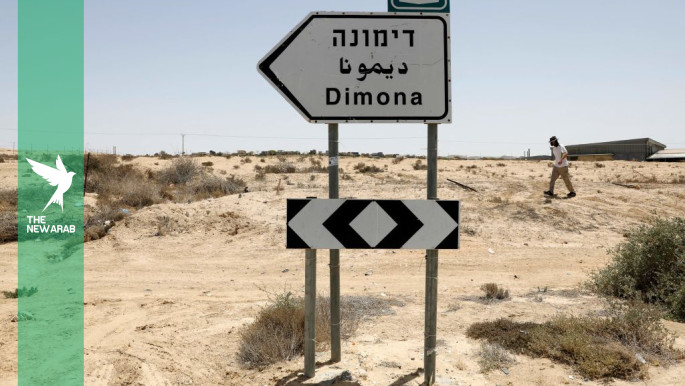
The Bedouin village slated for demolition is near Dimona, home to Israel’s secretive nuclear sites [Getty]
Israel’s Supreme Court has authorised the expulsion of the entire Palestinian Bedouin community of Ras Jaraba in the Naqab (also Negev) Desert, clearing the way for the demolition of the village and the displacement of roughly 500 residents to facilitate the expansion of the nearby Israeli city of Dimona, where the state’s secretive nuclear complex is located.
The ruling, issued on Wednesday, upheld the state’s plan to remove the residents within 90 days, despite a lower court in Beersheba having annulled the same plan in June after finding serious flaws in the process, including the absence of an environmental impact assessment and the failure to examine any option that would allow the community to remain on its land.
Ras Jaraba lies just east of Dimona and within its municipal boundaries. Its residents, from the Hawashleh, Abu Sulb and Nsasrah families, have lived on the land for decades with what the court itself acknowledged was the state’s knowledge and implicit permission.
The land, historically belonging to the Hawashleh tribe, stretches from the Karnab area near the old British Mandate police station to Umm Dimna, an early settlement point near Dimona’s founding.
Rights group Adalah, which represented the community, condemned the decision. It noted that the High Court’s ruling effectively grants the state sweeping authority to displace Palestinians in the Naqab without a clear public-interest justification, other than advancing planning schemes that exclude Bedouin communities from Jewish-majority cities.
The court, Adalah said, has once again “turned itself into a legal instrument of Israel’s colonial system”.
The judges rejected the community’s arguments, insisting that the state may revoke its permission for residents to remain at any time. They maintained that the residents, “like any other citizen”, could simply bid for land in Dimona through state tenders – a claim Adalah dismissed as detached from reality, noting that Bedouins were routinely excluded from Jewish urban planning frameworks.
The ruling also accepted the state’s assertion that suitable relocation options had been offered. But according to Adalah, state lawyers had failed in court to present any immediate housing solutions, pointing instead to temporary units or rental assistance in Dimona – options residents said were neither viable nor permanent.
In September, satellite imagery shared by AP showed intensified construction at the Shimon Peres Negev Nuclear Research Centre near Dimona, long associated with Israel’s undeclared nuclear weapons programme.
Independent analysts said new structures at the site suggest the possible construction of a new reactor or other nuclear-related facilities.
Israel is also believed to possess between 80 and 400 nuclear warheads, but has never acknowledged this.
Adalah said that while Israel expands sensitive national security infrastructure near Dimona, Palestinian communities in the area continue to face systemic attempts to remove them.
The forced displacement of Ras Jaraba, it said, reflects a broader policy of confining Bedouins to designated townships while reserving surrounding land for Jewish settlement, industrial zones and state projects.
The court’s decision means demolitions can begin once the state declares alternative arrangements “available”, potentially within three months. Residents say they remain determined to resist eviction, insisting that their presence long predates the city of Dimona itself.